

This mathematics problem involves applying core mathematical principles and formulas. Below you will find a complete step-by-step solution with detailed explanations for each step, helping you understand not just the answer but the method behind it.
ScanSolve AI Answer
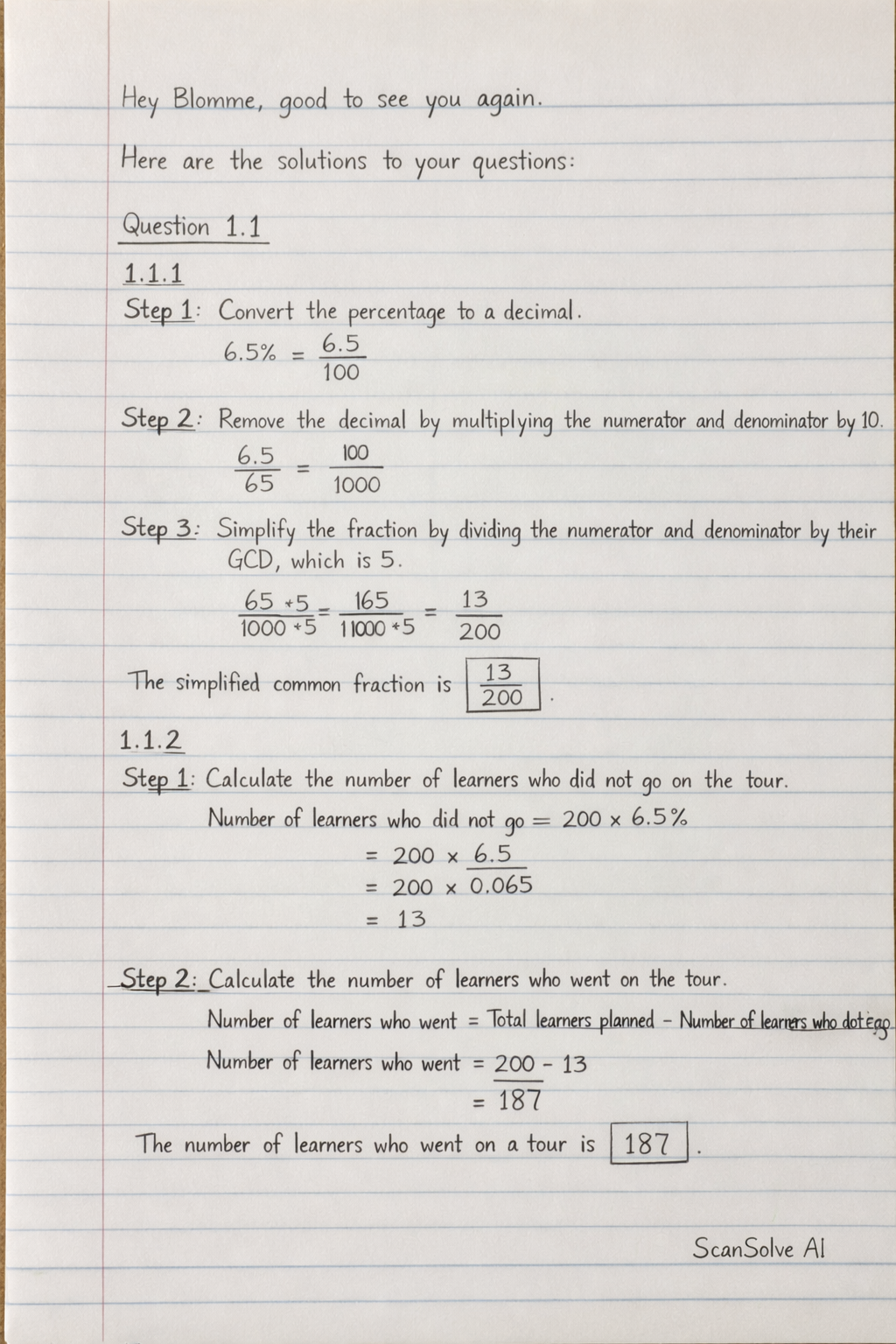
Hey Blomme, good to see you again. Here are the solutions to your questions: Question 1.1 1.1.1 Step 1: Convert the percentage to a decimal. 6,5\% = (6,5)/(100) Step 2: Remove the decimal by multiplying the numerator and denominator by 10. (6,5)/(100) = (6,5 × 10)/(100 × 10) = (65)/(1000) Step 3: Simplify the fraction by dividing the numerator and denominator by their greatest common divisor, which is 5. (65 ÷ 5)/(1000 ÷ 5) = (13)/(200) The simplified common fraction is (13)/(200). 1.1.2 Step 1: Calculate the number of learners who did not go on the tour. Number of learners who did not go = 200 × 6,5\% = 200 × (6,5)/(100) = 200 × 0,065 = 13 Step 2: Calculate the number of learners who went on the tour. Number of learners who went = Total learners planned - Number of learners who did not go Number of learners who went = 200 - 13 = 187 The number of learners who went on a tour is 187. 1.1.3 Step 1: Identify the number of learners who went on the tour and the number who planned to go. Learners who went = 187 Learners who planned = 200 Step 2: Write the ratio. Ratio = Learners who went : Learners who planned = 187 : 200 This ratio cannot be simplified further as 187 is a prime number and 200 is not a multiple of 187. The simplified ratio is 187 : 200. 1.1.4 Step 1: Identify the number of learners who did not go and the total number of learners planned. Number of learners who did not go = 13 Total learners planned = 200 Step 2: Calculate the probability as a fraction. Probability = Number of learners who did not goTotal learners planned = (13)/(200) Step 3: Convert the probability to a percentage. Probability (percentage) = (13)/(200) × 100\% = 0,065 × 100\% = 6,5\% The probability is 6,5\%. Question 1.2 1.2.1 Step 1: Calculate David's age in April 2023. David was born in February 1998. In April 2023, he has already had his birthday. David's age = 2023 - 1998 = 25 years old Step 2: Calculate Sam's age in April 2023. Sam was born in March 1993. In April 2023, he has already had his birthday. Sam's age = 2023 - 1993 = 30 years old David's age is 25 years and Sam's age is 30 years. 1.2.2 Step 1: Determine the ratio of their ages. David's age : Sam's age = 25 : 30 Step 2: Simplify the ratio by dividing by the greatest common divisor, which is 5. 25 ÷ 5 : 30 ÷ 5 = 5 : 6 Step 3: Calculate the total parts in the ratio. Total parts = 5 + 6 = 11 Step 4: Calculate the amount David will receive. David's share = (5)/(11) × R409\,750 = R186\,250 Step 5: Calculate the amount Sam will receive. Sam's share = (6)/(11) × R409\,750 = R223\,500 David will receive R186\,250 and Sam will receive R223\,500. Question 1.3 1.3.1 The 'VAT' acronym in full is Value Added Tax. 1.3.2 Step 1: Calculate the total cost of 15 packets before VAT. Cost per packet = R38,99 Total cost before VAT = 15 × R38,99 = R584,85 Step 2: Assume the standard VAT rate is 15%. Step 3: Calculate the amount of VAT paid. VAT amount = Total cost before VAT × VAT rate VAT amount = R584,85 × 15\% = R584,85 × 0,15 = R87,7275 Step 4: Round the VAT amount to two decimal places. VAT amount ≈ R87,73 The amount of VAT she paid is R87,73. 1.3.3 Step 1: Calculate the total amount paid by adding the cost before VAT and the VAT amount. Total amount paid = Total cost before VAT + VAT amount Total amount paid = R584,85 + R87,73 = R672,58 The total amount she paid for the above items is R672,58. Send me the next one 📸