
We read your photo as:
Convert an interest rate of 14% p.a. compounded monthly to an effective interest rate per annum.
ScanSolve AI Answer
Step-by-step solution
15 stepsHere are the solutions to your questions:
Part 2
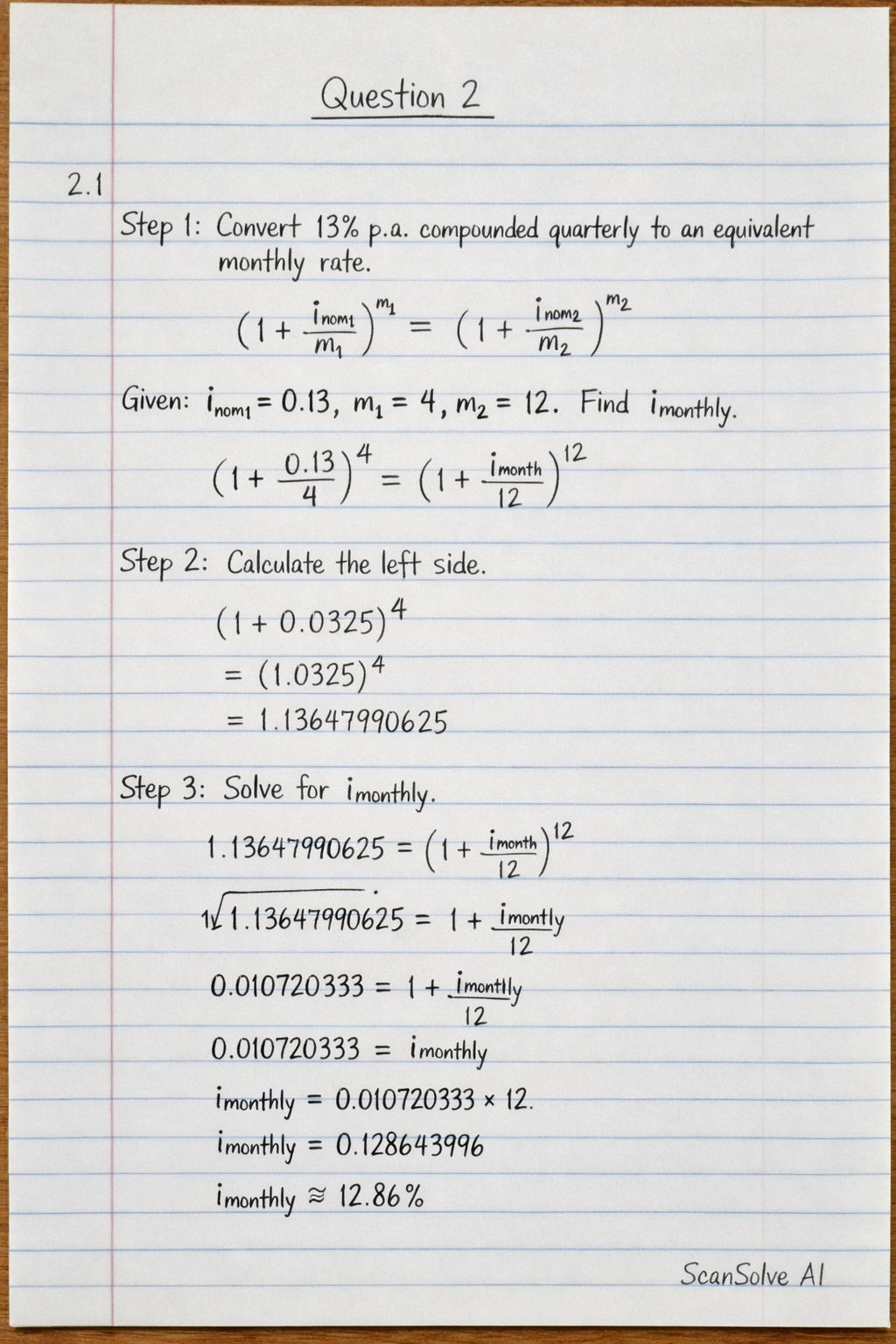
Part 2.1· 3 steps
Convert the nominal interest rate of 13% p.a.
compounded quarterly to an equivalent nominal interest rate compounded monthly.
We use the formula for equivalent interest rates:Given (13%), (quarterly). We want to find (monthly rate), with .
Calculate the left side of the equation.
Solve for .
Take the 12th root of both sides:
Expressed as a percentage, this is .
Thus, the effective interest rate is .
Part 2.2· 3 steps
Identify the known values for the present value annuity formula.
Loan amount () = R600 000
Monthly instalment () = R9 000
Monthly interest rate () =
We need to find the number of payments ().
The present value annuity formula is:Substitute the values into the formula.
Solve for .
Take the natural logarithm of both sides:
Since is not an integer, there will be 117 full instalments of R9 000.
The number of instalments of R9 000 that must be paid is .
Part 2.3· 2 steps
Calculate the outstanding balance after 117 payments.
The balance outstanding after payments () is given by:
Using , , , and :
First, calculate .
Calculate the final payment.
The final payment will be this outstanding balance plus one month's interest. This payment occurs at the end of the 118th month.
The final payment will be .
Part 2.4· 1 step
Calculate the total amount paid.
Total cost = (Number of full payments Instalment amount) + Final payment
The car cost Jake in total .
Part 3
Part 3.1· 3 steps
Identify the nominal interest rate and compounding frequency.
Nominal rate () = 0.14 (14%)
Number of compounding periods per year () = 12 (monthly)Use the formula for effective annual interest rate.
Calculate the effective annual rate.
Expressed as a percentage, this is .
The effective interest rate per annum is .
Part 3.2· 3 steps
Identify the known values for the future value annuity formula.
Future Value () = R7003007.22
Monthly payment () = R800
Nominal interest rate = 16% p.a. compounded monthly.
Monthly interest rate () =
We need to find the number of payments ().
The future value annuity formula is:Substitute the values into the formula.
Solve for .
Take the natural logarithm of both sides:
Skomota made payments.
Still stuck on this one?
Ask a follow-up, and the answer starts from this question.
More Mathematics Questions
Handwritten Step-by-Step Solution
Get this as a handwritten image on WhatsApp — like a tutor wrote it for you.
Try on WhatsApp