
We read your photo as:
Convert athlete heights to meters, calculate their BMIs, and classify Athlete C's BMI.
ScanSolve AI Answer
Step-by-step solution
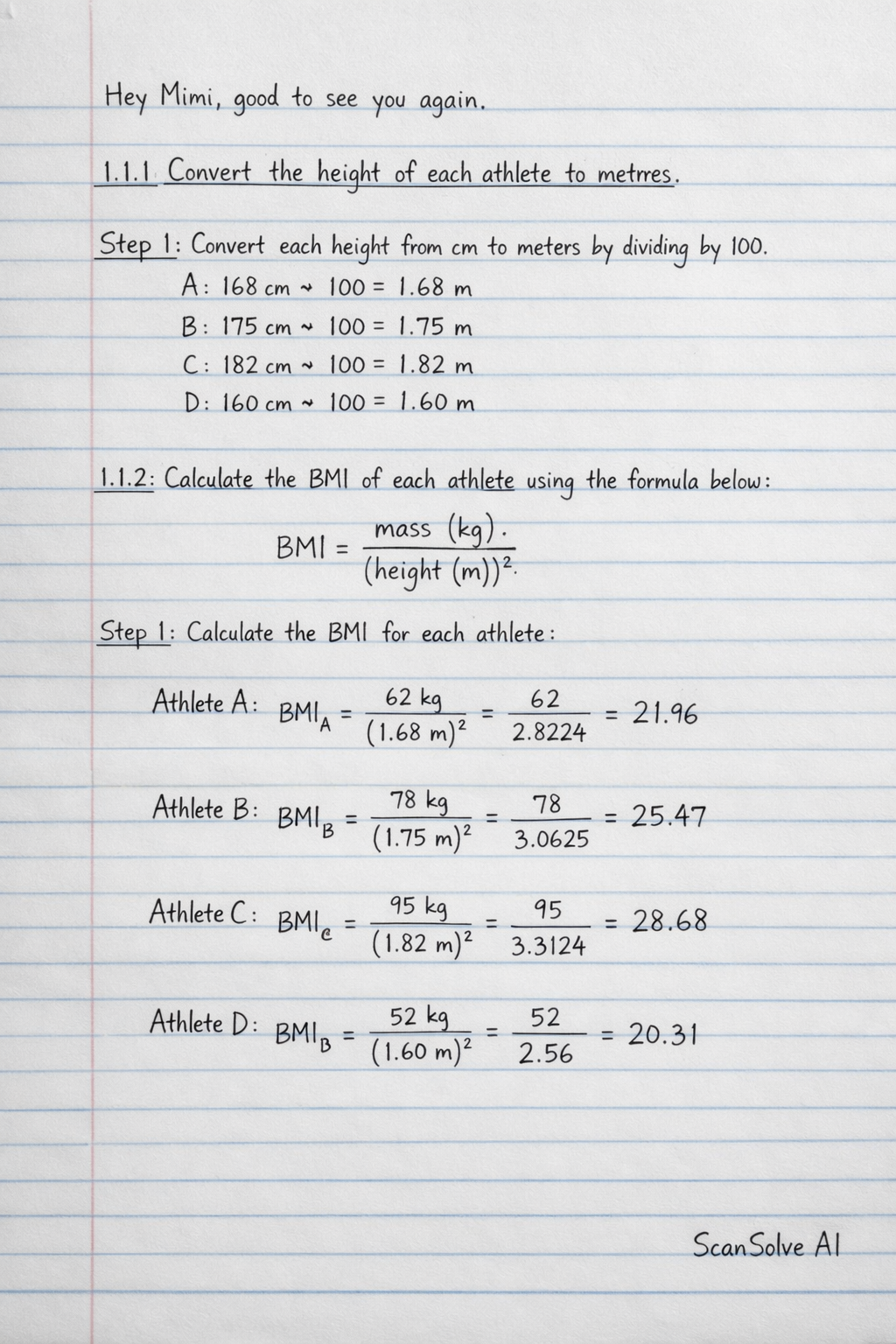
6 steps1.1.1 Convert the height of each athlete to metres.
Convert each height from centimeters to meters by dividing by 100.
- Athlete A:
- Athlete B:
- Athlete C:
- Athlete D:
1.1.2 Calculate the BMI of each athlete using the formula below.
Calculate the BMI for each athlete using their mass and converted height.
- Athlete A:
- Athlete B:
- Athlete C:
- Athlete D:
1.1.3 Refer to the BMI categories chart provided below to classify the BMI of Athlete C according to the given categories.
Compare Athlete C's BMI to the categories.
Athlete C's BMI is approximately 28.68.
According to the chart:- Underweight (<18.5)
- Normal (18.5–24.9)
- Overweight (25.0–29.9)
- Obese (≥30.0)
Classify Athlete C.
Since , Athlete C is classified as Overweight.
1.1.4 Identify TWO athletes who may require further health advice. Provide ONE reason for the selected athletes.
Identify athletes whose BMI falls outside the "Normal" range (18.5–24.9).
- Athlete A: BMI 21.96 (Normal)
- Athlete B: BMI 25.47 (Overweight)
- Athlete C: BMI 28.68 (Overweight)
- Athlete D: BMI 20.31 (Normal)
Select two athletes and provide a reason.
The two athletes who may require further health advice are Athlete B and Athlete C.
Reason: Their BMI values fall into the Overweight category, which indicates they are at an increased risk for certain health conditions.
Still stuck on this one?
Ask a follow-up, and the answer starts from this question.
More Mathematics Questions
Handwritten Step-by-Step Solution
Get this as a handwritten image on WhatsApp — like a tutor wrote it for you.
Try on WhatsApp