
We read your photo as:
Calculate and classify the BMI for athletes A, B, C, and D using the provided height, mass, and BMI categories.
ScanSolve AI Answer
Step-by-step solution
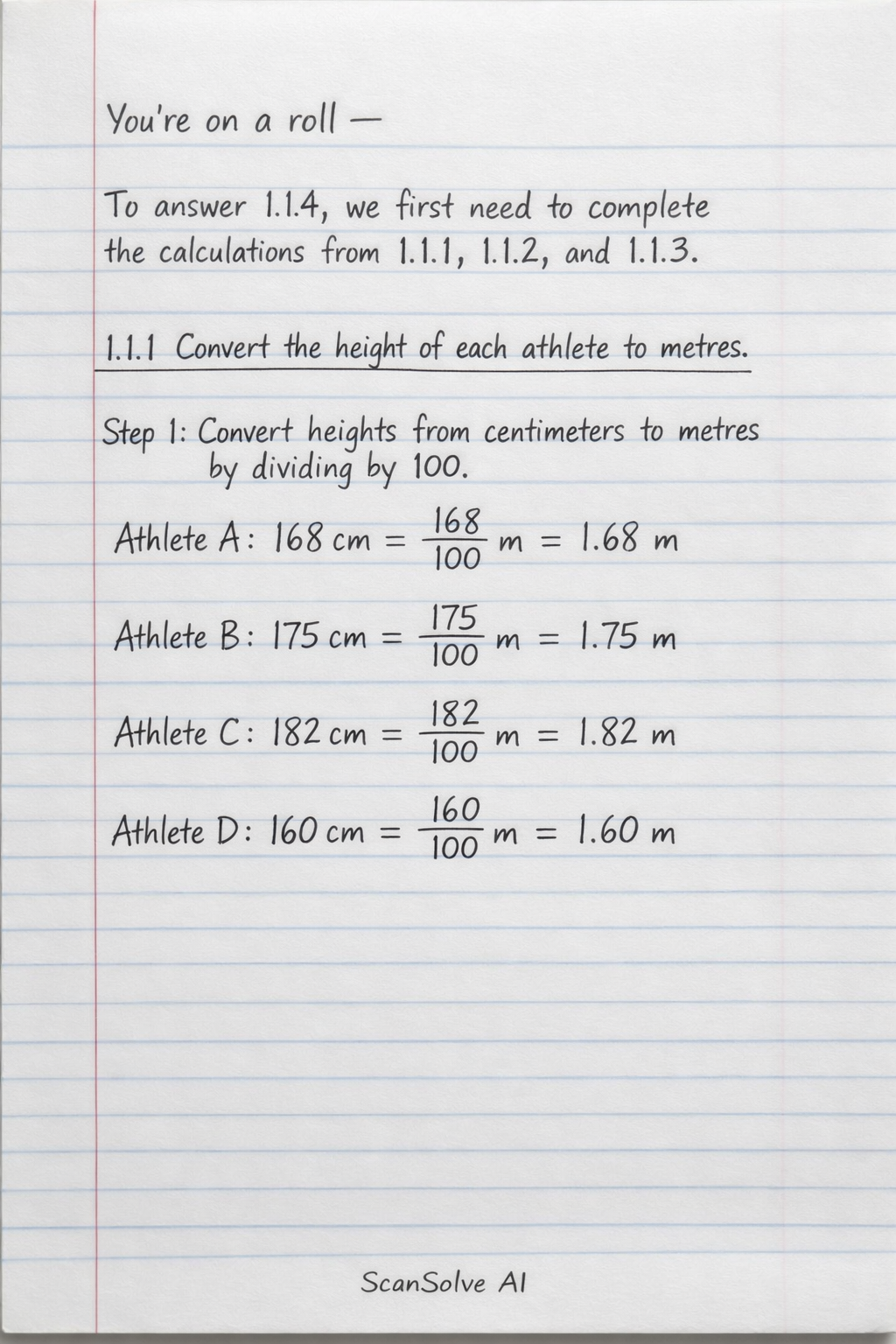
4 stepsTo answer 1.1.4, we first need to complete the calculations from 1.1.1, 1.1.2, and 1.1.3.
1.1.1 Convert the height of each athlete to metres.
Convert heights from centimeters to meters by dividing by 100.
- Athlete A:
- Athlete B:
- Athlete C:
- Athlete D:
1.1.2 Calculate the BMI of each athlete using the formula .
Calculate BMI for each athlete.
- Athlete A:
- Athlete B:
- Athlete C:
- Athlete D:
1.1.3 Refer to the BMI categories chart provided below to classify the BMI of Athlete C according to the given categories.
BMI Categories for Adults:
Underweight (<18.5)
Normal (18.5–24.9)
Overweight (25.0–29.9)
Obese (≥30.0)Classify Athlete C's BMI.
Athlete C's BMI is approximately 28.68. This falls into the Overweight category.
1.1.4 Identify TWO athletes who may require further health advice. Provide ONE reason for the selected athletes.
Identify athletes whose BMI falls outside the "Normal" range (18.5–24.9).
- Athlete A: BMI (Normal)
- Athlete B: BMI (Overweight)
- Athlete C: BMI (Overweight)
- Athlete D: BMI (Normal)
The two athletes who may require further health advice are Athlete B and Athlete C.
Reason: Their BMI values fall into the Overweight category, which indicates a higher risk of certain health issues and may impact their athletic performance.
Still stuck on this one?
Ask a follow-up, and the answer starts from this question.
More Mathematics Questions
Handwritten Step-by-Step Solution
Get this as a handwritten image on WhatsApp — like a tutor wrote it for you.
Try on WhatsApp