Evaluate the following: 1.256 + 0.7 - 0.15

Mathematics
Evaluate the following: 1.256 + 0.7 - 0.15

ScanSolve AI Answer

Answer

1.2\dot{5}\dot{6}.Thismeans. This means x = 1.2565656...$

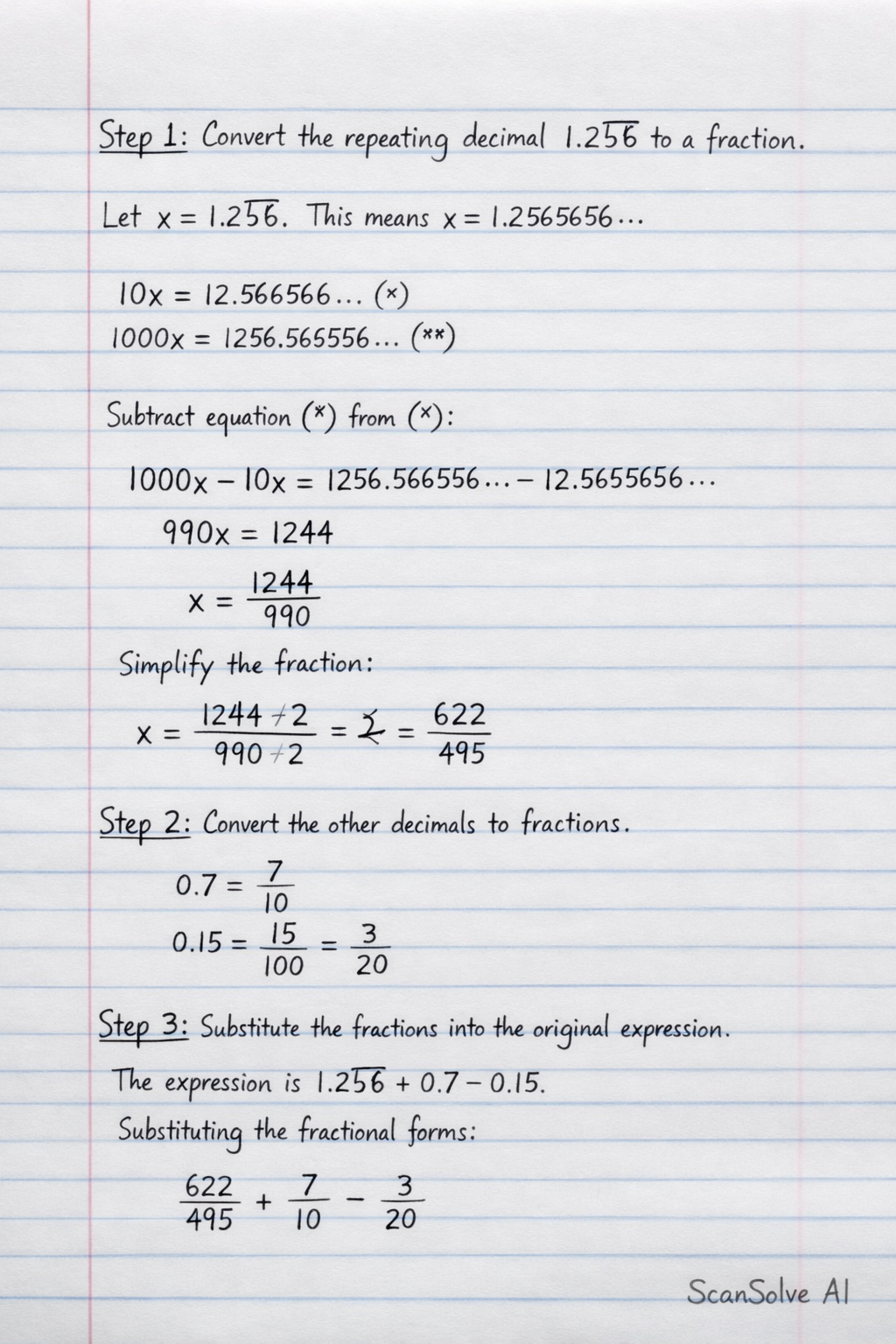
Step 1: Convert the repeating decimal 1.25˙6˙1.2\dot{5}\dot{6} to a fraction. Let x=1.25˙6˙x = 1.2\dot{5}\dot{6}. This means x=1.2565656...x = 1.2565656... Multiply by 1010 to move the non-repeating digit to the left of the decimal point: 10x=12.565656...()10x = 12.565656... \quad (*) Multiply by 10001000 to move one full cycle of the repeating part to the left of the decimal point: 1000x=1256.565656...()1000x = 1256.565656... \quad (**) Subtract equation ()(*) from equation ()(**): 1000x10x=1256.565656...12.565656...1000x - 10x = 1256.565656... - 12.565656... 990x=1244990x = 1244 x=1244990x = \frac{1244}{990} Simplify the fraction by dividing the numerator and denominator by their greatest common divisor, which is 22: x=1244÷2990÷2=622495x = \frac{1244 \div 2}{990 \div 2} = \frac{622}{495}

Step 2: Convert the other decimals to fractions. 0.7=7100.7 = \frac{7}{10} 0.15=15100=3200.15 = \frac{15}{100} = \frac{3}{20}

Step 3: Substitute the fractions into the original expression. The expression is 1.25˙6˙+0.70.151.2\dot{5}\dot{6} + 0.7 - 0.15. Substituting the fractional forms: 622495+710320\frac{622}{495} + \frac{7}{10} - \frac{3}{20}

Step 4: Find a common denominator for the fractions. The denominators are 495495, 1010, and 2020. Prime factorization of the denominators: 495=32×5×11495 = 3^2 \times 5 \times 11 10=2×510 = 2 \times 5 20=22×520 = 2^2 \times 5 The least common multiple (LCM) is 22×32×5×11=4×9×5×11=19802^2 \times 3^2 \times 5 \times 11 = 4 \times 9 \times 5 \times 11 = 1980.

Step 5: Convert each fraction to have the common denominator 19801980.

Was this helpful?

Need help with your own homework?

Get instant step-by-step solutions to any question. Free to start.

Ask Your Question
Handwritten step-by-step solution preview

Handwritten Step-by-Step Solution

Get this as a handwritten image on WhatsApp — like a tutor wrote it for you.

Try on WhatsApp

Still have questions?

Quick Answer
  1. This means x = 1.2565656..
  2. Multiply by 10 to move the non-repeating digit to the left of the decimal point: 10x = 12.565656..
  3. (*) Multiply by 1000 to move one full cycle of the repeating part to the left of the decimal point: 1000x = 1256.565656..
  4. (**) Subtract equation () from equation (*): 1000x - 10x = 1256.565656..
Evaluate the following: 1.256 + 0.7 - 0.15
Mathematics

This mathematics problem involves applying core mathematical principles and formulas. Below you will find a complete step-by-step solution with detailed explanations for each step, helping you understand not just the answer but the method behind it.

ScanSolve AI Answer
Step 1: Convert the repeating decimal 1.256 to a fraction. Let x = 1.256. This means x = 1.2565656... Multiply by 10 to move the non-repeating digit to the left of the decimal point: 10x = 12.565656... (*) Multiply by 1000 to move one full cycle of the repeating part to the left of the decimal point: 1000x = 1256.565656... (**) Subtract equation () from equation (*): 1000x - 10x = 1256.565656... - 12.565656... 990x = 1244 x = (1244)/(990) Simplify the fraction by dividing the numerator and denominator by their greatest common divisor, which is 2: x = (1244 ÷ 2)/(990 ÷ 2) = (622)/(495) Step 2: Convert the other decimals to fractions. 0.7 = (7)/(10) 0.15 = (15)/(100) = (3)/(20) Step 3: Substitute the fractions into the original expression. The expression is 1.256 + 0.7 - 0.15. Substituting the fractional forms: (622)/(495) + (7)/(10) - (3)/(20) Step 4: Find a common denominator for the fractions. The denominators are 495, 10, and 20. Prime factorization of the denominators: 495 = 3^2 × 5 × 11 10 = 2 × 5 20 = 2^2 × 5 The least common multiple (LCM) is 2^2 × 3^2 × 5 × 11 = 4 × 9 × 5 × 11 = 1980. Step 5: Convert each fraction to have the common denominator 1980. (622)/(495) = 622 × (19