
We read your photo as:
State the definition of the derivative from first principles.
Mathematics
ScanSolve AI Answer
This answer stops before the end.
It was cut off when it was first written. Ask ScanSolve this question again for the full working.
Here are the derivatives of the given functions using first principles:
1)
Step 1: State the definition of the derivative from first principles.
Step 2: Substitute and into the formula.
Step 3: Apply the sum-to-product trigonometric identity .
Step 4: Rearrange the expression to use the fundamental limit .
Was this helpful?
Still stuck on this one?
Ask a follow-up, and the answer starts from this question.
Got a different question?Ask your own question
More Mathematics Questions
QWrite down the definition of the derivative from first principles.QTo determine the derivative of the functions from first principles, we use the definition:QFind the derivative using first principleQWhat is the definition of a derivative in calculus?QWhat is the definition of the derivative of a function and what does it represent?
Browse by topic:Calculus
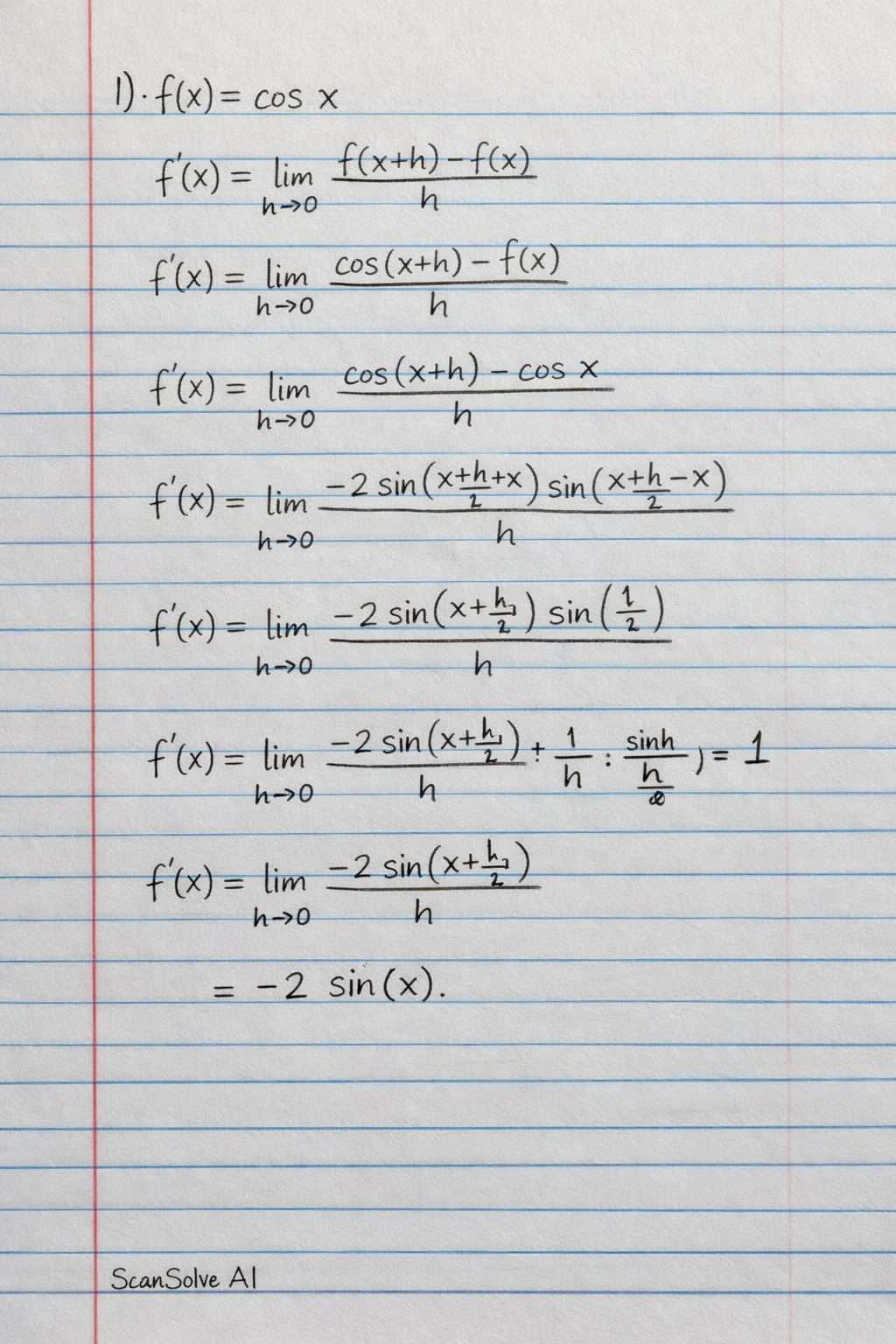
Handwritten Step-by-Step Solution
Get this as a handwritten image on WhatsApp — like a tutor wrote it for you.
Try on WhatsApp