
We read your photo as:
Find the derivative dy/dx for the following equations: 1) x2 + y2 = x + 4 + 8. 2) x3 + y3 = x3 y3 - 1.
ScanSolve AI Answer
Step-by-step solution
11 stepsHere are the differentiations with respect to :
- For the equation :
Simplify the equation.
Differentiate both sides with respect to .
Remember to use the chain rule for terms involving .
Isolate .
The derivative is:
- For the equation :
Differentiate both sides with respect to .
Use the chain rule for terms and the product rule for .
Group terms containing on one side and other terms on the other side.
Factor out and solve for it.
Simplify the expression by factoring out common terms.
The derivative is:
- For the equation :
Take the natural logarithm of both sides to bring down the exponents.
Differentiate both sides with respect to using the product rule.
Group terms containing on one side and other terms on the other side.
Factor out and solve for it.
The derivative is:
Still stuck on this one?
Ask a follow-up, and the answer starts from this question.
More Mathematics Questions
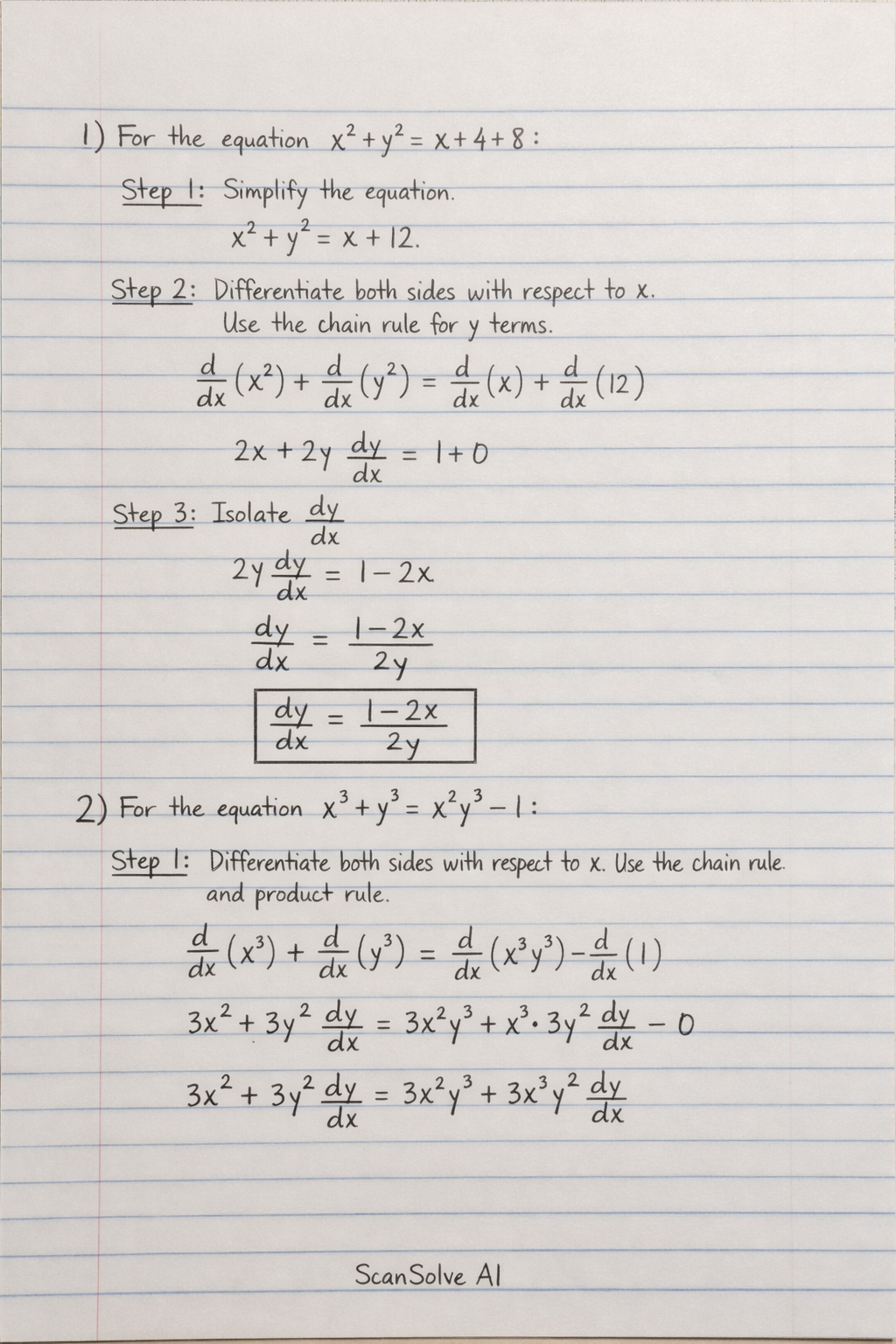
Handwritten Step-by-Step Solution
Get this as a handwritten image on WhatsApp — like a tutor wrote it for you.
Try on WhatsApp