
We read your photo as:
Find the derivative of ^-1x + ^-1x, x, and ^-1sqrt(1+x2) + ^-1sqrt(1+x2) with respect to x.
ScanSolve AI Answer
This answer stops before the end.
It was cut off when it was first written. Ask ScanSolve this question again for the full working.
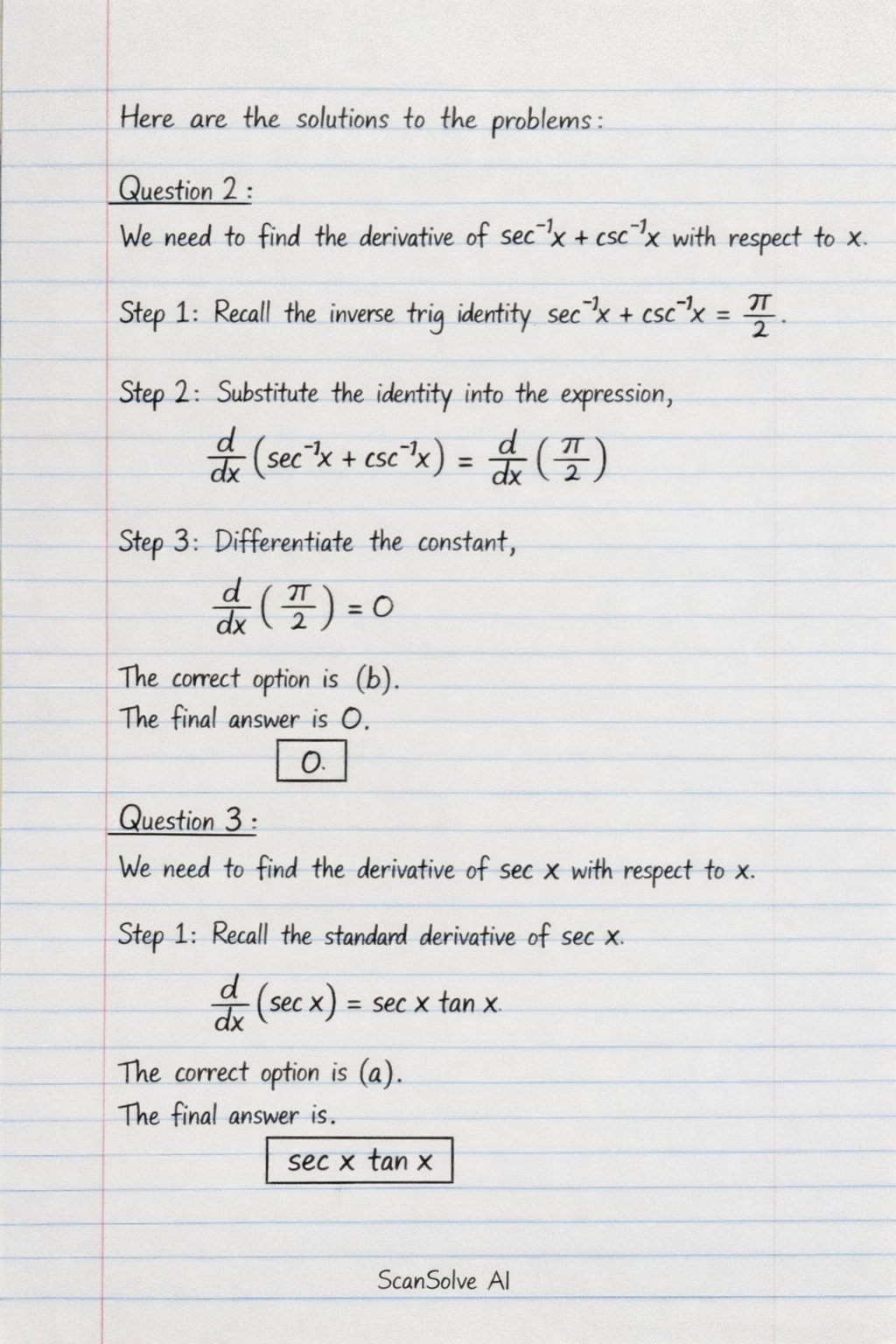
Here are the solutions to the problems:
Question 2:
We need to find the derivative of with respect to .
Step 1: Recall the inverse trigonometric identity .
Step 2: Substitute the identity into the expression.
Step 3: Differentiate the constant.
The correct option is (b).
The final answer is .
Question 3:
We need to find the derivative of with respect to .
Step 1: Recall the standard derivative of .
The correct option is (a).
The final answer is .
Question 4:
We need to find the derivative of with respect to .
Step 1: Recall the inverse trigonometric identity . Here, .
Step 2: Substitute the identity into the expression.
Step 3: Differentiate the constant.
The correct option is (d).
The final answer is .
Question 5:
We need to find . This is a derivative with respect to .
Step 1: Let and . We want to find .
Step 2: Find and .
Step 3: Use the chain rule .
The result is , which does not match options (a), (b), or (c).
The correct option is (d).
The final answer is .
Question 6:
Given , find .
Step 1: Simplify the expression inside the function.
Still stuck on this one?
Ask a follow-up, and the answer starts from this question.
More Mathematics Questions
Handwritten Step-by-Step Solution
Get this as a handwritten image on WhatsApp — like a tutor wrote it for you.
Try on WhatsApp