
We read your photo as:
Design a lesson plan that uses the game Morabaraba to teach basic addition and subtraction to Grade 1 students.
ScanSolve AI Answer
Here is the response to your assessment task, formatted as requested:
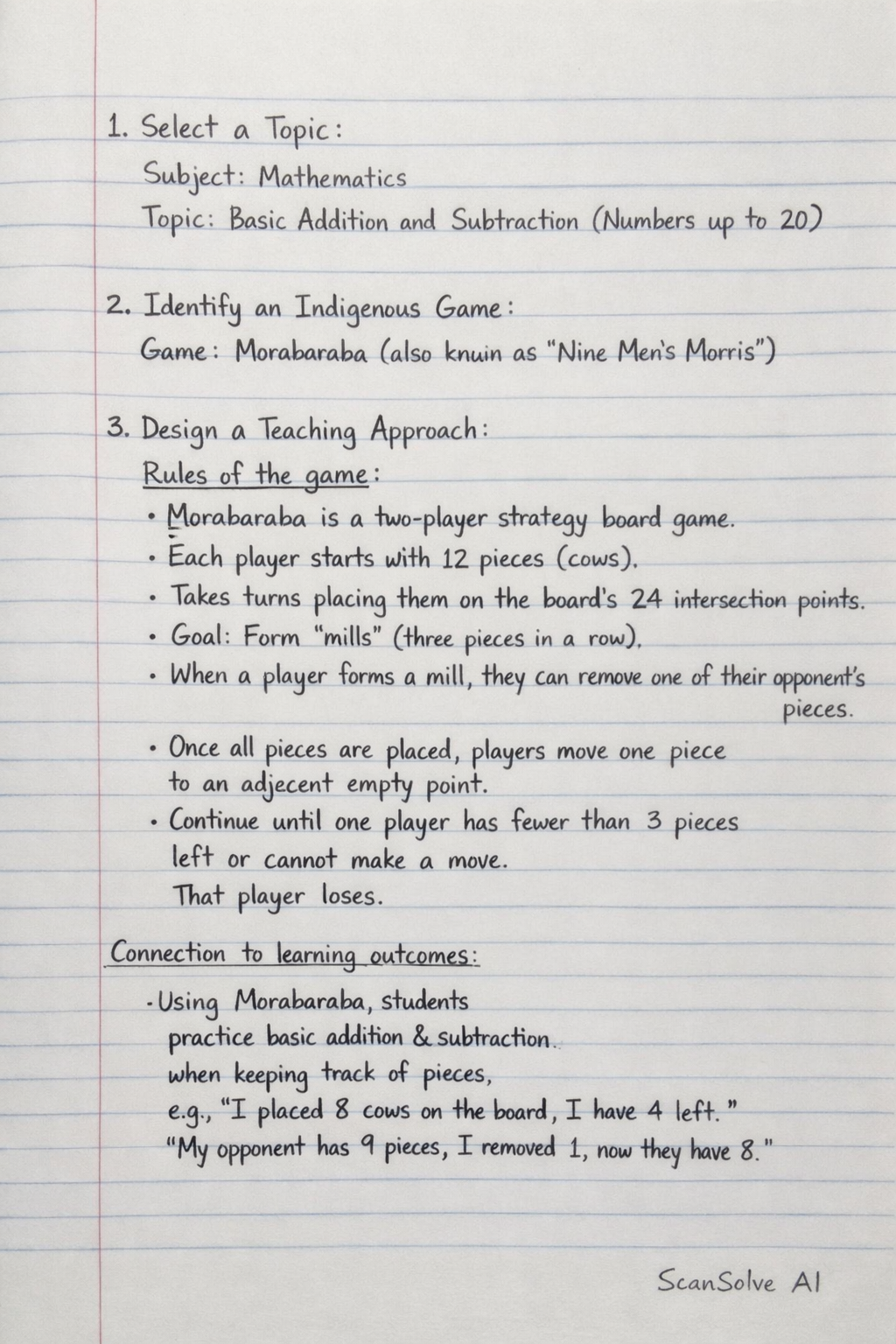
1. Select a Topic:
- Subject: Mathematics
- Topic: Basic Addition and Subtraction (Numbers up to 20)
2. Identify an Indigenous Game:
- Game: Morabaraba (also known as "Nine Men's Morris" in some cultures)
3. Design a Teaching Approach:
- Rules of the game: Morabaraba is a two-player strategy board game. Each player starts with 12 pieces (cows) and takes turns placing them on the board's 24 intersection points. The goal is to form "mills" (three pieces in a row). When a player forms a mill, they can remove one of their opponent's pieces. Once all pieces are placed, players take turns moving one of their pieces along a line to an adjacent empty point. The game continues until one player has fewer than three pieces left or cannot make a move, at which point they lose.
- Connection to learning outcomes:
- Addition: Students can count the total number of pieces on the board, or the total number of pieces placed by both players. They can add the number of pieces in a mill (e.g., 3 pieces) to the number of pieces remaining on the board.
- Subtraction: Students subtract pieces when an opponent's piece is captured (e.g., "If you had 12 pieces and I captured 1, how many do you have left?"). They can also subtract the number of pieces in a mill from the total pieces on the board.
- Counting: Players continuously count their own pieces, opponent's pieces, and empty spaces.
- Number Recognition: Identifying and associating numbers with quantities of pieces.
- Skills or values learners will gain:
- Problem-solving: Strategizing to form mills and block opponents.
- Critical thinking: Analyzing board positions and anticipating opponent's moves.
- Patience and concentration: The game requires careful thought and observation.
- Teamwork (if played in pairs): Students can discuss strategies.
- Cultural appreciation: Engaging with a traditional game from African culture.
4. Reflect:
Using indigenous games like Morabaraba makes learning more inclusive, engaging, and culturally relevant by connecting classroom content to students' cultural heritage and lived experiences. It fosters an environment where diverse backgrounds are valued, making learning accessible and relatable for all students. The hands-on, interactive nature of games naturally increases engagement and motivation, promoting active participation and deeper understanding. Furthermore, it validates indigenous knowledge systems and traditions, helping students develop a stronger sense of identity and cultural pride while learning essential academic skills.
Still stuck on this one?
Ask a follow-up, and the answer starts from this question.
More Mathematics Questions
Handwritten Step-by-Step Solution
Get this as a handwritten image on WhatsApp — like a tutor wrote it for you.
Try on WhatsApp