This mathematics problem involves applying core mathematical principles and formulas. Below you will find a complete step-by-step solution with detailed explanations for each step, helping you understand not just the answer but the method behind it.
ScanSolve AI Answer
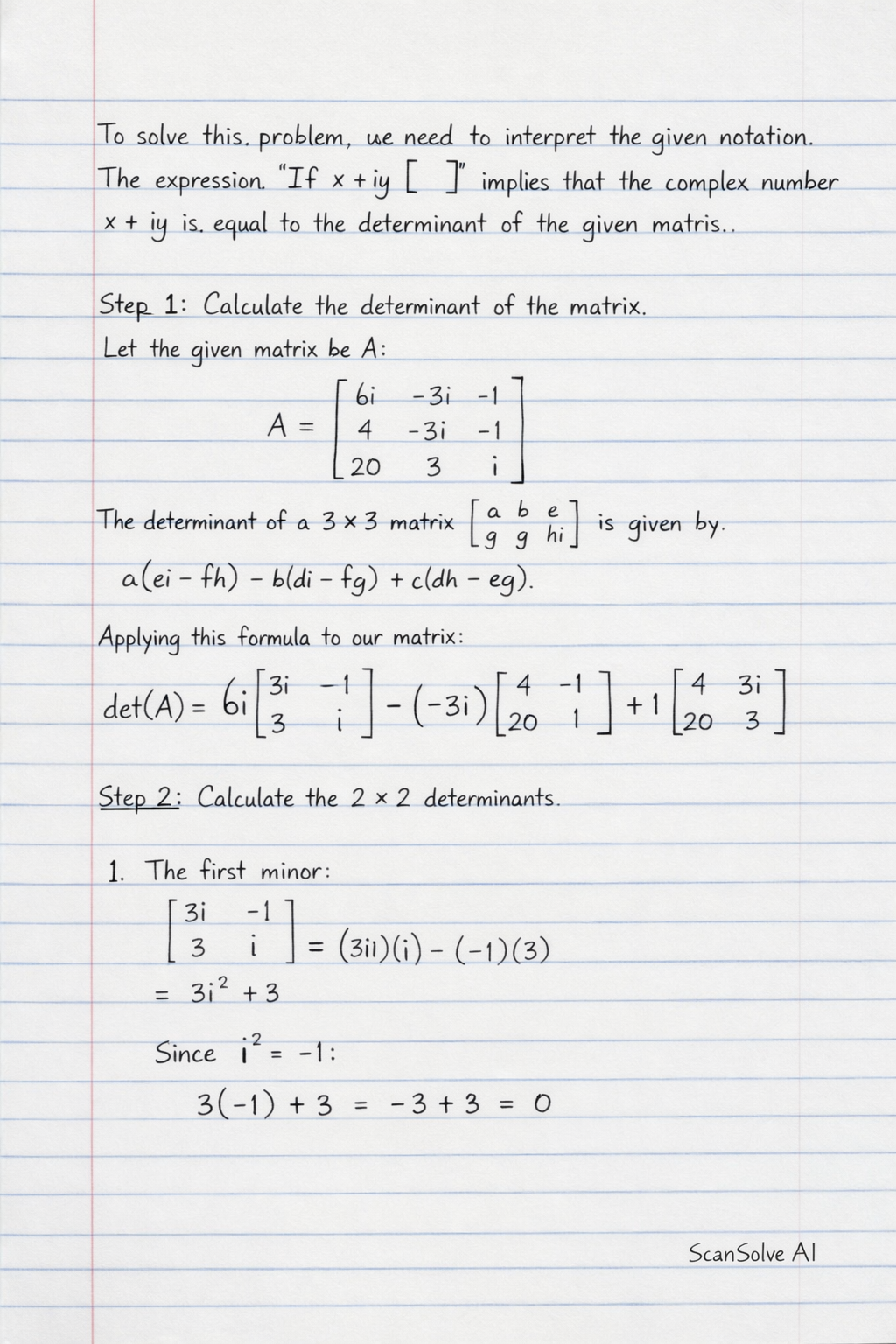
To solve this problem, we need to interpret the given notation. The expression "If $x + iy \begin{bmatrix} \dots \end{bmatrix}$" implies that the complex number $x+iy$ is equal to the determinant of the given matrix.
Step 1: Calculate the determinant of the matrix.
Let the given matrix be $A$:
$$ A = \begin{bmatrix} 6i & -3i & 1 \\ 4 & 3i & -1 \\ 20 & 3 & i \end{bmatrix} $$
The determinant of a $3 \times 3$ matrix $\begin{bmatrix} a & b & c \\ d & e & f \\ g & h & i \end{bmatrix}$ is given by $a(ei - fh) - b(di - fg) + c(dh - eg)$.
Applying this formula to our matrix:
$$ \det(A) = 6i \left| \begin{matrix} 3i & -1 \\ 3 & i \end{matrix} \right| - (-3i) \left| \begin{matrix} 4 & -1 \\ 20 & i \end{matrix} \right| + 1 \left| \begin{matrix} 4 & 3i \\ 20 & 3 \end{matrix} \right| $$
Step 2: Calculate the $2 \times 2$ determinants.
1. The first minor:
$$ \left| \begin{matrix} 3i & -1 \\ 3 & i \end{matrix} \right| = (3i)(i) - (-1)(3) = 3i^2 + 3 $$
Since $i^2 = -1$:
$$ 3(-1) + 3 = -3 + 3 = 0 $$
2. The second minor:
$$ \left| \begin{matrix} 4 & -1 \\ 20 & i \end{matrix} \right| = (4)(i) - (-1)(20) = 4i + 20 $$
3. The third minor:
$$ \left| \begin{matrix} 4 & 3i \\ 20 & 3 \end{matrix} \right| = (4)(3) - (3i)(20) = 12 - 60i $$
Step 3: Substitute the minor determinants back into the main determinant formula.
$$ x + iy = 6i(0) - (-3i)(4i + 20) + 1(12 - 60i) $$
$$ x + iy = 0 + 3i(4i + 20) + 12 - 60i $$
Distribute $3i$:
$$ x + iy = 12i^2 + 60i + 12 - 60i $$
Substitute $i^2 = -1$:
$$ x + iy = 12(-1) + 60i + 12 - 60i $$
$$ x + iy = -12 + 60i + 12 - 60i $$
Combine the real and imaginary parts:
$$ x + iy = (-12 + 12) + (60i - 60i) $$
$$ x + iy = 0 + 0i $$
$$ x + iy = 0 $$
Step 4: Determine $x$ and $y$, then find $x - iy$.
From $x + iy = 0$, we can equate the real and imaginary parts:
$x = 0$
$y = 0$
Now, we need to find $x - iy$:
$$ x - iy = 0 - i(0) $$
$$ x - iy = 0 $$
Comparing this result with the given options:
a. 0
b. $1 + 3i$
c. $3i$
d. $3 + i$
The calculated value matches option a.
The final answer is $\boxed{\text{a. 0}}$.
Calculate the determinant of the matrix.
|Mathematics
Calculate the determinant of the matrix.
ScanSolve AI Answer
To solve this problem, we need to interpret the given notation. The expression "If x+iy[…]" implies that the complex number x+iy is equal to the determinant of the given matrix.
Step 1: Calculate the determinant of the matrix.
Let the given matrix be A:
A=6i420−3i3i31−1i
The determinant of a 3×3 matrix adgbehcfi is given by a(ei−fh)−b(di−fg)+c(dh−eg).
Applying this formula to our matrix:
det(A)=6i3i3−1i−(−3i)420−1i+14203i3
Step 2: Calculate the 2×2 determinants.
The first minor:
3i3−1i=(3i)(i)−(−1)(3)=3i2+3
Since i2=−1:
3(−1)+3=−3+3=0
The second minor:
420−1i=(4)(i)−(−1)(20)=4i+20
The third minor:
4203i3=(4)(3)−(3i)(20)=12−60i
Step 3: Substitute the minor determinants back into the main determinant formula.
x+iy=6i(0)−(−3i)(4i+20)+1(12−60i)x+iy=0+3i(4i+20)+12−60i
Distribute 3i:
x+iy=12i2+60i+12−60i
Substitute i2=−1:
x+iy=12(−1)+60i+12−60ix+iy=−12+60i+12−60i
Combine the real and imaginary parts:
x+iy=(−12+12)+(60i−60i)x+iy=0+0ix+iy=0
Step 4: Determine x and y, then find x−iy.
From x+iy=0, we can equate the real and imaginary parts:
x=0y=0
Now, we need to find x−iy:
x−iy=0−i(0)x−iy=0
Comparing this result with the given options:
a. 0
b. 1+3i
c. 3i
d. 3+i
The calculated value matches option a.
The final answer is a.0.
Need help with your own homework?
Get instant step-by-step solutions to any question. Free to start.