
We read your photo as:
Determine, with calculations, which container has the biggest volume. Then, show that the surface area of CONTAINER 2 is 168,8825 in2. Finally, convert the diameter of the ball to inches and verify if CONTAINER 1 holds more balls than CONTAINER 2.
ScanSolve AI Answer
Step-by-step solution
8 steps4.2.1
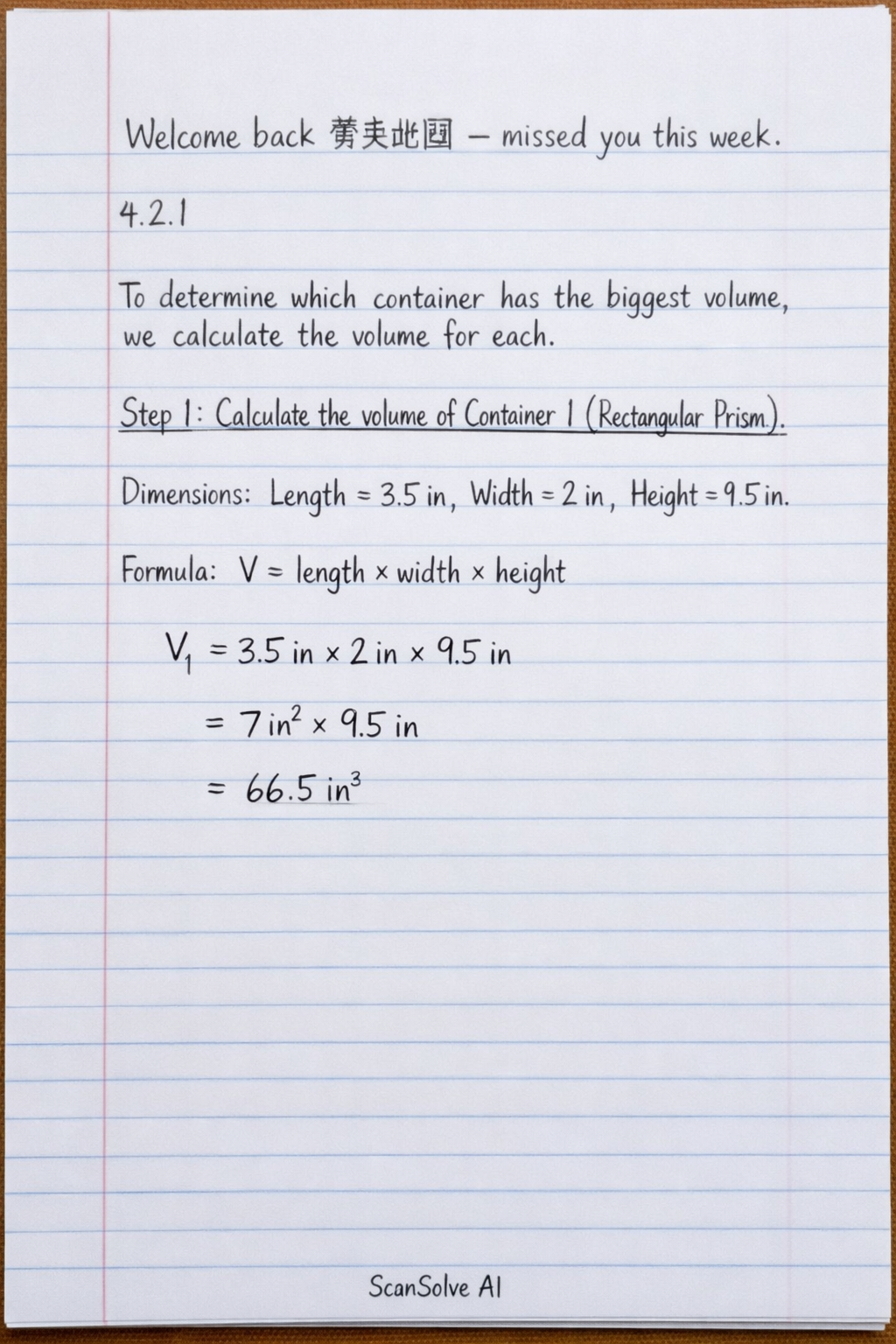
To determine which container has the biggest volume, we calculate the volume for each.
Calculate the volume of Container 1 (Rectangular Prism).
The dimensions of Container 1 are length = 3.5 in, width = 2 in, and height = 9.5 in.
The formula for the volume of a rectangular prism is .Calculate the volume of Container 2 (Cylinder).
The dimensions of Container 2 are diameter = 5 in and height = 9.5 in.
The radius is half of the diameter, so .
We are given .
The formula for the volume of a cylinder is .Compare the volumes.
Comparing and .
Since , Container 2 has the biggest volume.
The container with the biggest volume is .4.2.2
To show that the surface area of Container 2 is approximately 168.8825 in, we use the given formula.
Calculate the surface area of Container 2 (Cylinder).
The dimensions of Container 2 are radius in and height in.
We are given .
The formula for the surface area is .The calculated surface area is . This is approximately equal to the given value of , with a small difference likely due to rounding in the problem statement or a slightly different value used to derive the target number.
4.2.3
a) Convert the diameter of the ball to inches.
b) Verify the manager's claim about the number of balls each container can hold.
Convert the diameter of the ball to inches.
The diameter of the table tennis ball is 40 mm.
We are given the conversion factor: 1 inch = 25.4 mm.
To convert mm to inches, we divide by 25.4.Rounding to two decimal places:
The diameter of the ball is .
Calculate the number of balls Container 1 can hold.
Container 1 is a rectangular prism with dimensions: length = 3.5 in, width = 2 in, height = 9.5 in.
The ball diameter is in.
Number of balls along the length:Number of balls along the width:
Number of balls along the height:
Total balls in Container 1:
Calculate the number of balls Container 2 can hold.
Container 2 is a cylinder with diameter = 5 in and height = 9.5 in.
The ball diameter is in.
First, determine how many balls can be stacked vertically (along the height):Next, determine how many balls can fit in a single layer (circular packing within the 5-inch diameter).
The ratio of the container diameter to the ball diameter is .
Based on optimal circle packing within a larger circle, for a ratio of approximately 3.18, up to 7 balls can fit in a single layer.
So, balls.
Total balls in Container 2:Verify the manager's claim.
The manager claimed that Container 1 will hold more balls than Container 2.
Our calculations show:- Container 1 holds 12 balls.
- Container 2 holds 42 balls. Since , Container 1 holds fewer balls than Container 2. Therefore, the manager's statement is .
Still stuck on this one?
Ask a follow-up, and the answer starts from this question.
More Mathematics Questions
Handwritten Step-by-Step Solution
Get this as a handwritten image on WhatsApp — like a tutor wrote it for you.
Try on WhatsApp