
We read your photo as:
Differentiate the equation sin(x2y3) + 3x3y2 = 6 implicitly with respect to x.
ScanSolve AI Answer
Step-by-step solution
7 stepsDifferentiate both sides of the equation with respect to .
The given equation is .
Differentiate each term using the chain rule and product rule.
For the first term, :
Using the chain rule, , where .
Now, find using the product rule.
Let and . Then and .
So, .
Therefore, the derivative of the first term is:For the second term, :
Using the product rule, let and . Then and .
So, the derivative of the second term is:The derivative of the right side is .
Combine the differentiated terms.
Expand the equation and group terms containing .
Move terms without to the right side:
Factor out .
Solve for .
Simplify the expression by factoring out common terms from the numerator and denominator.
Factor out from the numerator:
Factor out from the denominator:
So,
Cancel from the numerator and denominator (assuming and ):
The final answer is .
Still stuck on this one?
Ask a follow-up, and the answer starts from this question.
More Mathematics Questions
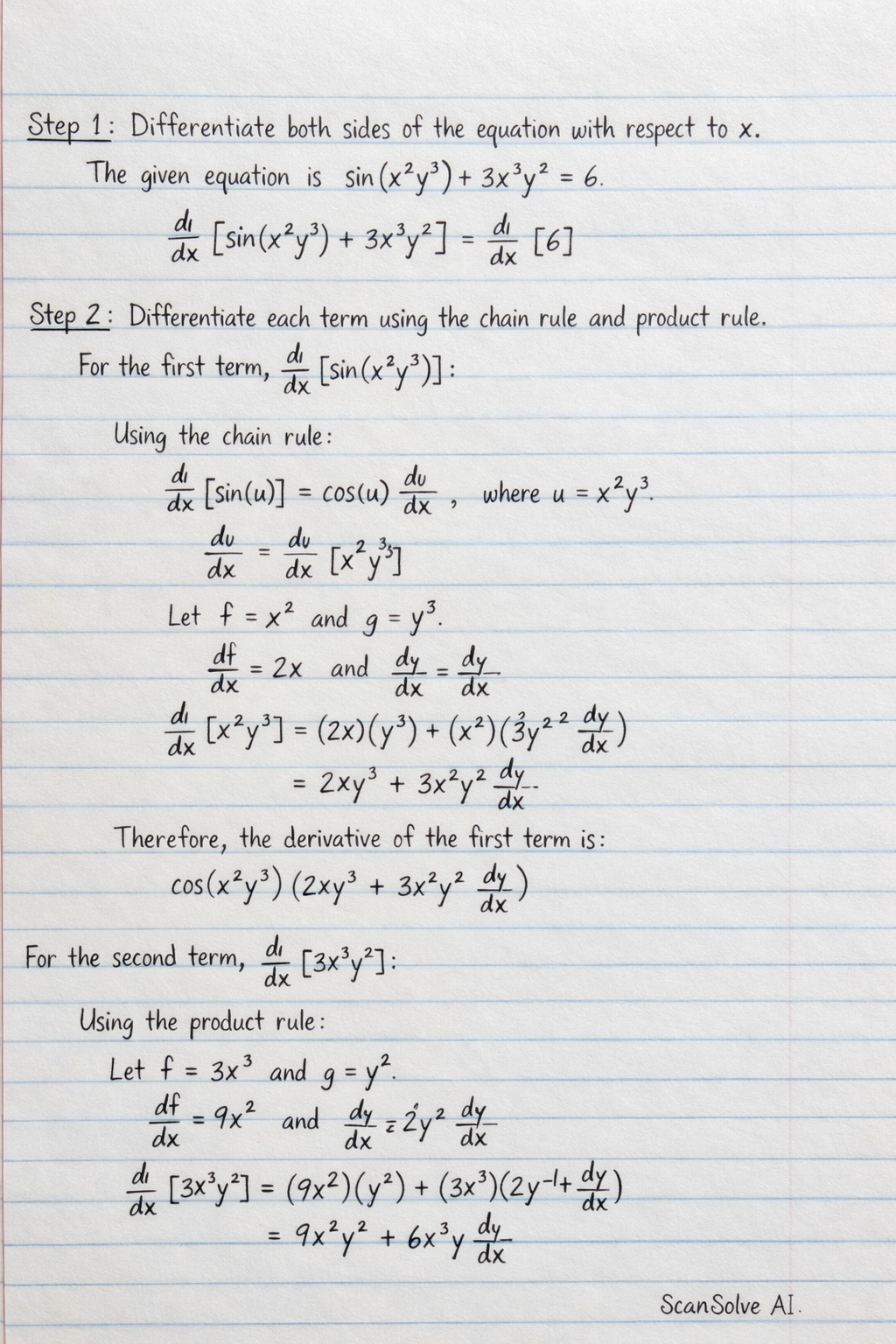
Handwritten Step-by-Step Solution
Get this as a handwritten image on WhatsApp — like a tutor wrote it for you.
Try on WhatsApp