
We read your photo as:
Differentiate the following functions: f(x) = x * tan2(1/x) and y = cos(sqrt(1 + sin2(x)))
Mathematics
ScanSolve AI Answer
Step-by-step solution
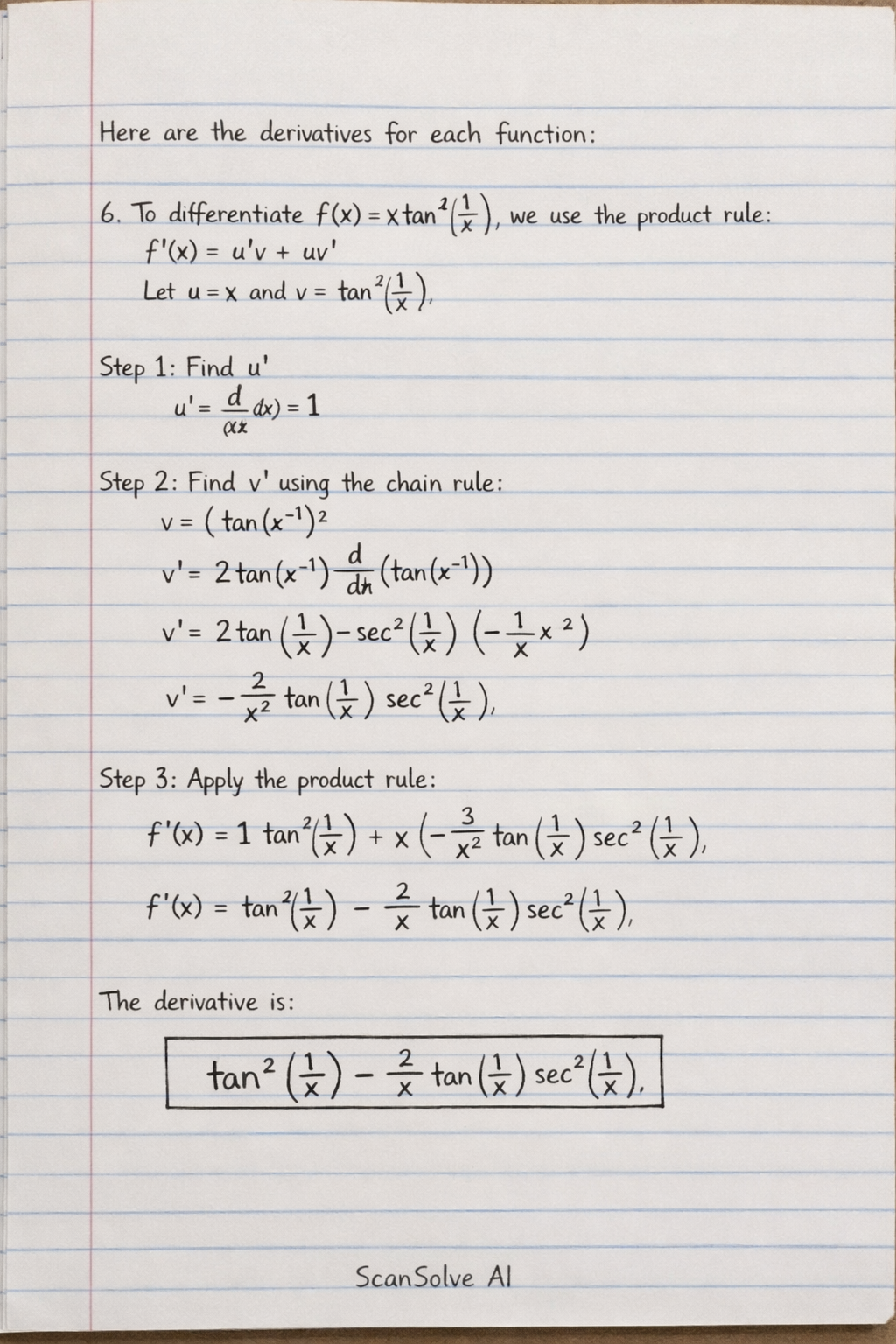
20 stepsHere are the derivatives for each function:
- To differentiate , we use the product rule . Let and .
Find .
$$ u' = \frac{d}{dx}(x) = 1 $$Find using the chain rule.
$$ v = (\tan(x^{-1}))^2 $$ $$ v' = 2\tan(x^{-1}) \cdot \frac{d}{dx}(\tan(x^{-1})) $$ $$ v' = 2\tan(x^{-1}) \cdot \sec^2(x^{-1}) \cdot \frac{d}{dx}(x^{-1}) $$ $$ v' = 2\tan(1/x) \cdot \sec^2(1/x) \cdot (-1x^{-2}) $$ $$ v' = -\frac{2}{x^2}\tan(1/x)\sec^2(1/x) $$Apply the product rule.
$$ f'(x) = 1 \cdot \tan^2(1/x) + x \cdot \left(-\frac{2}{x^2}\tan(1/x)\sec^2(1/x)\right) $$ $$ f'(x) = \tan^2(1/x) - \frac{2}{x}\tan(1/x)\sec^2(1/x) $$ The derivative is: $$ \boxed{\tan^2(1/x) - \frac{2}{x}\tan(1/x)\sec^2(1/x)} $$7. To differentiate , we use the chain rule multiple times.
Differentiate the outermost function, .
$$ \frac{dy}{dx} = -\sin(\sqrt{1 + \sin^2(x)}) \cdot \frac{d}{dx}(\sqrt{1 + \sin^2(x)}) $$Differentiate .
$$ \frac{d}{dx}((1 + \sin^2(x))^{1/2}) = \frac{1}{2}(1 + \sin^2(x))^{-1/2} \cdot \frac{d}{dx}(1 + \sin^2(x)) $$Differentiate .
$$ \frac{d}{dx}(1 + \sin^2(x)) = 0 + 2\sin(x)\cos(x) $$Combine the results.
$$ \frac{dy}{dx} = -\sin(\sqrt{1 + \sin^2(x)}) \cdot \frac{1}{2\sqrt{1 + \sin^2(x)}} \cdot (2\sin(x)\cos(x)) $$ $$ \frac{dy}{dx} = -\frac{\sin(x)\cos(x)\sin(\sqrt{1 + \sin^2(x)})}{\sqrt{1 + \sin^2(x)}} $$ The derivative is: $$ \boxed{-\frac{\sin(x)\cos(x)\sin(\sqrt{1 + \sin^2(x)})}{\sqrt{1 + \sin^2(x)}}} $$8. To differentiate , we first simplify using logarithm properties.
Apply logarithm properties and .
$$ y = \ln(x\sin(x)) - \ln(\sqrt{1-x^2}) $$ $$ y = \ln(x) + \ln(\sin(x)) - \frac{1}{2}\ln(1-x^2) $$Differentiate each term.
$$ \frac{d}{dx}(\ln(x)) = \frac{1}{x} $$ $$ \frac{d}{dx}(\ln(\sin(x))) = \frac{1}{\sin(x)} \cdot \cos(x) = \cot(x) $$ $$ \frac{d}{dx}\left(-\frac{1}{2}\ln(1-x^2)\right) = -\frac{1}{2} \cdot \frac{1}{1-x^2} \cdot (-2x) = \frac{x}{1-x^2} $$Combine the derivatives.
$$ \frac{dy}{dx} = \frac{1}{x} + \cot(x) + \frac{x}{1-x^2} $$ The derivative is: $$ \boxed{\frac{1}{x} + \cot(x) + \frac{x}{1-x^2}} $$9. To differentiate , we use the chain rule multiple times.
Rewrite the function.
$$ y = (\sec((\sin(x))^{1/2}))^2 $$Apply the power rule and chain rule.
$$ \frac{dy}{dx} = 2\sec(\sqrt{\sin(x)}) \cdot \frac{d}{dx}(\sec(\sqrt{\sin(x)})) $$Differentiate .
$$ \frac{d}{dx}(\sec(\sqrt{\sin(x)})) = \sec(\sqrt{\sin(x)})\tan(\sqrt{\sin(x)}) \cdot \frac{d}{dx}(\sqrt{\sin(x)}) $$Differentiate .
$$ \frac{d}{dx}((\sin(x))^{1/2}) = \frac{1}{2}(\sin(x))^{-1/2} \cdot \frac{d}{dx}(\sin(x)) $$ $$ \frac{d}{dx}((\sin(x))^{1/2}) = \frac{1}{2\sqrt{\sin(x)}} \cdot \cos(x) = \frac{\cos(x)}{2\sqrt{\sin(x)}} $$Combine all parts.
$$ \frac{dy}{dx} = 2\sec(\sqrt{\sin(x)}) \cdot \sec(\sqrt{\sin(x)})\tan(\sqrt{\sin(x)}) \cdot \frac{\cos(x)}{2\sqrt{\sin(x)}} $$ $$ \frac{dy}{dx} = \frac{2\sec^2(\sqrt{\sin(x)})\tan(\sqrt{\sin(x)})\cos(x)}{2\sqrt{\sin(x)}} $$ $$ \frac{dy}{dx} = \frac{\sec^2(\sqrt{\sin(x)})\tan(\sqrt{\sin(x)})\cos(x)}{\sqrt{\sin(x)}} $$ The derivative is: $$ \boxed{\frac{\sec^2(\sqrt{\sin(x)})\tan(\sqrt{\sin(x)})\cos(x)}{\sqrt{\sin(x)}}} $$10. To differentiate , we first simplify using logarithm properties.
Apply logarithm property .
$$ y = \ln((\cos(5x^2 + 3))^{1/2}) $$ $$ y = \frac{1}{2}\ln(\cos(5x^2 + 3)) $$Differentiate using the chain rule.
$$ \frac{dy}{dx} = \frac{1}{2} \cdot \frac{1}{\cos(5x^2 + 3)} \cdot \frac{d}{dx}(\cos(5x^2 + 3)) $$Differentiate .
$$ \frac{d}{dx}(\cos(5x^2 + 3)) = -\sin(5x^2 + 3) \cdot \frac{d}{dx}(5x^2 + 3) $$Differentiate .
$$ \frac{d}{dx}(5x^2 + 3) = 10x $$Combine the results.
$$
\frac{dy}{dx} = \frac{1}{2} \cdot \frac{1}{\cos(5x^2 + 3)} \cdot (-\sin(5x^2 + 3)) \cdot (10x)
$$
$$
\frac{dy}{dx} = -\frac{10x\sin(5x^2 + 3)}{2\cos(5x^2 + 3)}
$$
$$
\frac{dy}{dx} = -5x\tan(5x^2 + 3)
$$
The derivative is:
$$
\boxed{-5x\tan(5x^2 + 3)}
$$
Was this helpful?
Still stuck on this one?
Ask a follow-up, and the answer starts from this question.
Got a different question?Ask your own question
More Mathematics Questions
QDifferentiate the following functions: 1. y = x3 + x 2. y = x2 x 3. y = (x2 + x)/(x)QDifferentiate y = x2 + cos x - sin x.QFind the derivatives for each function: 1. y = cos4(sin2(x3)). 2. f(x) = sqrt(x2 + sqrt(x2 + 1)).QDifferentiate the following functions using the first principle: iii) y = 4x2 + 2x + 1 iv) y = sin xQDifferentiate with respect to x. y = (cosx)2
Handwritten Step-by-Step Solution
Get this as a handwritten image on WhatsApp — like a tutor wrote it for you.
Try on WhatsApp