
We read your photo as:
Ditekelelo tsa kgonego di dirwa go dira ditshwetso tse di nepagetseng. A re batliseng ka go dira tekeletso e e latelang. Latihela madi a tshipi mme o kwale dipholo tsa gago tsa di saete tsa Ditlhogo (H) kgotsa Tails (T) o dirisa thali theibole. N.B. Bontsha se o se gatisitseng ka sediko.
ScanSolve AI Answer
Step-by-step solution
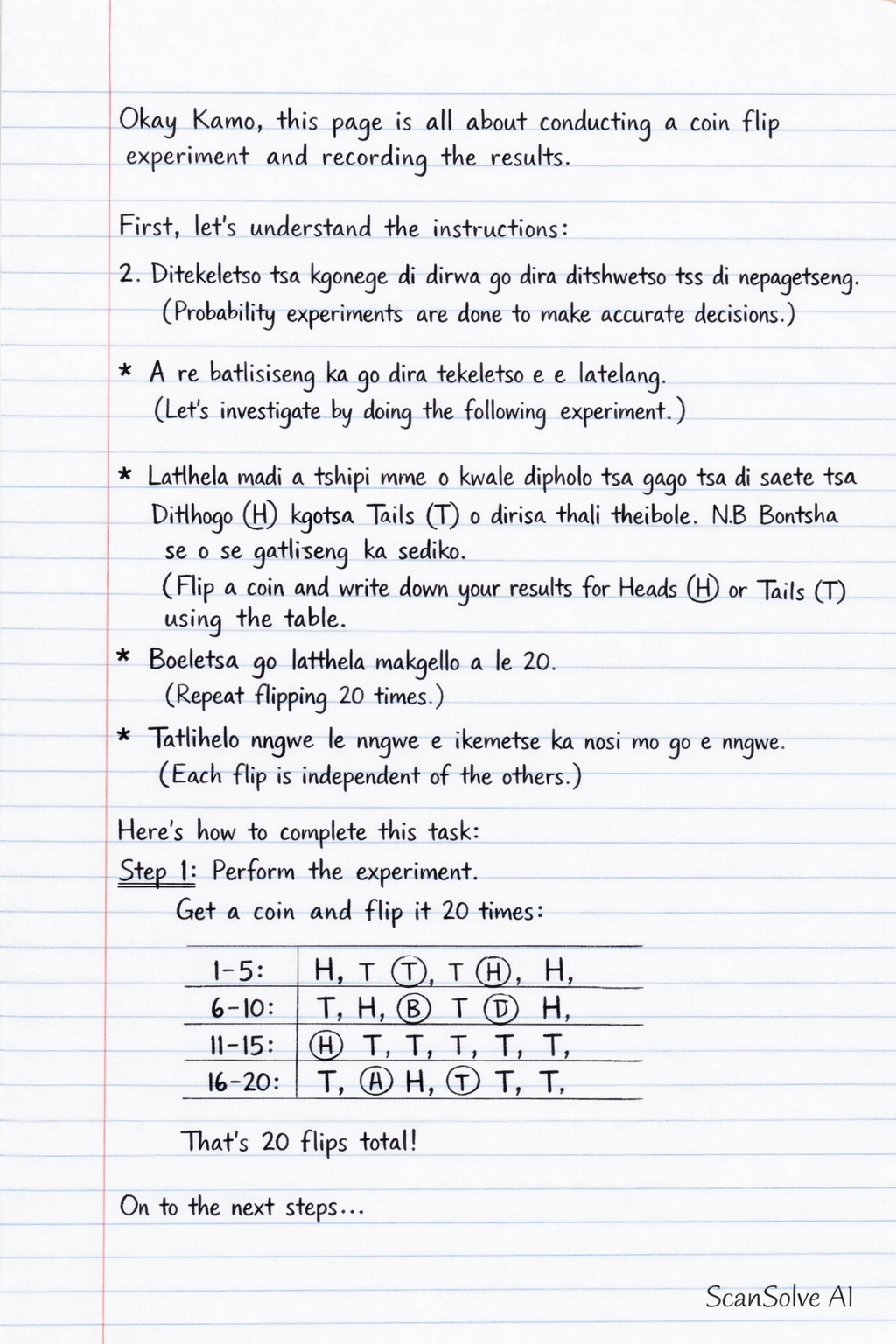
2 stepsOkay Kamo, this page is all about conducting a coin flip experiment and recording the results.
First, let's understand the instructions:
"2. Ditekeletso tsa kgonego di dirwa go dira ditshwetso tse di nepagetsegng."
(Probability experiments are done to make accurate decisions.)
"A re batlisiseng ka go dira tekeletso e e latelang."
(Let's investigate by doing the following experiment.)
-
"Latlhela madi a tshipi mme o kwale dipholo tsa gago tsa di saete tsa Ditlhogo (H) kgotsa Tails (T) o dirisa thali theibole. N.B. Bontsha se o se gatlitseng ka sediko." (Flip a coin and write down your results for Heads (H) or Tails (T) using the table. N.B. Show what you tallied with a circle.)
-
"Boeletsa go latlhela makgello a le 20." (Repeat flipping 20 times.)
-
"Tatlihelo nngwe le nngwe e ikemetse ka nosi mo go e nngwe." (Each flip is independent of the others.)
Here's how to complete this task:
Perform the experiment.
Get a coin and flip it 20 times.
Record your results in the table.
For each flip (from 1 to 20), write down the outcome in the "Ditlamorago" (Results) row, under the corresponding "Palo ya makgetlo" (Number of times/flip number).
- If you get Heads, write 'H'.
- If you get Tails, write 'T'. The instruction "Bontsha se o se gatlitseng ka sediko" means to circle the 'H' or 'T' you write for each flip.
Example of how to fill the table (your results will be different):
Palo ya makgetlo 1 2 3 4 5 ... 20 Ditlamorago (H) (T) (H) (H) (T) ... (H) Regarding the numbers '20' and '40' already written in the 'Palo ya makgetlo' column below the numbered rows:
These numbers do not correspond to the individual flip numbers (1 to 20) for this specific recording task. The table is designed for you to record the outcome of each of the 20 flips. You can ignore the '20' and '40' for now as they might be for a different part of the exercise or a summary not directly related to recording the individual flips.The statement "Each flip is independent of the others" is important. It means that the outcome of one flip does not affect the outcome of the next flip.
Still stuck on this one?
Ask a follow-up, and the answer starts from this question.
More Mathematics Questions
Handwritten Step-by-Step Solution
Get this as a handwritten image on WhatsApp — like a tutor wrote it for you.
Try on WhatsApp