
We read your photo as:
Divide the numerator (8) by the denominator (3).
Mathematics
ScanSolve AI Answer
Answers
2 partsStep-by-step solution
4 stepsHere's how to convert the fractions to mixed numbers:
Part a· 2 steps
Divide the numerator (8) by the denominator (3).
The whole number part is 2. The remainder is 2. The original denominator is 3.
Write the mixed number using the whole number, remainder, and original denominator.
The mixed number is .
Part b
Compare the numerator (5) and the denominator (7).
Since the numerator (5) is less than the denominator (7), this is a proper fraction.
Explain why it cannot be converted to a mixed number with a non-zero whole part.
Proper fractions cannot be converted into a mixed number with a whole number part greater than zero. It is already in its simplest fractional form.
The fraction is .
Was this helpful?
Try one yourself
A new problem that tests the same skill.
Still stuck on this one?
Ask a follow-up, and the answer starts from this question.
Got a different question?Ask your own question
More Mathematics Questions
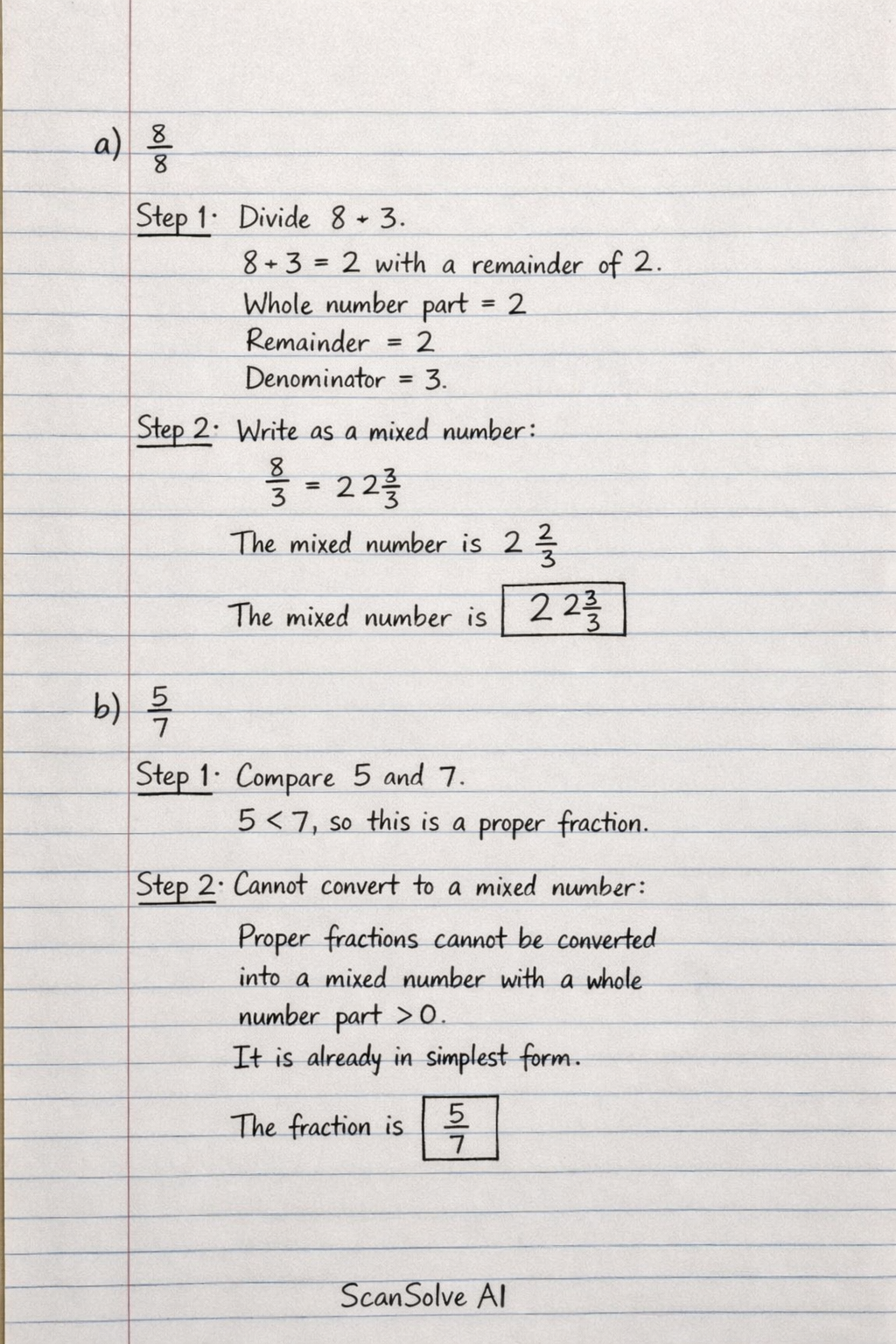
Handwritten Step-by-Step Solution
Get this as a handwritten image on WhatsApp — like a tutor wrote it for you.
Try on WhatsApp