We read your photo as:

Write down how much water is in each jug. Which pairs of jugs will make a litre if their liquids are poured together? How much water is in the jugs altogether?

Mathematics

ScanSolve AI Answer

Step-by-step solution

6 steps

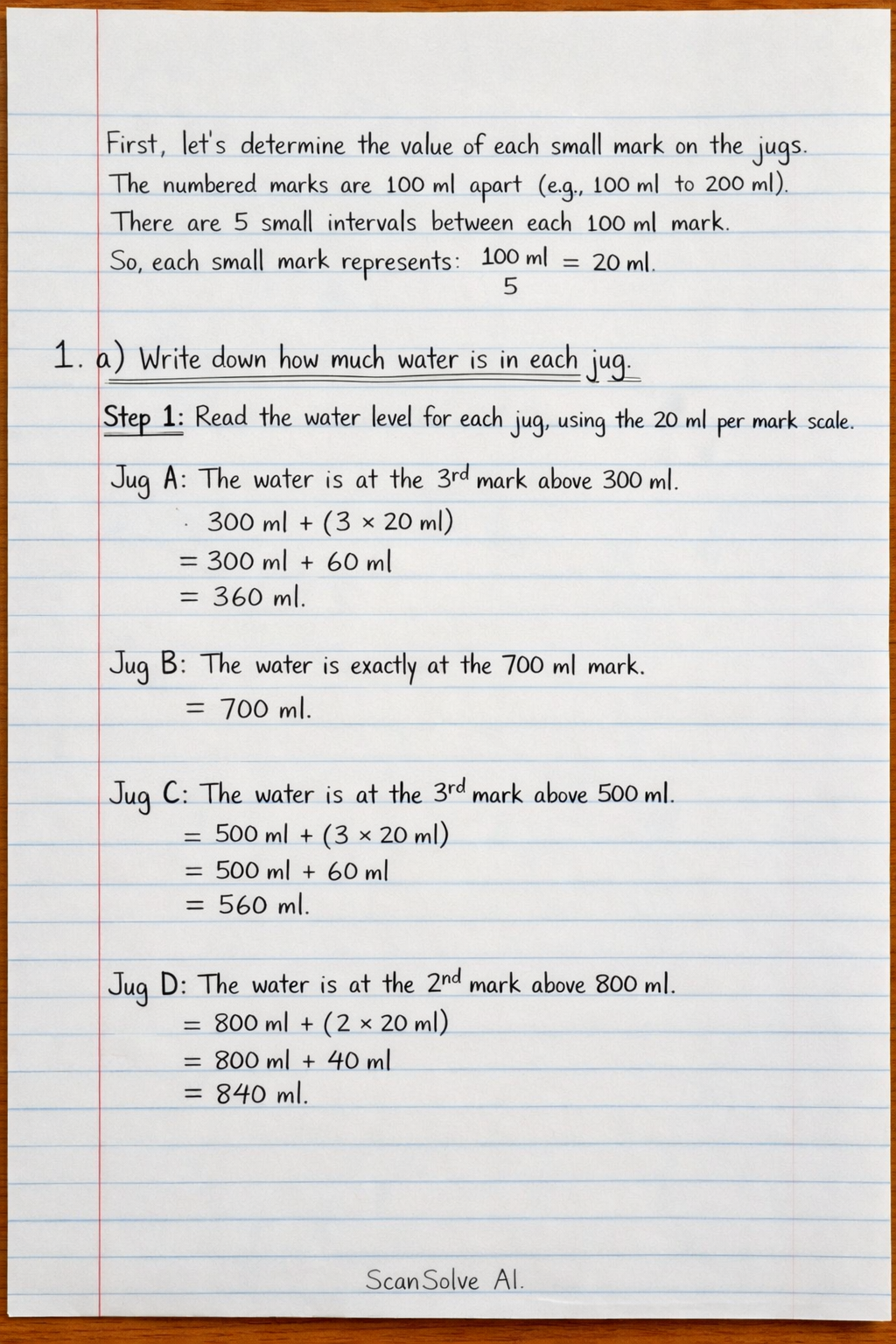
First, let's determine the value of each small mark on the jugs. The numbered marks are 100 ml100 \text{ ml} apart (e.g., 100 ml100 \text{ ml} to 200 ml200 \text{ ml}). There are 5 small intervals between each 100 ml100 \text{ ml} mark.
So, each small mark represents 100 ml5=20 ml\frac{100 \text{ ml}}{5} = 20 \text{ ml}.

1. a) Write down how much water is in each jug.

  1. Read the water level for each jug, using the 20 ml20 \text{ ml} per mark scale.

    • Jug A: The water is at the 3rd mark above 300 ml300 \text{ ml}. 300 ml+(3×20 ml)=300 ml+60 ml=360 ml300 \text{ ml} + (3 \times 20 \text{ ml}) = 300 \text{ ml} + 60 \text{ ml} = 360 \text{ ml}.
    • Jug B: The water is exactly at the 700 ml700 \text{ ml} mark. 700 ml700 \text{ ml}.
    • Jug C: The water is at the 3rd mark above 500 ml500 \text{ ml}. 500 ml+(3×20 ml)=500 ml+60 ml=560 ml500 \text{ ml} + (3 \times 20 \text{ ml}) = 500 \text{ ml} + 60 \text{ ml} = 560 \text{ ml}.
    • Jug D: The water is at the 2nd mark above 800 ml800 \text{ ml}. 800 ml+(2×20 ml)=800 ml+40 ml=840 ml800 \text{ ml} + (2 \times 20 \text{ ml}) = 800 \text{ ml} + 40 \text{ ml} = 840 \text{ ml}.
    • Jug E: The water is exactly at the 500 ml500 \text{ ml} mark. 500 ml500 \text{ ml}.
    • Jug F: The water is at the 2nd mark above 200 ml200 \text{ ml}. 200 ml+(2×20 ml)=200 ml+40 ml=240 ml200 \text{ ml} + (2 \times 20 \text{ ml}) = 200 \text{ ml} + 40 \text{ ml} = 240 \text{ ml}.

    The amounts of water in each jug are:

    • Jug A: 360 ml\boxed{360 \text{ ml}}
    • Jug B: 700 ml\boxed{700 \text{ ml}}
    • Jug C: 560 ml\boxed{560 \text{ ml}}
    • Jug D: 840 ml\boxed{840 \text{ ml}}
    • Jug E: 500 ml\boxed{500 \text{ ml}}
    • Jug F: 240 ml\boxed{240 \text{ ml}}

    1. b) Which pairs of jugs will make a litre if their liquids are poured together?

  2. A litre is equal to 1000 ml1000 \text{ ml}.

  3. Check all possible pairs of jug capacities to see if their sum is 1000 ml1000 \text{ ml}.

    • 360 ml+700 ml=1060 ml360 \text{ ml} + 700 \text{ ml} = 1060 \text{ ml}
    • 360 ml+560 ml=920 ml360 \text{ ml} + 560 \text{ ml} = 920 \text{ ml}
    • 360 ml+840 ml=1200 ml360 \text{ ml} + 840 \text{ ml} = 1200 \text{ ml}
    • 360 ml+500 ml=860 ml360 \text{ ml} + 500 \text{ ml} = 860 \text{ ml}
    • 360 ml+240 ml=600 ml360 \text{ ml} + 240 \text{ ml} = 600 \text{ ml}
    • 700 ml+560 ml=1260 ml700 \text{ ml} + 560 \text{ ml} = 1260 \text{ ml}
    • 700 ml+840 ml=1540 ml700 \text{ ml} + 840 \text{ ml} = 1540 \text{ ml}
    • 700 ml+500 ml=1200 ml700 \text{ ml} + 500 \text{ ml} = 1200 \text{ ml}
    • 700 ml+240 ml=940 ml700 \text{ ml} + 240 \text{ ml} = 940 \text{ ml}
    • 560 ml+840 ml=1400 ml560 \text{ ml} + 840 \text{ ml} = 1400 \text{ ml}
    • 560 ml+500 ml=1060 ml560 \text{ ml} + 500 \text{ ml} = 1060 \text{ ml}
    • 560 ml+240 ml=800 ml560 \text{ ml} + 240 \text{ ml} = 800 \text{ ml}
    • 840 ml+500 ml=1340 ml840 \text{ ml} + 500 \text{ ml} = 1340 \text{ ml}
    • 840 ml+240 ml=1080 ml840 \text{ ml} + 240 \text{ ml} = 1080 \text{ ml}
    • 500 ml+240 ml=740 ml500 \text{ ml} + 240 \text{ ml} = 740 \text{ ml}

    Based on the readings, no pairs of jugs make exactly 1 litre\boxed{\text{no pairs of jugs make exactly 1 litre}}.

    1. c) How much water is in the jugs altogether?

  4. Sum the amounts of water in all six jugs.

    360 ml+700 ml+560 ml+840 ml+500 ml+240 ml360 \text{ ml} + 700 \text{ ml} + 560 \text{ ml} + 840 \text{ ml} + 500 \text{ ml} + 240 \text{ ml}
  5. Perform the addition.

    3200 ml3200 \text{ ml}
  6. Convert the total amount to litres.

    3200 ml=32001000ℓ=3.2ℓ3200 \text{ ml} = \frac{3200}{1000} \ell = 3.2 \ell

    The total amount of water in the jugs altogether is 3200 ml or 3.2ℓ\boxed{3200 \text{ ml} \text{ or } 3.2 \ell}.

    1. d) Write the amounts of water in jugs B, E and F in three different ways.

    • Jug B: 700 ml700 \text{ ml}
      1. 700 ml700 \text{ ml}
      2. 0.7ℓ0.7 \ell
      3. 710ℓ\frac{7}{10} \ell
    • Jug E: 500 ml500 \text{ ml}
      1. 500 ml500 \text{ ml}
      2. 0.5ℓ0.5 \ell
      3. 12ℓ\frac{1}{2} \ell
    • Jug F: 240 ml240 \text{ ml}
      1. 240 ml240 \text{ ml}
      2. 0.24ℓ0.24 \ell
      3. 625ℓ\frac{6}{25} \ell
Was this helpful?

Still stuck on this one?

Ask a follow-up, and the answer starts from this question.

Got a different question?Ask your own question
Handwritten step-by-step solution preview

Handwritten Step-by-Step Solution

Get this as a handwritten image on WhatsApp — like a tutor wrote it for you.

Try on WhatsApp