
We read your photo as:
Draw a cumulative frequency curve for The median mark (ii) the inter quartile range and semi interquartile range (iii) If only 5 % of the candidates attained the distinction level, estimate the lowest mark for this level.
ScanSolve AI Answer
Step-by-step solution
8 stepsHere's the solution to the matrix problems. The data for the cumulative frequency curve is not provided, so that part cannot be solved.
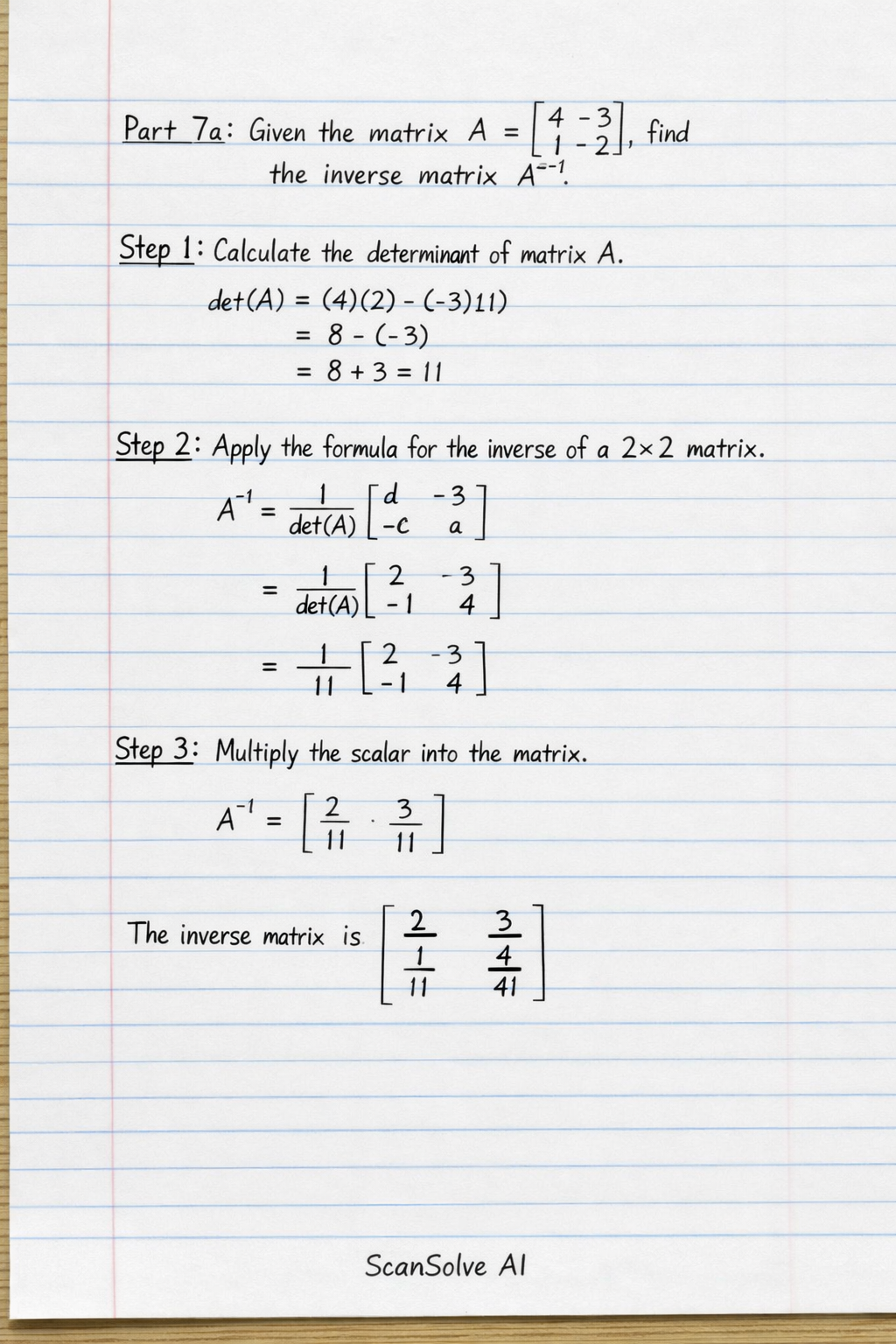
Part 7a:
Given the matrix , find the inverse matrix .
Calculate the determinant of matrix .
For a matrix , the determinant is .
Apply the formula for the inverse of a matrix.
The inverse of is .
Multiply the scalar into the matrix.
The inverse matrix is .
Part 7b:
Under the linear transformation of a plane, the image of is and that of is . Find the matrix of the transformation.Set up the matrix equation for the transformation.
Let the transformation matrix be .
The transformation can be written as .
Given and .
These two equations can be combined into a single matrix equation:Let and . So, .
Find the inverse of matrix .
First, calculate the determinant of :
Now, find :
Calculate by multiplying by .
Since , then .
Perform the matrix multiplication.
Multiply the scalar into the matrix.
The matrix of the transformation is .
Still stuck on this one?
Ask a follow-up, and the answer starts from this question.
More Mathematics Questions
Handwritten Step-by-Step Solution
Get this as a handwritten image on WhatsApp — like a tutor wrote it for you.
Try on WhatsApp