
We read your photo as:
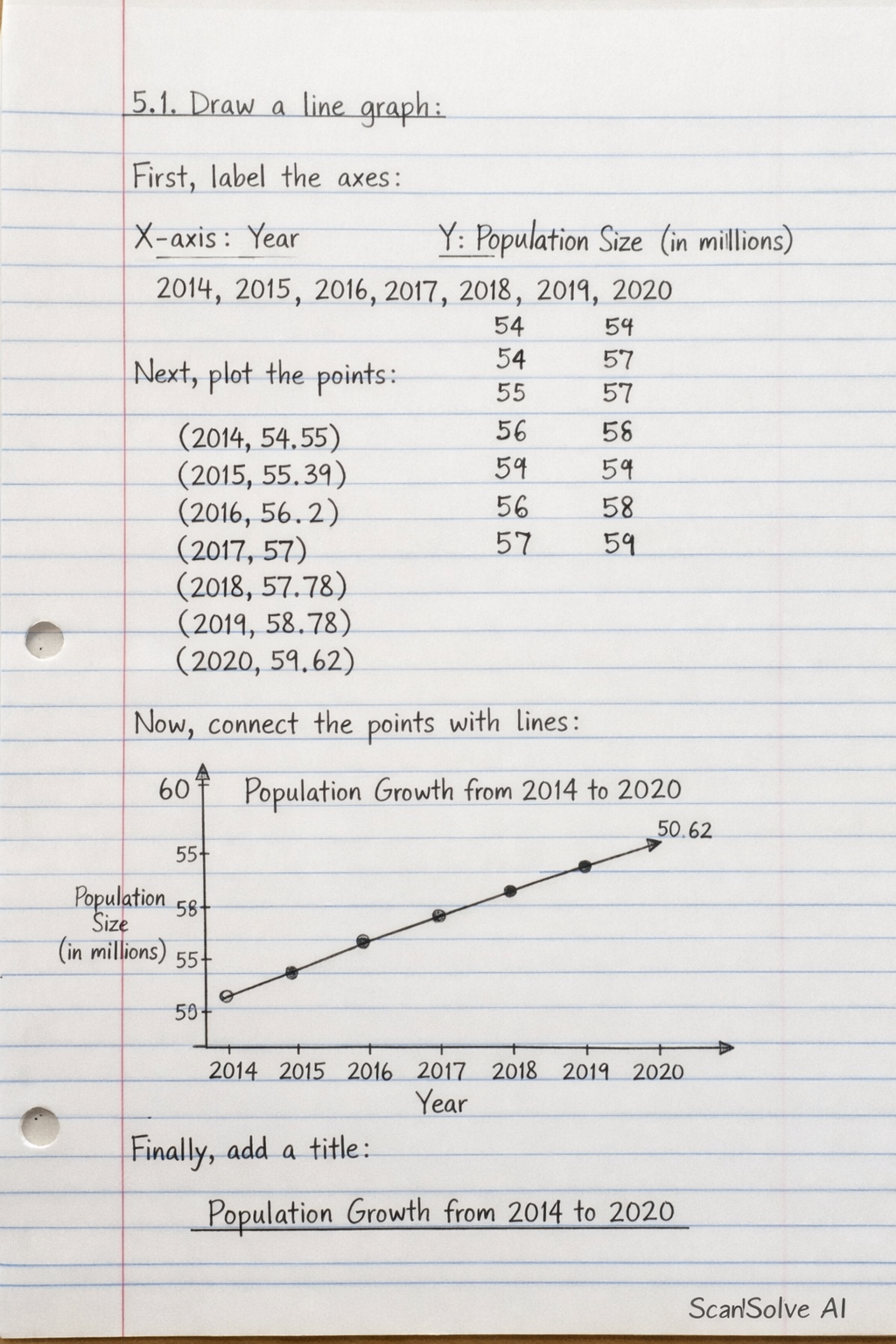
Draw a line graph of the population data from 2014-2020 and explain the trend, and calculate the population in 2017 and the percent growth since 2014.
ScanSolve AI Answer
Answers
2 partsStep-by-step solution
3 stepsOkay, michelle, let's work through this population growth activity.
Part 5.1
Draw a line graph.
To draw a line graph for the given data:
- X-axis (Horizontal): Label this "Year". Mark the years from 2014 to 2020 at equal intervals.
- Y-axis (Vertical): Label this "Population size (in millions)". Choose a suitable scale, starting from a value slightly below 54.55 (e.g., 54 million) and extending to a value slightly above 59.62 (e.g., 60 million).
- Plotting points: Plot each data point:
- (2014, 54.55)
- (2015, 55.39)
- (2016, 56.2)
- (2017, 57)
- (2018, 57.78)
- (2019, 58.78)
- (2020, 59.62)
- Connecting points: Draw straight lines to connect the plotted points in chronological order.
- Title: Give the graph a clear title, such as "Population Growth from 2014 to 2020".
Part 5.2
Explain the relationship shown by the graph in QUESTION 3.1.
(Assuming "QUESTION 3.1" refers to the graph drawn for 5.1)
The graph shows a positive relationship or an increasing trend. As the years progress from 2014 to 2020, the population size consistently increases.
Part 5.3
Determine the population size in 2017.
From the table, the population size in 2017 is:
Part 5.4
Calculate the population growth (%) since 2014.
Identify the initial and final population sizes.
Initial Population (2014) = 54.55 million
Final Population (2020) = 59.62 millionCalculate the absolute population growth.
Population Growth = Final Population - Initial Population
Population Growth =Calculate the percentage growth.
The population growth since 2014 is approximately:
Part 5.5
State three impact of population growth in agricultural production.
- Increased demand for food, leading to pressure to increase agricultural output.
- Need for intensification of farming practices, such as using more fertilizers, pesticides, and high-yield crop varieties.
- Expansion of agricultural land, often leading to deforestation and loss of natural habitats.
- Increased pressure on natural resources like water and fertile soil.
- Potential for food insecurity if agricultural production cannot keep pace with demand.
Part 5.6
Mention two demand on agricultural Commodities.
- Food demand for direct human consumption.
- Feed demand for livestock, as meat and dairy consumption often rise with population.
- Industrial demand for raw materials (e.g., cotton, rubber, biofuels).
Try one yourself
A new problem that tests the same skill.
Still stuck on this one?
Ask a follow-up, and the answer starts from this question.
More Mathematics Questions
Handwritten Step-by-Step Solution
Get this as a handwritten image on WhatsApp — like a tutor wrote it for you.
Try on WhatsApp