
We read your photo as:
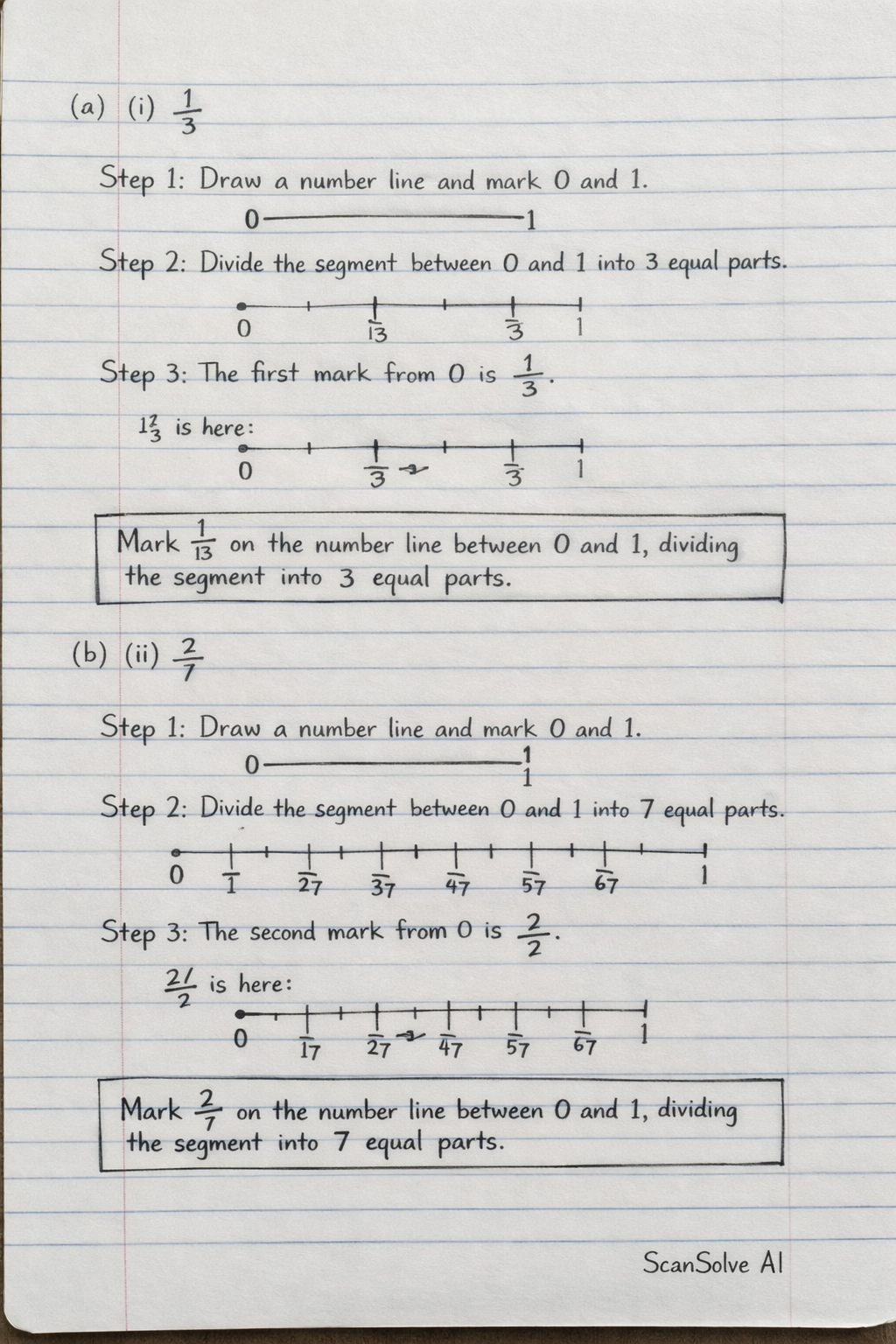
Represent each of the following numbers on the number line: 1/3, 2/7, 1 3/4, 2 2/5, 3 1/2, 5 5/7, 4 2/3, 8.
Mathematics
ScanSolve AI Answer
Step-by-step solution
23 stepsTo represent a number on a number line, first determine which two integers it lies between. Then, divide the segment between those integers into equal parts based on the denominator of the fractional part.
Part a· 3 steps
(i)
Draw a number line and mark integers 0 and 1.
Divide the segment between 0 and 1 into 3 equal parts.
The first mark from 0 represents .
Part b· 3 steps
(ii)
Draw a number line and mark integers 0 and 1.
Divide the segment between 0 and 1 into 7 equal parts.
The second mark from 0 represents .
Part c· 3 steps
(iii)
Draw a number line and mark integers 1 and 2.
Divide the segment between 1 and 2 into 4 equal parts.
The third mark from 1 represents .
Part d· 3 steps
(iv)
Draw a number line and mark integers 2 and 3.
Divide the segment between 2 and 3 into 5 equal parts.
The second mark from 2 represents .
Part e· 3 steps
(v)
Draw a number line and mark integers 3 and 4.
Divide the segment between 3 and 4 into 2 equal parts.
The first mark from 3 represents .
Part f· 3 steps
(vi)
Draw a number line and mark integers 5 and 6.
Divide the segment between 5 and 6 into 7 equal parts.
The fifth mark from 5 represents .
Part g· 3 steps
(vii)
Draw a number line and mark integers 4 and 5.
Divide the segment between 4 and 5 into 3 equal parts.
The second mark from 4 represents .
Part h· 2 steps
(viii) 8
Draw a number line.
Mark the integer 8 directly on the number line.
Was this helpful?
Still stuck on this one?
Ask a follow-up, and the answer starts from this question.
Got a different question?Ask your own question
More Mathematics Questions
QOrder the fractions 2/3, 5/7, 5/8, and 6/21 from least to greatest.QFill in the missing fractions on the number line. Choose from the fractions in the box below. The…QArrange the following fractions in ascending order: 2/5, 1/2, 3/8, 3/10QArrange these fractions in ascending order 3/4, 1/6, 9/8, 1/13 10/15, 8/6, 9/4, 1/3 3/4, 8/6, 1/13…QArrange the following fractions in ascending order: 2/5, 6/10, 7/20, 1/2, 3/4. Compare the following…
Handwritten Step-by-Step Solution
Get this as a handwritten image on WhatsApp — like a tutor wrote it for you.
Try on WhatsApp