
We read your photo as:
Draw a number line showing the sum (-7) + (+9) = (+2) and its inverse operation.
ScanSolve AI Answer
Step-by-step solution
8 stepsHere's how to represent the sum and its inverse operation on a number line:
Part a· 4 steps
Draw a number line showing the following sum:
Draw a number line with 0 in the center and markings for positive and negative integers.
Start at 0.
To represent , draw an arrow from 0 moving 7 units to the left, ending at .
From , to represent , draw another arrow moving 9 units to the right.
This second arrow will end at .
The final position, , is the result of the sum.
Part b· 4 steps
Draw a number line to show the inverse operation of the sum above.
The original sum is . An inverse operation would undo this sum. One way to show this is to start from the result and subtract one of the numbers to get back to the other. Let's show .
Draw a number line with 0 in the center and markings for positive and negative integers.
Start at 0.
To represent , draw an arrow from 0 moving 2 units to the right, ending at .
From , to represent subtracting , draw another arrow moving 9 units to the left (because subtracting a positive number is equivalent to moving left).
This second arrow will end at .
The final position, , is the result of the inverse operation.
Still stuck on this one?
Ask a follow-up, and the answer starts from this question.
More Mathematics Questions
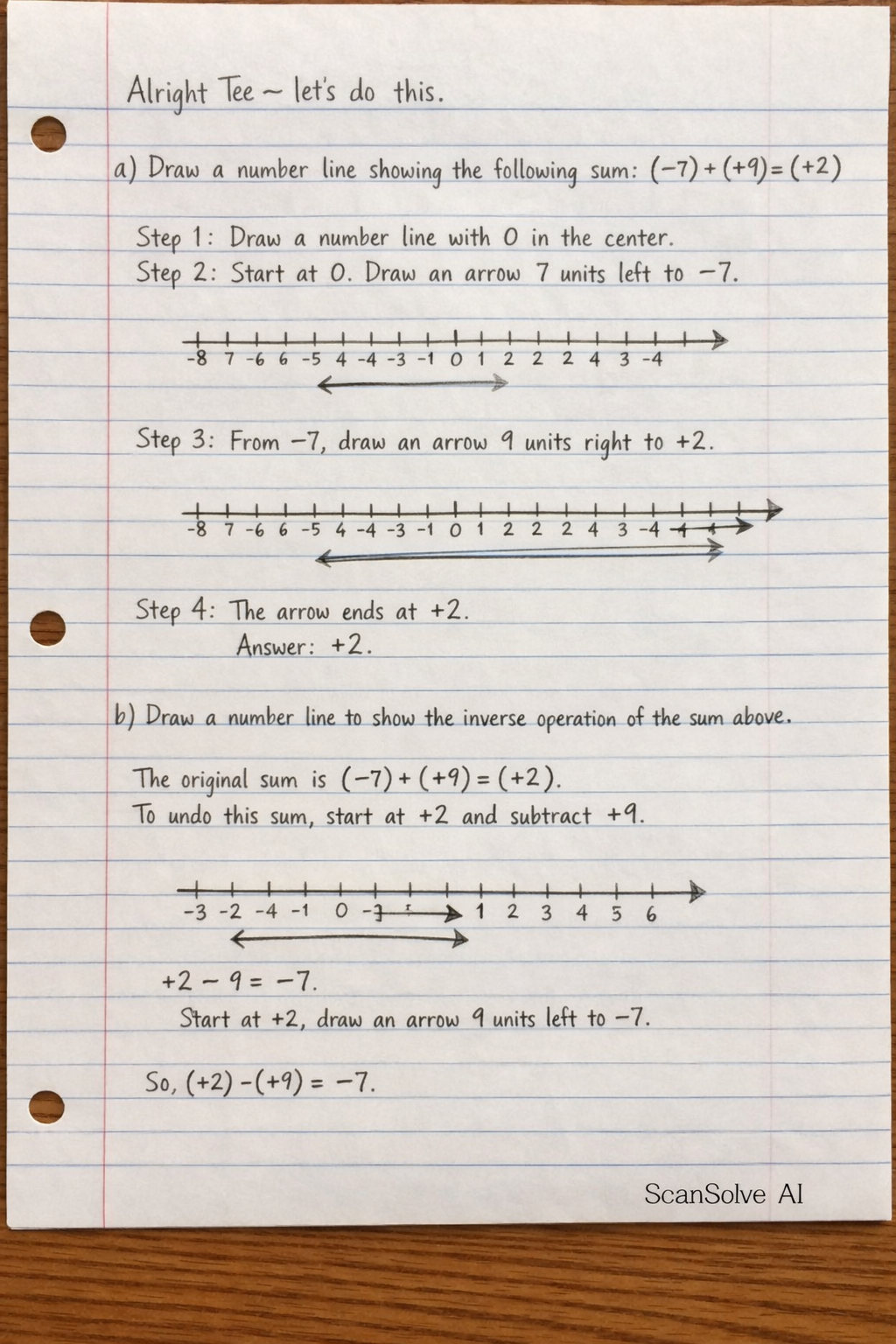
Handwritten Step-by-Step Solution
Get this as a handwritten image on WhatsApp — like a tutor wrote it for you.
Try on WhatsApp