
We read your photo as:
Work Exercise 2: 1. Draw a number line and show the following additions on it. i. 6+(-2) ii. (-2)+(-3) iii. (-149)+(-311) 4. Write the additive inverse of the following integers. i. 17 iii. (-101) 5. Write any two integers. i. 6+(-8) iii. (-12)+11
ScanSolve AI Answer
Step-by-step solution
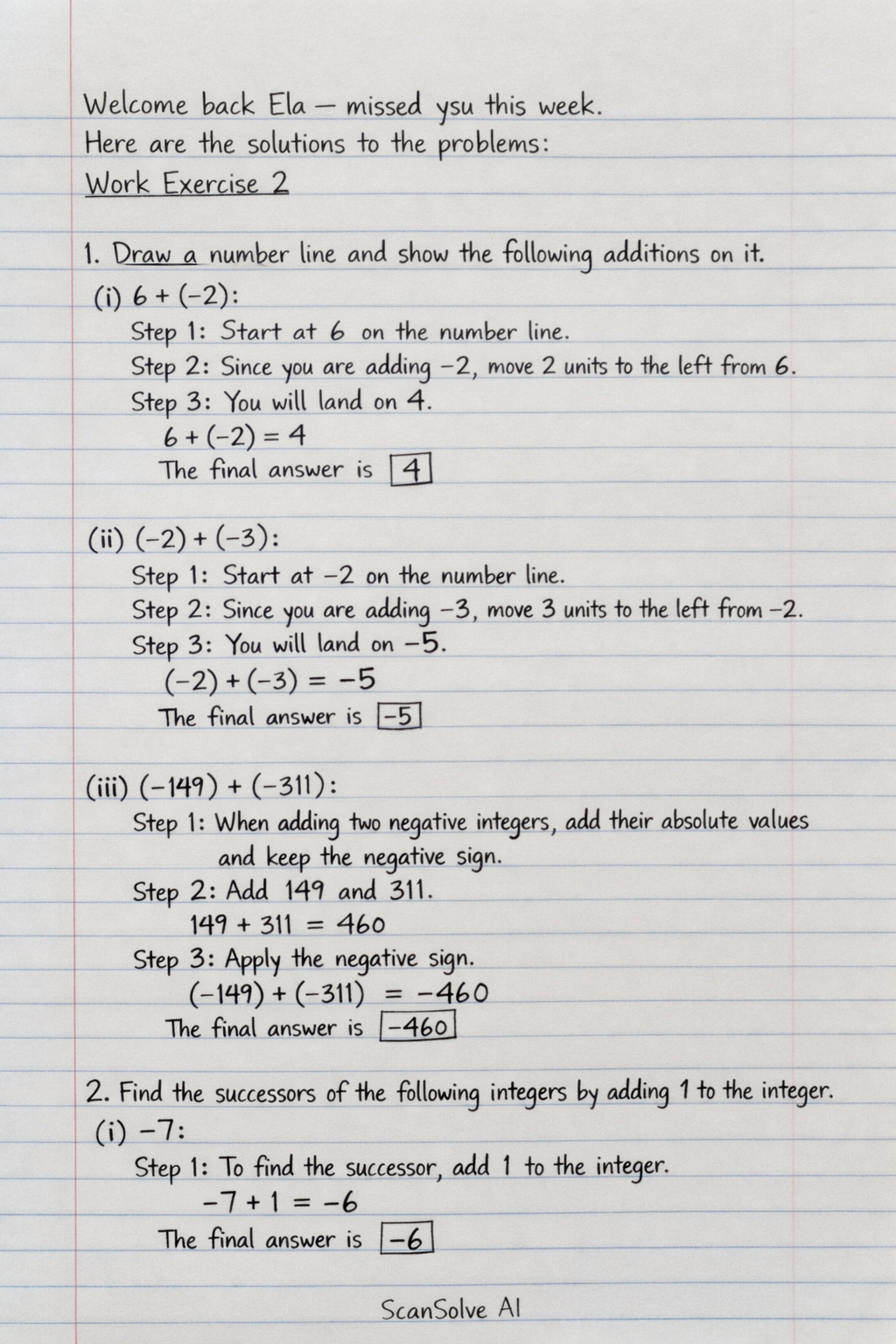
24 stepsHere are the solutions to the problems:
**Work **
1. Draw a number line and show the following additions on it.
i)
Start at 6 on the number line.
Since you are adding , move 2 units to the left from 6.
You will land on 4.
The final answer is
ii)
Start at on the number line.
Since you are adding , move 3 units to the left from .
You will land on .
The final answer is
iii)
When adding two negative integers, add their absolute values and keep the negative sign.
Add 149 and 311.
Apply the negative sign.
The final answer is
2. Find the successors of the following integers by adding 1 to the integer.
i)
To find the successor, add 1 to the integer.
The final answer is
ii) 12
To find the successor, add 1 to the integer.
The final answer is
iii)
To find the successor, add 1 to the integer.
The final answer is
3. Add the following integers by the rules of addition.
i)
When adding integers with different signs, subtract the smaller absolute value from the larger absolute value.
The result takes the sign of the integer with the larger absolute value, which is .
The final answer is
ii)
Subtract the smaller absolute value from the larger absolute value.
The result takes the sign of the integer with the larger absolute value, which is 596.
The final answer is
4. Write the additive inverse of the following integers.
i) 17
The additive inverse of an integer is the number that, when added to the integer, results in zero.
It is the integer with the opposite sign.
The additive inverse of 17 is .
The final answer is
iii)
The additive inverse of an integer is the number with the opposite sign.
The additive inverse of is 101.
The final answer is
5. Write any two integers and add them.
i)
Subtract the smaller absolute value from the larger absolute value.
The result takes the sign of the integer with the larger absolute value, which is .
The final answer is
iii)
Subtract the smaller absolute value from the larger absolute value.
The result takes the sign of the integer with the larger absolute value, which is .
The final answer is
Still stuck on this one?
Ask a follow-up, and the answer starts from this question.
More Mathematics Questions
Handwritten Step-by-Step Solution
Get this as a handwritten image on WhatsApp — like a tutor wrote it for you.
Try on WhatsApp