
We read your photo as:
Draw an abacus, write numbers in words, round numbers to the nearest ten millions, and find prime numbers.
ScanSolve AI Answer
Answer
Step-by-step solution
5 stepsMATHEMATICS
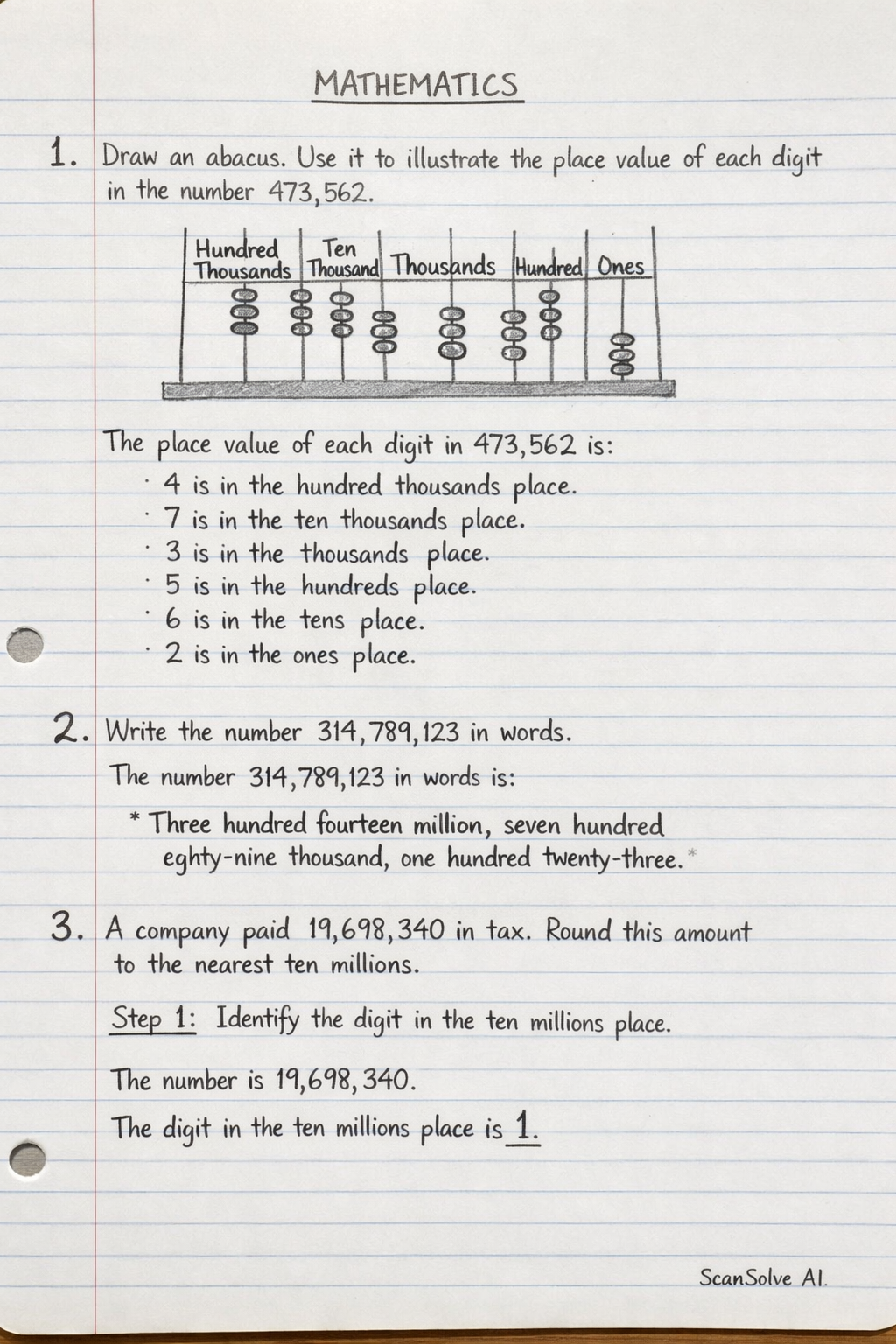
1. Draw an abacus. Use it to illustrate the place value of each digit in the number 473,562.
To illustrate 473,562 on an abacus, you would have rods representing place values, and beads on each rod.
- Hundred Thousands rod: 4 beads
- Ten Thousands rod: 7 beads
- Thousands rod: 3 beads
- Hundreds rod: 5 beads
- Tens rod: 6 beads
- Ones rod: 2 beads
The place value of each digit in 473,562 is:
- 4 is in the hundred thousands place.
- 7 is in the ten thousands place.
- 3 is in the thousands place.
- 5 is in the hundreds place.
- 6 is in the tens place.
- 2 is in the ones place.
2. Write the number 314,789,123 in words.
The number 314,789,123 in words is:
- Three hundred fourteen million, seven hundred eighty-nine thousand, one hundred twenty-three.
3. A company paid 19,698,340 in tax. Round this amount to the nearest ten millions.
Identify the digit in the ten millions place.
The number is 19,698,340. The digit in the ten millions place is 1.
Look at the digit to its right (the millions place).
The digit to the right of 1 is 9.
Round up or down.
Since 9 is 5 or greater, we round up the digit in the ten millions place.
1 becomes 2. All digits to the right become zeros.4. Find the sum of all prime numbers between 1 and 20.
List all prime numbers between 1 and 20.
A prime number is a natural number greater than 1 that has no positive divisors other than 1 and itself.
The prime numbers between 1 and 20 are: 2, 3, 5, 7, 11, 13, 17, 19.Sum these prime numbers.
Try one yourself
A new problem that tests the same skill.
Still stuck on this one?
Ask a follow-up, and the answer starts from this question.
More Mathematics Questions
Handwritten Step-by-Step Solution
Get this as a handwritten image on WhatsApp — like a tutor wrote it for you.
Try on WhatsApp