
We read your photo as:
Draw the following quadrilaterals and indicate their properties on the diagram:
ScanSolve AI Answer
Here are the drawings of the quadrilaterals with their properties indicated:
-
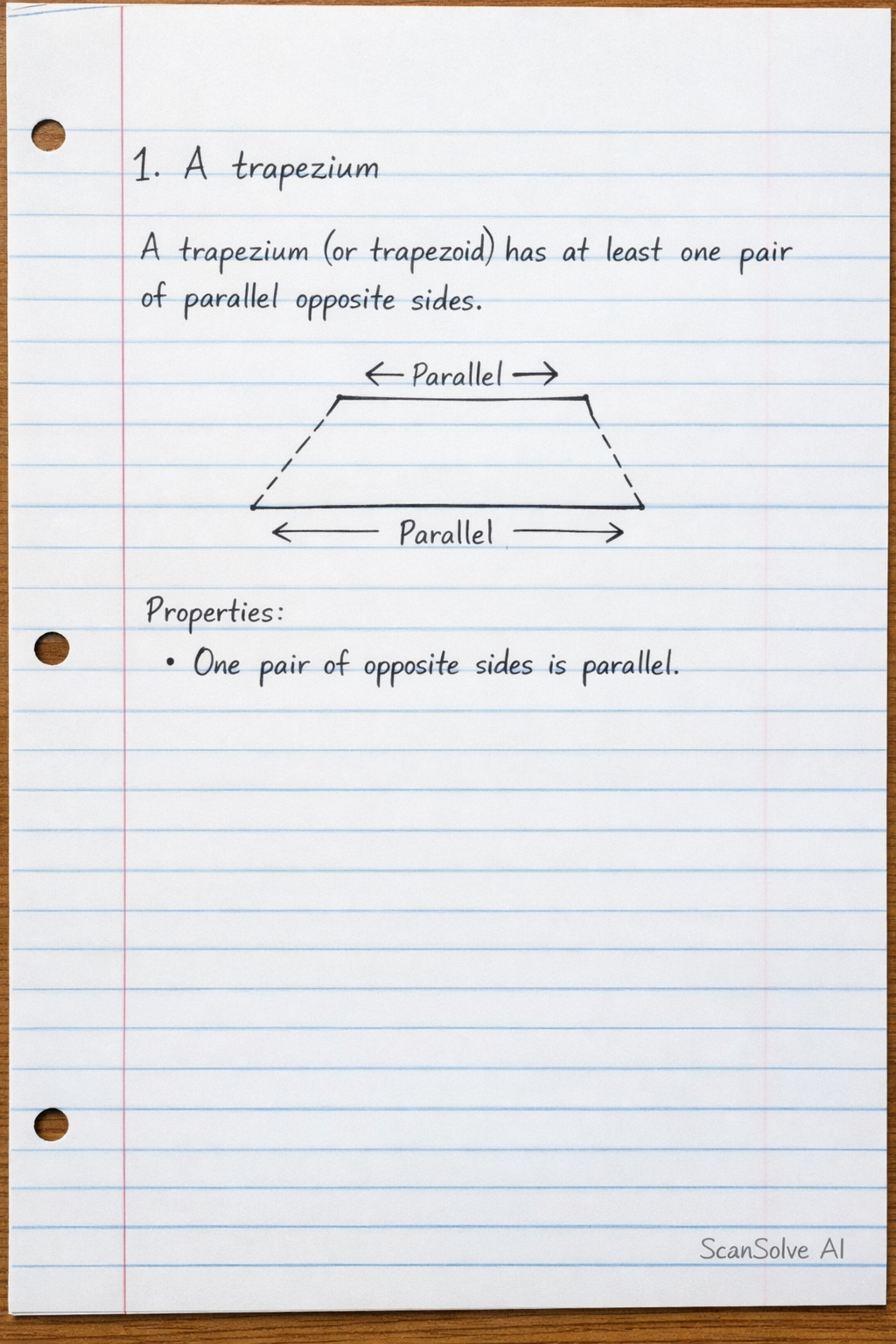
A trapezium A trapezium (or trapezoid) has at least one pair of parallel opposite sides.
\begin{tikzpicture}
\draw (0,0) -- (3,0) node[right] {} -- (2,1.5) node[above right] {} -- (1,1.5) node[above left] {} -- cycle;
\draw[<->] (0.5,0) -- (2.5,0);
\draw[<->] (1.2,1.5) -- (1.8,1.5);
\draw[dashed] (0.5,0) -- (1.2,1.5);
\draw[dashed] (2.5,0) -- (1.8,1.5);
\node at (1.5,-0.3) {Parallel};
\node at (1.5,1.8) {Parallel};
\end{tikzpicture}
Properties: One pair of opposite sides is parallel.
-
A kite A kite has two pairs of equal-length sides that are adjacent to each other.
\begin{tikzpicture}
\draw (0,0) -- (1.5,2) node[above right] {} -- (3,0) node[right] {} -- (1.5,-2) node[below right] {} -- cycle;
\draw (0,0) -- (1.5,2);
\draw (1.5,2) -- (3,0);
\draw (3,0) -- (1.5,-2);
\draw (1.5,-2) -- (0,0);
\draw[red, thick] (0.2,0.1) -- (0.3,0.2);
\draw[red, thick] (1.4,1.8) -- (1.3,1.7);
\draw[red, thick] (2.8,0.1) -- (2.7,0.2);
\draw[red, thick] (1.6,1.8) -- (1.7,1.7);
\draw[blue, thick] (0.2,-0.1) -- (0.3,-0.2);
\draw[blue, thick] (1.4,-1.8) -- (1.3,-1.7);
\draw[blue, thick] (2.8,-0.1) -- (2.7,-0.2);
\draw[blue, thick] (1.6,-1.8) -- (1.7,-1.7);
\draw[dashed] (0,0) -- (3,0);
\draw[dashed] (1.5,2) -- (1.5,-2);
\node at (1.5,0) {$\llcorner$};
\end{tikzpicture}
Properties: Two pairs of adjacent sides are equal in length (marked with single and double dashes). Diagonals are perpendicular (marked with a right angle symbol).
-
A parallelogram A parallelogram has two pairs of parallel opposite sides, and opposite sides are equal in length.
\begin{tikzpicture}
\draw (0,0) -- (2,0) node[right] {} -- (3,1.5) node[above right] {} -- (1,1.5) node[above left] {} -- cycle;
\draw[<->] (0.5,0) -- (1.5,0);
\draw[<->] (1.5,1.5) -- (2.5,1.5);
\draw[<->, blue] (0.2,0.75) -- (0.7,0.75);
\draw[<->, blue] (2.2,0.75) -- (2.7,0.75);
\draw[red, thick] (0.1,0.1) -- (0.2,0.2);
\draw[red, thick] (1.9,0.1) -- (1.8,0.2);
\draw[red, thick] (3.1,1.4) -- (3,1.3);
\draw[red, thick] (1.1,1.4) -- (1.2,1.3);
\draw[blue, thick] (0.1,0.2) -- (0.2,0.1);
\draw[blue, thick] (1.1,1.3) -- (1.2,1.4);
\draw[blue, thick] (1.9,0.2) -- (1.8,0.1);
\draw[blue, thick] (3.1,1.3) -- (3,1.4);
\end{tikzpicture}
Properties: Opposite sides are parallel (indicated by single and double arrows). Opposite sides are equal in length (indicated by single and double dashes).
-
A square A square has four equal sides and four right angles.
\begin{tikzpicture}
\draw (0,0) -- (2,0) node[right] {} -- (2,2) node[above right] {} -- (0,2) node[above left] {} -- cycle;
\draw[red, thick] (0.1,0.1) -- (0.2,0.2);
\draw[red, thick] (1.9,0.1) -- (1.8,0.2);
\draw[red, thick] (1.9,1.9) -- (1.8,1.8);
\draw[red, thick] (0.1,1.9) -- (0.2,1.8);
\node at (0.2,0.2) {$\llcorner$};
\node at (1.8,0.2) {$\llcorner$};
\node at (1.8,1.8) {$\llcorner$};
\node at (0.2,1.8) {$\llcorner$};
\end{tikzpicture}
Properties: All four sides are equal in length (indicated by single dashes). All four interior angles are right angles (90 degrees, indicated by square symbols).
Still stuck on this one?
Ask a follow-up, and the answer starts from this question.
More Mathematics Questions
Handwritten Step-by-Step Solution
Get this as a handwritten image on WhatsApp — like a tutor wrote it for you.
Try on WhatsApp