
We read your photo as:
Describe the properties and provide a drawing description for a kite, trapezium, parallelogram, and rhombus.
Mathematics
ScanSolve AI Answer
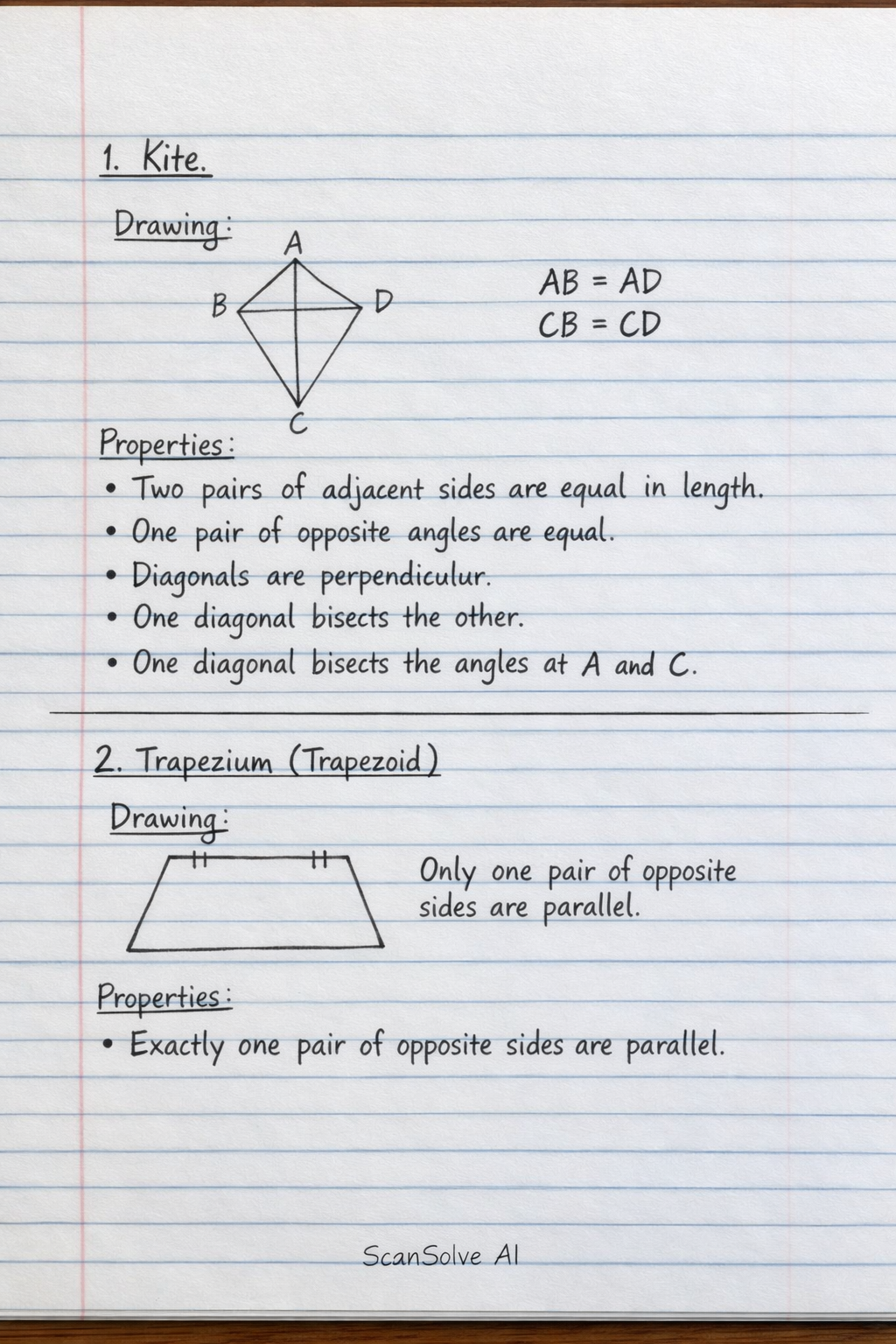
Here are the drawings and properties for each quadrilateral:
-
Kite
- Drawing: Imagine a shape with four vertices. Connect two pairs of adjacent sides so that each pair has equal length. For example, if the vertices are A, B, C, D in order, then AB = AD and CB = CD. The shape will look like a traditional kite.
- Properties:
- Two distinct pairs of adjacent sides are equal in length.
- One pair of opposite angles are equal.
- The diagonals are perpendicular to each other.
- One diagonal bisects the other diagonal.
- One diagonal bisects the angles at the vertices it connects.
-
Trapezium (also known as Trapezoid)
- Drawing: Draw a quadrilateral where only one pair of opposite sides are parallel. The other two sides are not parallel.
- Properties:
- Exactly one pair of opposite sides are parallel.
-
Parallelogram
- Drawing: Draw a quadrilateral where both pairs of opposite sides are parallel. It looks like a "slanted" rectangle.
- Properties:
- Opposite sides are parallel.
- Opposite sides are equal in length.
- Opposite angles are equal.
- Consecutive angles are supplementary (add up to ).
- The diagonals bisect each other.
-
Rhombus
- Drawing: Draw a parallelogram where all four sides are equal in length. It looks like a "slanted" square.
- Properties:
- All four sides are equal in length.
- Opposite sides are parallel.
- Opposite angles are equal.
- The diagonals bisect each other at right angles ().
- The diagonals bisect the angles at the vertices.
-
Rectangle
- Drawing: Draw a parallelogram where all four angles are right angles ().
- Properties:
- All four angles are right angles ().
- Opposite sides are parallel and equal in length.
- The diagonals are equal in length.
- The diagonals bisect each other.
Was this helpful?
Still stuck on this one?
Ask a follow-up, and the answer starts from this question.
Got a different question?Ask your own question
More Mathematics Questions
QDraw and list the properties of a kite, trapezium, parallelogram, and rhombus.QDraw the following quadrilaterals and indicate their properties on the diagram:QIdentify the types of quadrilaterals based on their properties.QProvide properties of a parallelogram, rhombus, and trapezoid, and solve problems involving the area…QIdentify the shapes and their properties.
Browse by topic:Geometry
Handwritten Step-by-Step Solution
Get this as a handwritten image on WhatsApp — like a tutor wrote it for you.
Try on WhatsApp