
We read your photo as:
Which equation represents the statement "Twice a number decreased by 8 is equal to 14"?
ScanSolve AI Answer
Step-by-step solution
11 stepsHere are the solutions to the questions:
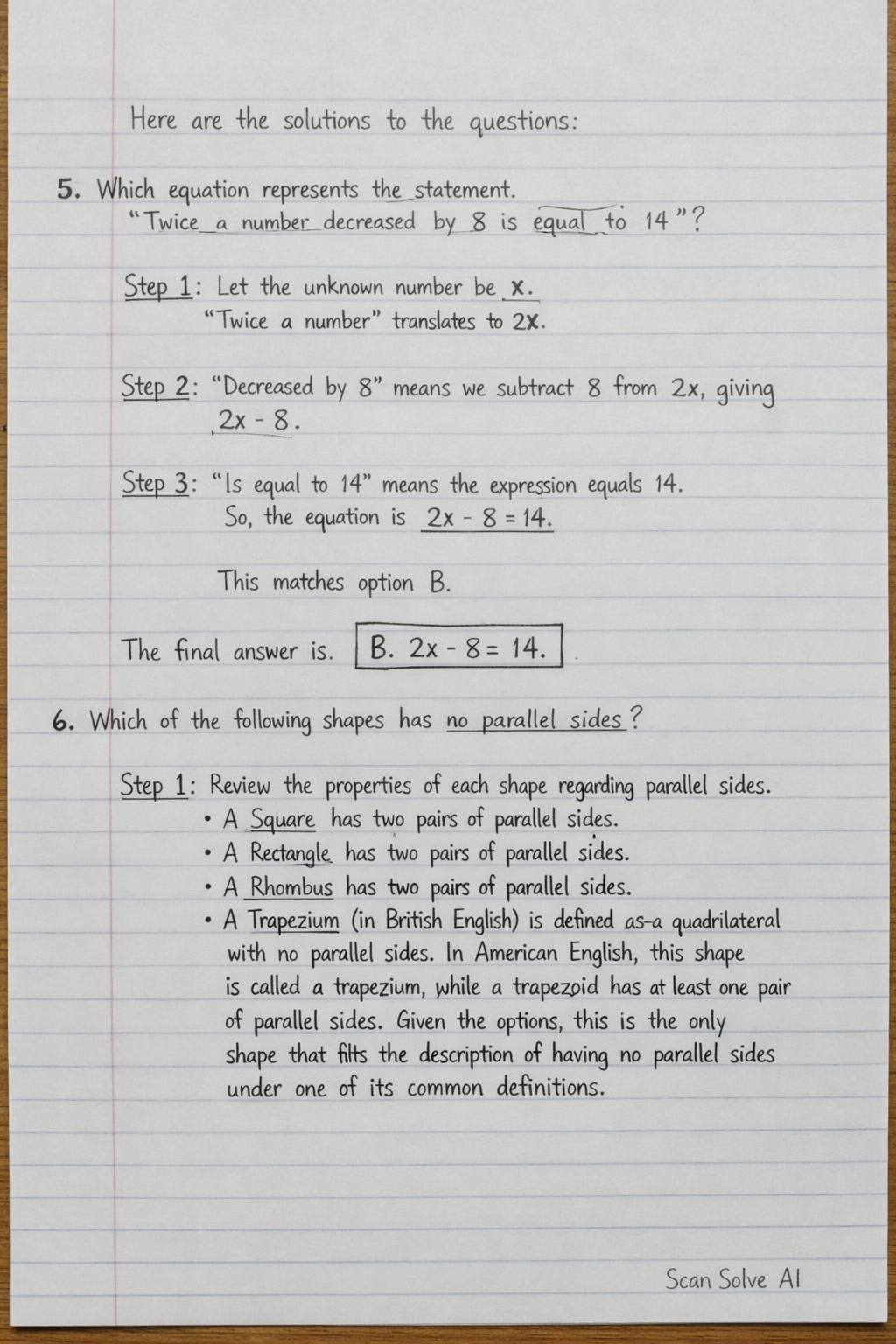
5. Which equation represents the statement "Twice a number decreased by 8 is equal to 14"?
Let the unknown number be .
"Twice a number" translates to $2x$.
"Decreased by 8" means we subtract 8 from , giving .
"Is equal to 14" means the expression equals 14.
So, the equation is .
This matches option B.The final answer is .
6. Which of the following shapes has no parallel sides?
Review the properties of each shape regarding parallel sides.
- A Square has two pairs of parallel sides.
- A Rectangle has two pairs of parallel sides.
- A Rhombus has two pairs of parallel sides.
- A Trapezium (in British English) is defined as a quadrilateral with no parallel sides. In American English, this shape is called a trapezium, while a trapezoid has at least one pair of parallel sides. Given the options, this is the only shape that fits the description of having no parallel sides under one of its common definitions.
The final answer is .
7. A car travels 50km east and then 30km south. What is the resultant displacement of the car?
Understand the directions and distances.
The car travels East and South. These two movements are perpendicular.
Calculate the magnitude of the resultant displacement.
The resultant displacement is the hypotenuse of a right-angled triangle formed by the East and South movements.
Magnitude .
None of the options match this magnitude. However, if the question is asking for the total distance traveled and the general direction, then:
Total distance = .Determine the direction of the resultant displacement.
Since the car moved East and then South, the overall direction from the starting point is Southeast.
Match with the given options.
Considering the total distance traveled and the general direction, option A, "80km southeast", is the most plausible answer, assuming a simplified interpretation of "resultant displacement" in this context.
The final answer is .
8. Expand
Distribute the to each term inside the parentheses.
Multiply by 3:
Multiply by
Combine the terms.
It is standard practice to write the term with the highest power first:
The final answer is .
Still stuck on this one?
Ask a follow-up, and the answer starts from this question.
More Mathematics Questions
Handwritten Step-by-Step Solution
Get this as a handwritten image on WhatsApp — like a tutor wrote it for you.
Try on WhatsApp