
We read your photo as:
Solve the congruence d x d + 2 = 14 8
Mathematics
ScanSolve AI Answer
Answer
Step-by-step solution
4 stepsTo solve the congruence :
Rewrite the equation.
The equation can be written as:
Subtract 2 from both sides of the congruence.
Reduce the right side modulo 8.
To find , we divide 12 by 8 and find the remainder: .
So, .
The congruence becomes:Find values of that satisfy the congruence.
We need to find integers such that leaves a remainder of 4 when divided by 8. We can test values for from 0 to 7:
- If , . .
- If , . .
- If , . . This is a solution.
- If , . . .
- If , . . .
- If , . . .
- If , . . This is a solution.
- If , . . .
The values of that satisfy the congruence are and .
The final answer is .
Was this helpful?
Try one yourself
A new problem that tests the same skill.
Still stuck on this one?
Ask a follow-up, and the answer starts from this question.
Got a different question?Ask your own question
More Mathematics Questions
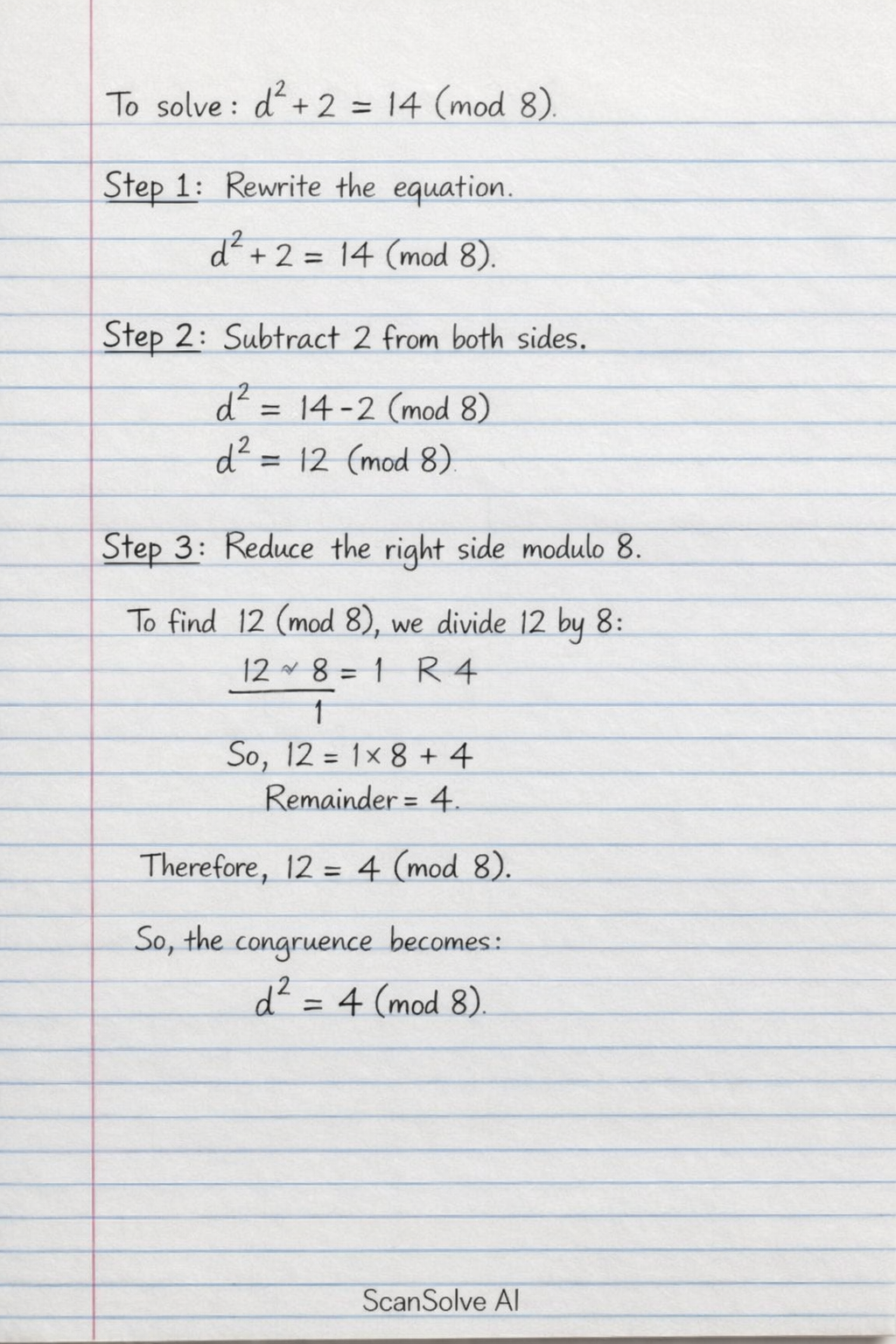
Handwritten Step-by-Step Solution
Get this as a handwritten image on WhatsApp — like a tutor wrote it for you.
Try on WhatsApp