
We read your photo as:
Solve the dy/dt = t2(1+y) equation.
ScanSolve AI Answer
Answer
Step-by-step solution
3 stepsSeparate the variables.
The given differential equation is:
To separate the variables, divide both sides by and multiply by :
Integrate both sides of the equation.
Integrate the left side with respect to and the right side with respect to :
The integral of is .
The integral of is .
So, we get:where is the constant of integration.
Solve for .
To isolate , exponentiate both sides using :
Let . Since is an arbitrary constant, is an arbitrary positive constant. We can remove the absolute value by allowing to be any non-zero constant (positive or negative).
Finally, solve for :
Try one yourself
A new problem that tests the same skill.
Still stuck on this one?
Ask a follow-up, and the answer starts from this question.
More Mathematics Questions
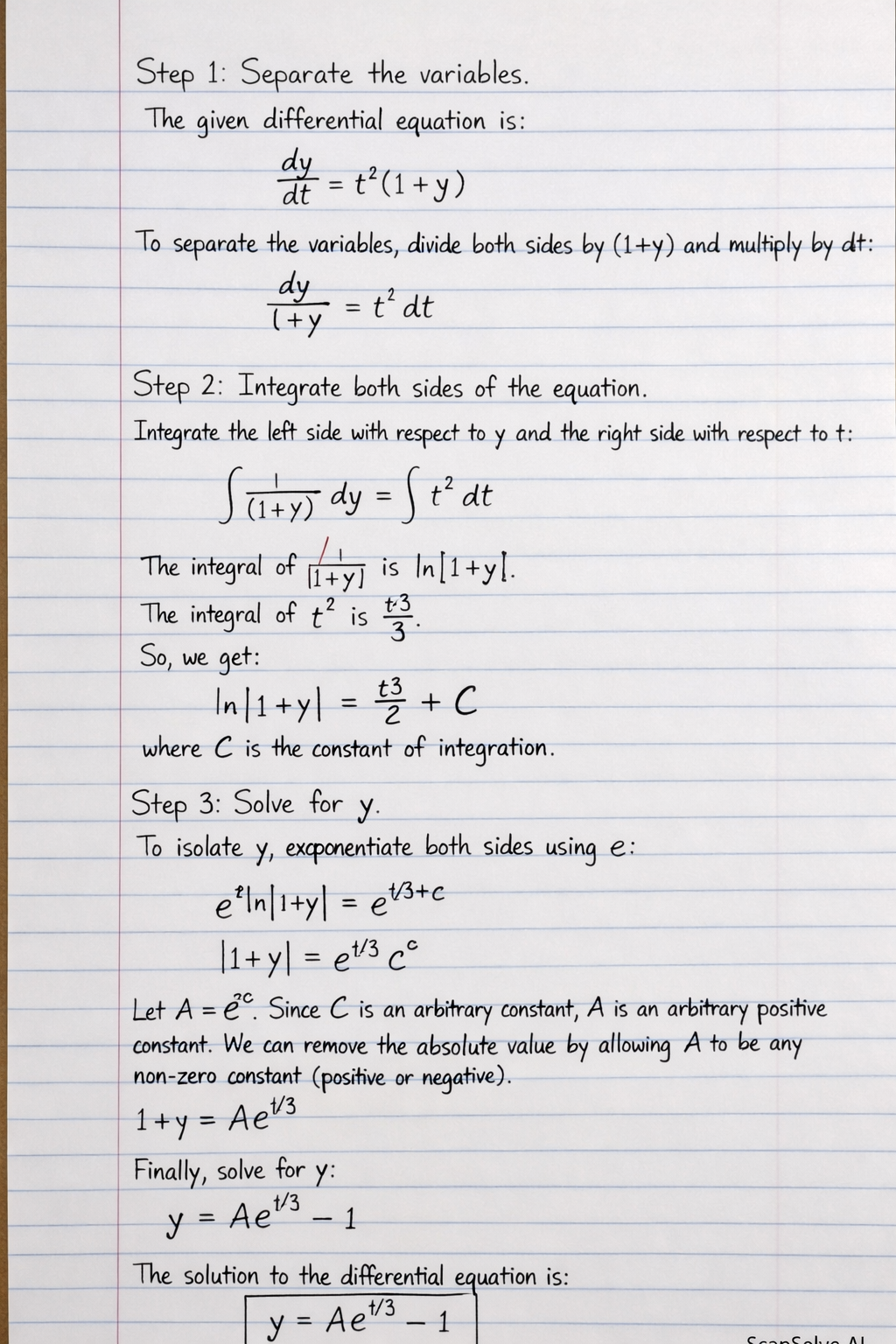
Handwritten Step-by-Step Solution
Get this as a handwritten image on WhatsApp — like a tutor wrote it for you.
Try on WhatsApp