
We read your photo as:
Find dy/dx of the equation sin(x2y3) + 3x3y2 = 6 using implicit differentiation.
ScanSolve AI Answer
This answer stops before the end.
It was cut off when it was first written. Ask ScanSolve this question again for the full working.
Step 1: Differentiate both sides of the equation with respect to .
The given equation is .
We apply the derivative operator to both sides:
Step 2: Differentiate each term.
For the first term, , we use the chain rule. Let .
Then .
To find , we use the product rule, where and .
.
(using the chain rule for ).
So, .
Therefore, .
For the second term, , we use the product rule, where and .
.
(using the chain rule for ).
So, .
For the right side, .
Step 3: Substitute the differentiated terms back into the equation.
Step 4: Expand and rearrange the equation to isolate .
Group terms containing on one side and other terms on the other side:
Factor out :
Step 5: Solve for .
Step 6: Simplify the expression by factoring common terms from the numerator and denominator.
Factor out from the numerator:
Numerator .
Factor out from the denominator:
Denominator .
Substitute these back into the expression for :
Assuming and , we can cancel from the numerator and denominator:
Still stuck on this one?
Ask a follow-up, and the answer starts from this question.
More Mathematics Questions
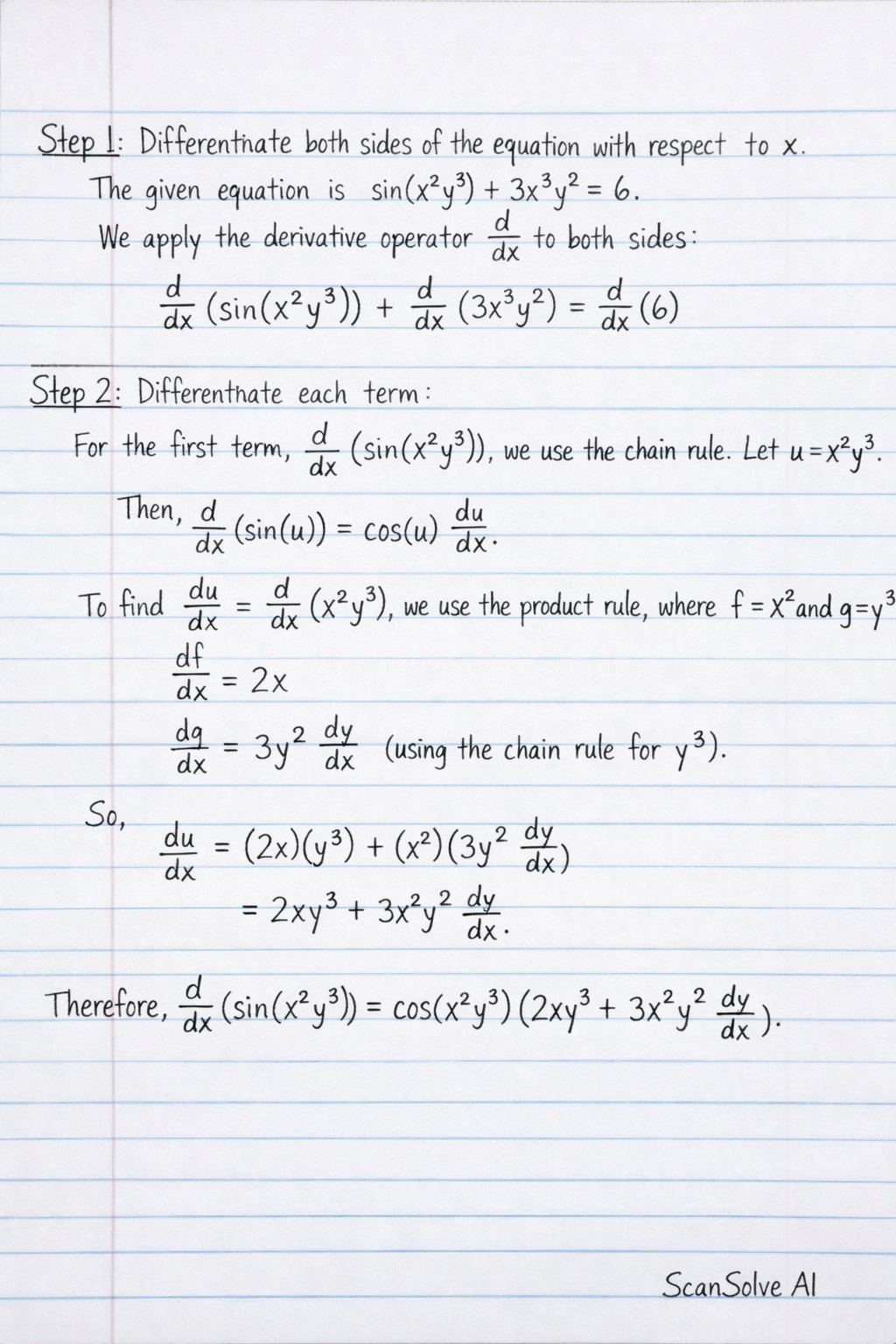
Handwritten Step-by-Step Solution
Get this as a handwritten image on WhatsApp — like a tutor wrote it for you.
Try on WhatsApp