
We read your photo as:
Solve the equation: (3X-1)/3 - (2X-1)/4 = 2. Also, find the distance of a landmark from a 30m cliff if the angle of elevation is 60 degrees.
ScanSolve AI Answer
Step-by-step solution
23 stepsHere are the step-by-step solutions for each question:
6. Solve the equation:
Find a common denominator for the fractions, which is 12.
Multiply the entire equation by 12.
Simplify the terms.
Distribute the numbers into the parentheses.
Combine like terms on the left side.
Add 1 to both sides of the equation.
Divide by 6 to solve for .
The solution is .
7. The angle of elevation of the top of a cliff 30 metres high from a landmark is . How far is the landmark from the foot of the cliff? Leave your answer in surd form.
Define the variables.
Let be the height of the cliff, . Let be the distance from the landmark to the foot of the cliff. The angle of elevation is .
Use the tangent function, as it relates the opposite side (height) to the adjacent side (distance) in a right-angled triangle.
Substitute the known values.
We know .
Solve for .
Rationalize the denominator by multiplying the numerator and denominator by .
Comparing this with the options, option (b) is , which simplifies to .
The distance is .8. For what value of X is the expression not defined?
An algebraic expression is undefined when its denominator is equal to zero.
Set the denominator to zero.
Factor the quadratic equation.
We need two numbers that multiply to -6 and add to -1. These numbers are -3 and 2.
Set each factor equal to zero and solve for .
The expression is not defined for and .
The correct option is .9. AOC is the diameter of a circle, if , calculate .
Identify properties of angles in a circle.
Since AOC is the diameter, the angle subtended by the diameter at any point on the circumference is a right angle. Therefore, .
Angles subtended by the same arc at the circumference are equal.
and are both subtended by arc AB.
Consider .
The sum of angles in a triangle is .
Substitute the known angles into the equation.
Solve for .
The correct option is .
10. ABCD is a cyclic quadrilateral. If , , calculate .
Identify properties of angles in a circle.
Angles subtended by the same arc at the circumference are equal.
- and are both subtended by arc AB. Therefore, .
- and are both subtended by arc AD. Therefore, .
Consider .
The sum of angles in a triangle is .
Substitute the known angles into the equation.
Solve for .
The correct option is .
Still stuck on this one?
Ask a follow-up, and the answer starts from this question.
More Mathematics Questions
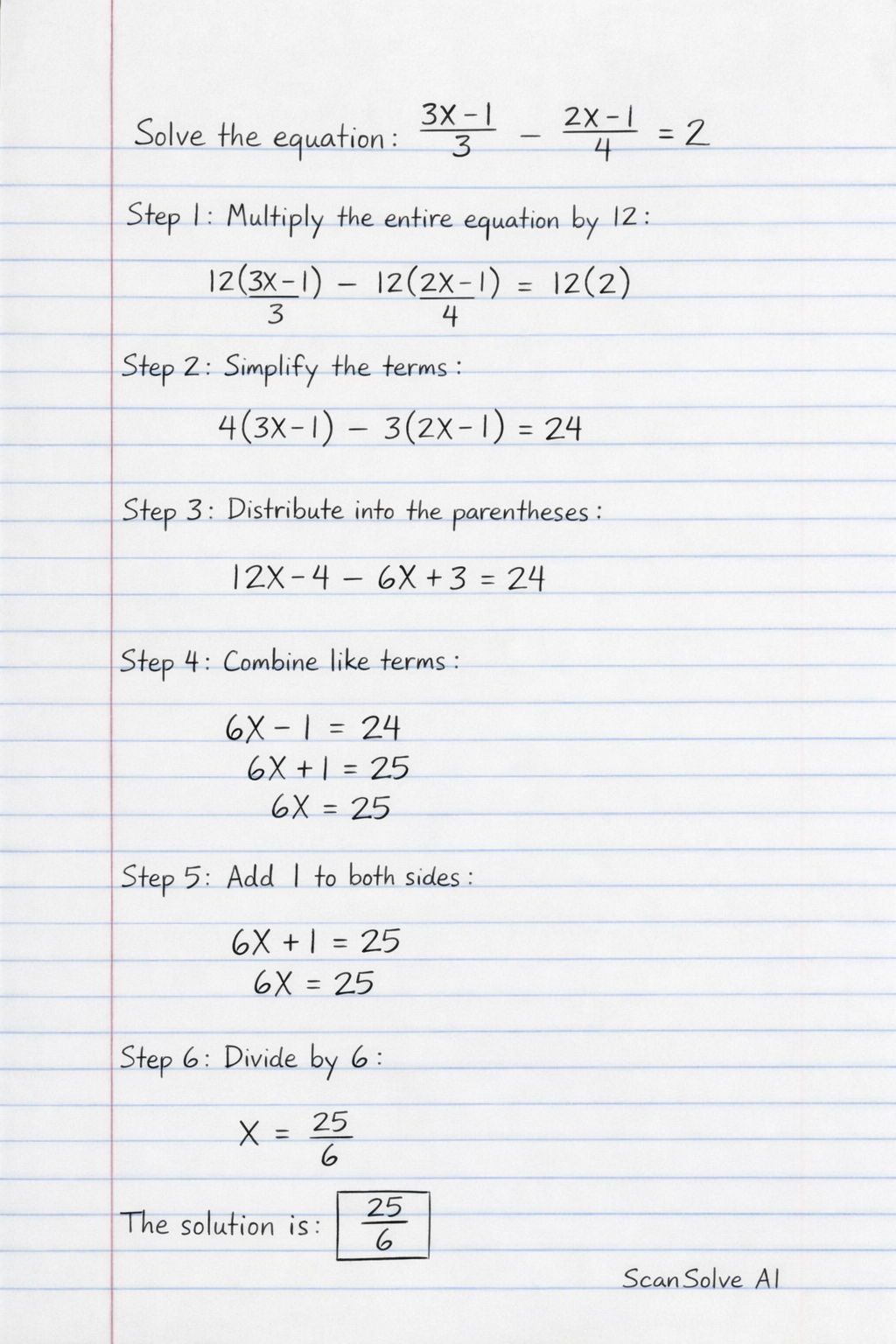
Handwritten Step-by-Step Solution
Get this as a handwritten image on WhatsApp — like a tutor wrote it for you.
Try on WhatsApp