We read your photo as:

Find the equation of the normal to the circle 3x2 + 3y2 + 5x − 3y − 22 = 0 at the point (2,1) and the length of the diameter.

Mathematics

ScanSolve AI Answer

Answer

3x−17y+11=0\mathbf{3x - 17y + 11 = 0}

2983\mathbf{\frac{\sqrt{298}}{3}}

Step-by-step solution

3 steps
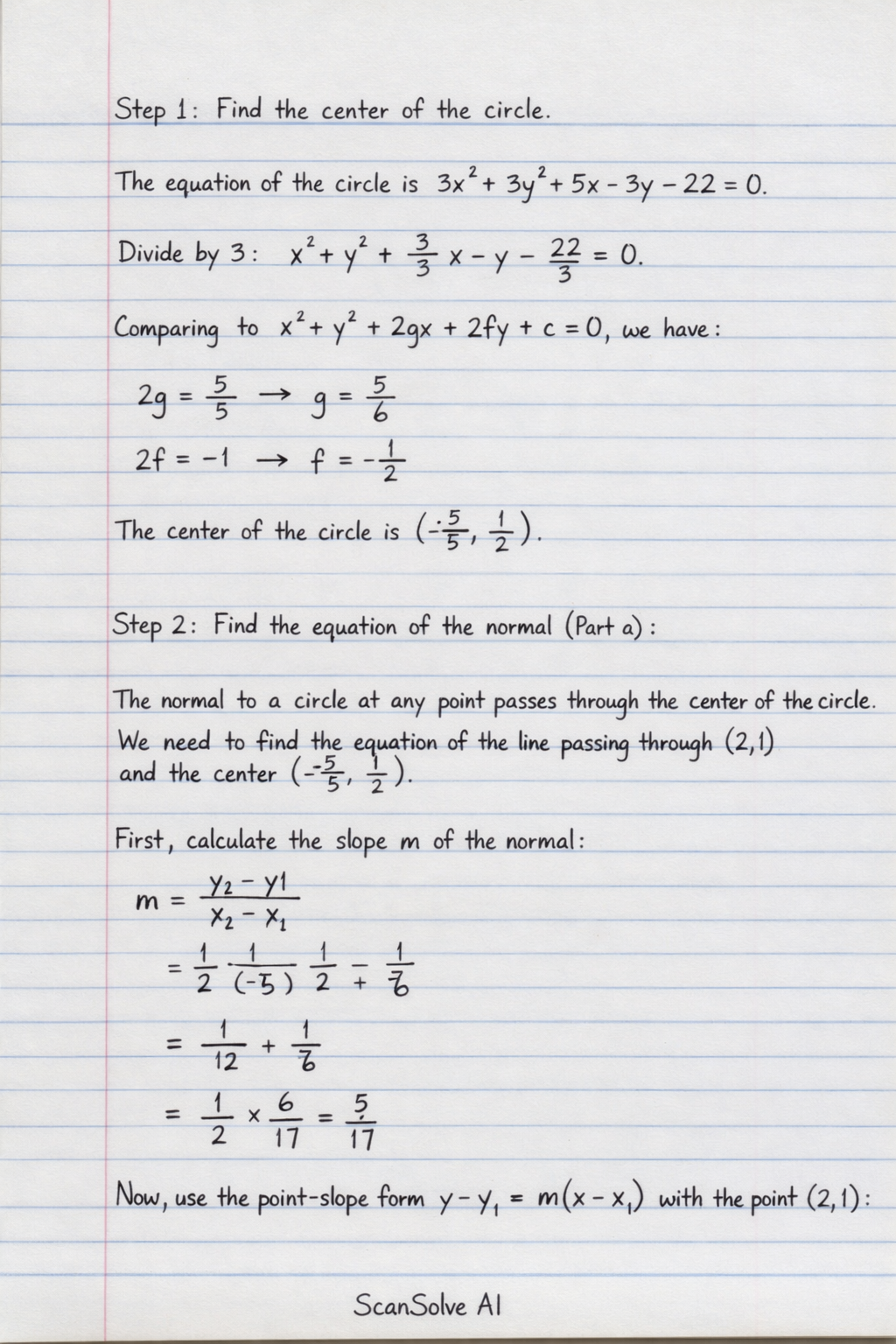
  1. Find the center of the circle.

    The equation of the circle is 3x2+3y2+5x−3y−22=03x^2 + 3y^2 + 5x - 3y - 22 = 0.
    Divide by 3 to get the standard form x2+y2+53x−y−223=0x^2 + y^2 + \frac{5}{3}x - y - \frac{22}{3} = 0.
    Comparing this to the general equation x2+y2+2gx+2fy+c=0x^2 + y^2 + 2gx + 2fy + c = 0, we have:
    2g=53  ⟹  g=562g = \frac{5}{3} \implies g = \frac{5}{6}
    2f=−1  ⟹  f=−122f = -1 \implies f = -\frac{1}{2}
    The center of the circle is (−g,−f)=(−56,12)(-g, -f) = \left(-\frac{5}{6}, \frac{1}{2}\right).

  2. Find the equation of the normal (Part a).

    The normal to a circle at any point passes through the center of the circle. We need to find the equation of the line passing through the given point (2,1)(2,1) and the center (−56,12)\left(-\frac{5}{6}, \frac{1}{2}\right).
    First, calculate the slope mm of the normal:

    m=y2−y1x2−x1=1−122−(−56)=122+56=12126+56=12176=12×617=317m = \frac{y_2 - y_1}{x_2 - x_1} = \frac{1 - \frac{1}{2}}{2 - \left(-\frac{5}{6}\right)} = \frac{\frac{1}{2}}{2 + \frac{5}{6}} = \frac{\frac{1}{2}}{\frac{12}{6} + \frac{5}{6}} = \frac{\frac{1}{2}}{\frac{17}{6}} = \frac{1}{2} \times \frac{6}{17} = \frac{3}{17}

    Now, use the point-slope form y−y1=m(x−x1)y - y_1 = m(x - x_1) with the point (2,1)(2,1):

    y−1=317(x−2)y - 1 = \frac{3}{17}(x - 2) 17(y−1)=3(x−2)17(y - 1) = 3(x - 2) 17y−17=3x−617y - 17 = 3x - 6 3x−17y+11=03x - 17y + 11 = 0

    The equation of the normal is 3x−17y+11=0\boxed{\mathbf{3x - 17y + 11 = 0}}.

  3. Calculate the length of the diameter (Part b).

    The normal cuts the circle at two points, (2,1)(2,1) and (−113,0)\left(-\frac{11}{3}, 0\right). Since the normal passes through the center, these two points are the endpoints of a diameter.
    Use the distance formula to find the length of the diameter DD:

    D=(x2−x1)2+(y2−y1)2D = \sqrt{(x_2 - x_1)^2 + (y_2 - y_1)^2} D=(−113−2)2+(0−1)2D = \sqrt{\left(-\frac{11}{3} - 2\right)^2 + (0 - 1)^2} D=(−113−63)2+(−1)2D = \sqrt{\left(-\frac{11}{3} - \frac{6}{3}\right)^2 + (-1)^2} D=(−173)2+12D = \sqrt{\left(-\frac{17}{3}\right)^2 + 1^2} D=2899+1D = \sqrt{\frac{289}{9} + 1} D=2899+99D = \sqrt{\frac{289}{9} + \frac{9}{9}} D=2989D = \sqrt{\frac{298}{9}} D=2983D = \frac{\sqrt{298}}{3}

    The length of the diameter is 2983\boxed{\mathbf{\frac{\sqrt{298}}{3}}}.

Was this helpful?

Try one yourself

A new problem that tests the same skill.

Still stuck on this one?

Ask a follow-up, and the answer starts from this question.

Got a different question?Ask your own question
Handwritten step-by-step solution preview

Handwritten Step-by-Step Solution

Get this as a handwritten image on WhatsApp — like a tutor wrote it for you.

Try on WhatsApp