

This mathematics problem involves applying core mathematical principles and formulas. Below you will find a complete step-by-step solution with detailed explanations for each step, helping you understand not just the answer but the method behind it.
ScanSolve AI Answer
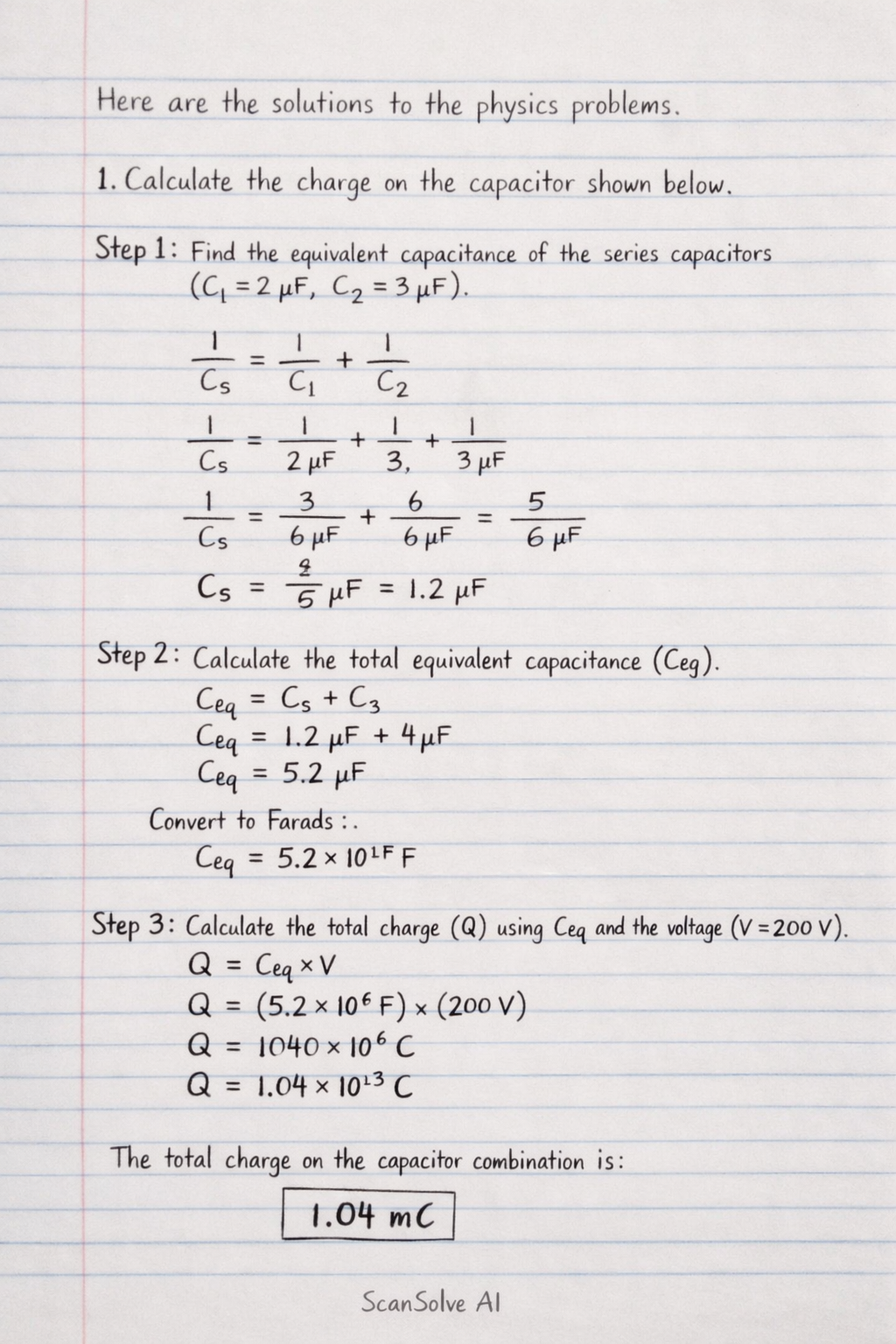
Here are the solutions to the physics problems. 1. Calculate the charge on the capacitor shown below. Step 1: Calculate the equivalent capacitance of the two capacitors in series (C_1 = 2 F, C_2 = 3 F). (1)/(C_s) = (1)/(C_1) + (1)/(C_2) (1)/(C_s) = (1)/(2 F) + (1)/(3 F) (1)/(C_s) = (3)/(6 F) + (2)/(6 F) = (5)/(6 F) C_s = (6)/(5) F = 1.2 F Step 2: Calculate the total equivalent capacitance (C_eq) by adding the series capacitance (C_s) to the parallel capacitor (C_3 = 4 F). C_eq = C_s + C_3 C_eq = 1.2 F + 4 F = 5.2 F Convert to Farads: C_eq = 5.2 × 10^-6 F Step 3: Calculate the total charge (Q) using the total equivalent capacitance and the supply voltage (V = 200 V). Q = C_eq × V Q = (5.2 × 10^-6 F) × (200 V) Q = 1040 × 10^-6 C Q = 1.04 × 10^-3 C The total charge on the capacitor combination is 1.04 mC. 2. A motor powered by a 240V Main supply requires a current of 30A to lift a load of mass 3 Tonnes at the rate of 5M/Minute. Calculate the: Given: Voltage (V) = 240 V Current (I) = 30 A Mass (m) = 3 Tonnes = 3 × 1000 kg = 3000 kg Velocity (v) = 5 M/Minute = 5 m60 s = (1)/(12) m/s Acceleration due to gravity (g) = 9.8 m/s^2 a) Power input Step 1: Use the formula for electrical power input. P_in = V × I P_in = 240 V × 30 A P_in = 7200 W The power input is 7200 W. b) Power output Step 1: Calculate the force required to lift the load (weight). F = m × g F = 3000 kg × 9.8 m/s^2 = 29400 N Step 2: Calculate the power output using the force and velocity. P_out = F × v P_out = 29400 N × (1)/(12) m/s P_out = 2450 W The power output is 2450 W. c) Overall efficiency Step 1: Use the formula for efficiency. = P_outP_in × 100\% = 2450 W7200 W × 100\% ≈ 0.34027 × 100\% ≈ 34.03\% The overall efficiency is 34.03\%. 3. a) State 3 factors that affect the rate of evaporation. • Temperature: A higher temperature increases the kinetic energy of liquid molecules, allowing more to escape the surface. • Surface area: A larger surface area exposes more liquid molecules to the air, increasing the rate of evaporation. • Air movement (wind): Wind carries away evaporated vapor molecules, reducing the concentration of vapor above the liquid and thus increasing the evaporation rate. • Humidity: Lower humidity (drier air) allows more water vapor to escape into the atmosphere. b) State two differences and one similarity between evaporation and boiling. Differences: 1. Temperature: Evaporation occurs at all temperatures below the boiling point, while boiling occurs at a specific, constant temperature (the boiling point). 2. Location: Evaporation occurs only at the surface of the liquid, whereas boiling occurs throughout the bulk of the liquid, forming bubbles. Similarity: 1. Both evaporation and boiling are processes of phase change where a liquid turns into a gas (vaporization). c) Calculate the quantity of heat required to change 0.50 kg of ice at -10°C completely into steam at 100°C. Given: Mass (m) = 0.50 kg Specific heat capacity of ice (c_ice) = 2100 J/kg/K Specific heat capacity of water (c_water) = 4200 J/kg/K Specific latent heat of fusion of ice (L_f) = 3.36 × 10^5 J/kg Specific latent heat of vaporization of steam (L_v) = 2.26 × 10^6 J/kg The process involves four stages: Step 1: Heat required to raise the temperature of ice from -10°C to 0°C (Q_1). Q_1 = m × c_ice × T_ice Q_1 = 0.50 kg × 2100 J/kg/K × (0 - (-10)) K Q_1 = 0.50 × 2100 × 10 J = 10500 J Step 2: Heat required to melt the ice at 0°C into water at 0°C (Q_2). Q_2 = m × L_f Q_2 = 0.50 kg × (3.36 × 10^5 J/