We read your photo as:

A) Given matrix P = 7 & 9 11 & 8 .

Mathematics

ScanSolve AI Answer

Answer

a

(71198)\begin{pmatrix} 7 & 11 \\ 9 & 8 \end{pmatrix}

Step-by-step solution

7 steps

Part a

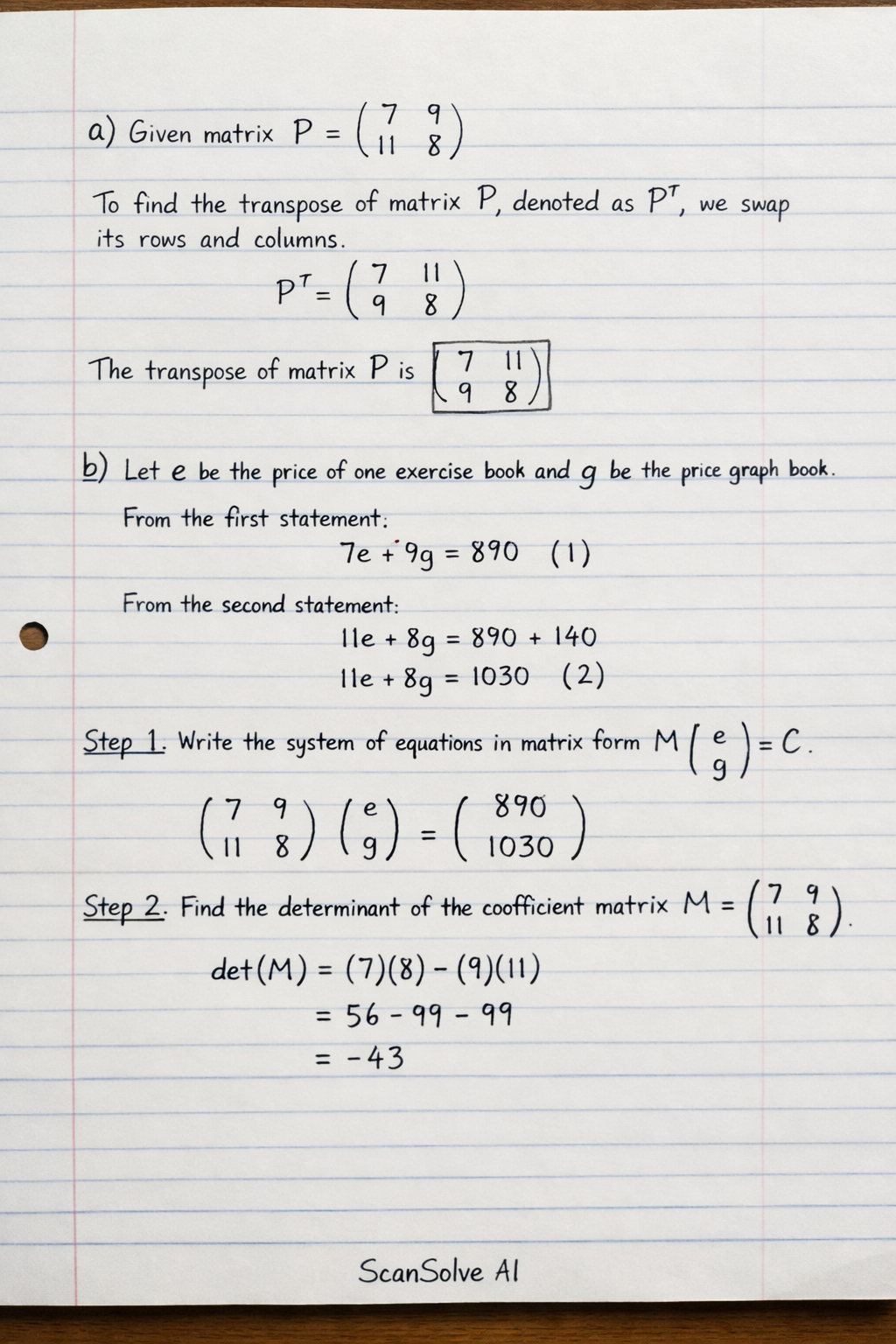
Given matrix P=(79118)P = \begin{pmatrix} 7 & 9 \\ 11 & 8 \end{pmatrix}.

To find the transpose of matrix PP, denoted as PTP^T, we swap its rows and columns.

PT=(71198)P^T = \begin{pmatrix} 7 & 11 \\ 9 & 8 \end{pmatrix}

The transpose of matrix P is (71198)\boxed{\begin{pmatrix} 7 & 11 \\ 9 & 8 \end{pmatrix}}.

Part b· 4 steps

Let ee be the price of one exercise book and gg be the price of one graph book.

From the first statement: Nesta bought 7 exercise books and 9 graph books for Kshs 890.

7e+9g=890(1)7e + 9g = 890 \quad (1)

From the second statement: If she bought 11 exercise books and 8 graph books, she would pay Kshs 140 more than 890.

11e+8g=890+14011e + 8g = 890 + 140 11e+8g=1030(2)11e + 8g = 1030 \quad (2)
  1. Write the system of equations in matrix form M(eg)=CM \begin{pmatrix} e \\ g \end{pmatrix} = C.

    (79118)(eg)=(8901030)\begin{pmatrix} 7 & 9 \\ 11 & 8 \end{pmatrix} \begin{pmatrix} e \\ g \end{pmatrix} = \begin{pmatrix} 890 \\ 1030 \end{pmatrix}
  2. Find the determinant of the coefficient matrix M=(79118)M = \begin{pmatrix} 7 & 9 \\ 11 & 8 \end{pmatrix}.

    det⁡(M)=(7)(8)−(9)(11)=56−99=−43\det(M) = (7)(8) - (9)(11) = 56 - 99 = -43
  3. Find the inverse of the coefficient matrix M−1M^{-1}.

    M−1=1det⁡(M)(8−9−117)=1−43(8−9−117)M^{-1} = \frac{1}{\det(M)} \begin{pmatrix} 8 & -9 \\ -11 & 7 \end{pmatrix} = \frac{1}{-43} \begin{pmatrix} 8 & -9 \\ -11 & 7 \end{pmatrix}
  4. Multiply M−1M^{-1} by the constant matrix CC to find (eg)\begin{pmatrix} e \\ g \end{pmatrix}.

    (eg)=1−43(8−9−117)(8901030)\begin{pmatrix} e \\ g \end{pmatrix} = \frac{1}{-43} \begin{pmatrix} 8 & -9 \\ -11 & 7 \end{pmatrix} \begin{pmatrix} 890 \\ 1030 \end{pmatrix} (eg)=1−43((8)(890)+(−9)(1030)(−11)(890)+(7)(1030))\begin{pmatrix} e \\ g \end{pmatrix} = \frac{1}{-43} \begin{pmatrix} (8)(890) + (-9)(1030) \\ (-11)(890) + (7)(1030) \end{pmatrix} (eg)=1−43(7120−9270−9790+7210)\begin{pmatrix} e \\ g \end{pmatrix} = \frac{1}{-43} \begin{pmatrix} 7120 - 9270 \\ -9790 + 7210 \end{pmatrix} (eg)=1−43(−2150−2580)\begin{pmatrix} e \\ g \end{pmatrix} = \frac{1}{-43} \begin{pmatrix} -2150 \\ -2580 \end{pmatrix} e=−2150−43=50e = \frac{-2150}{-43} = 50 g=−2580−43=60g = \frac{-2580}{-43} = 60

    The price of one exercise book is Kshs. 50 and the price of one graph book is Kshs. 60.

Part c· 3 steps

Step 1: Calculate the new price of an exercise book at shop B.

The price of an exercise book at shop B is 18% cheaper than in shop A.
Price of exercise book in shop A (eAe_A) = Kshs 50.
Price of exercise book in shop B (eBe_B) = eA×(1−0.18)=50×0.82=41e_A \times (1 - 0.18) = 50 \times 0.82 = 41 Kshs.

  1. Calculate the new price of a graph book at shop B.

    The price of a graph book at shop B is 5% higher than in shop A.
    Price of graph book in shop A (gAg_A) = Kshs 60.
    Price of graph book in shop B (gBg_B) = gA×(1+0.05)=60×1.05=63g_A \times (1 + 0.05) = 60 \times 1.05 = 63 Kshs.

  2. Calculate the total cost if Nesta bought the items from shop B.

    Nesta bought 7 exercise books and 9 graph books.
    Cost at shop B = (7×eB)+(9×gB)(7 \times e_B) + (9 \times g_B)
    Cost at shop B = (7×41)+(9×63)(7 \times 41) + (9 \times 63)
    Cost at shop B = 287+567=854287 + 567 = 854 Kshs.

  3. Calculate the amount of money she would have saved.

    Original cost at shop A = Kshs 890.
    Amount saved = Original cost at shop A - Cost at shop B
    Amount saved = 890−854=36890 - 854 = 36 Kshs.
    The amount of money she would have saved is Kshs. 36.

Was this helpful?

Try one yourself

A new problem that tests the same skill.

Still stuck on this one?

Ask a follow-up, and the answer starts from this question.

Got a different question?Ask your own question
Handwritten step-by-step solution preview

Handwritten Step-by-Step Solution

Get this as a handwritten image on WhatsApp — like a tutor wrote it for you.

Try on WhatsApp