
We read your photo as:
Solve the following word problems: 2.1 My friends my friend travelled 2 1/2 km to the party and my siblings travelled 2500m to the same party. Who travelled the furthest? 2.2 Round off to the nearest kilometer. 2.2.1 1km and 750m = km 2.2.2 5km and 320m = km 2.3 Complete the table below.
ScanSolve AI Answer
Step-by-step solution
9 stepsPart 2.1· 3 steps
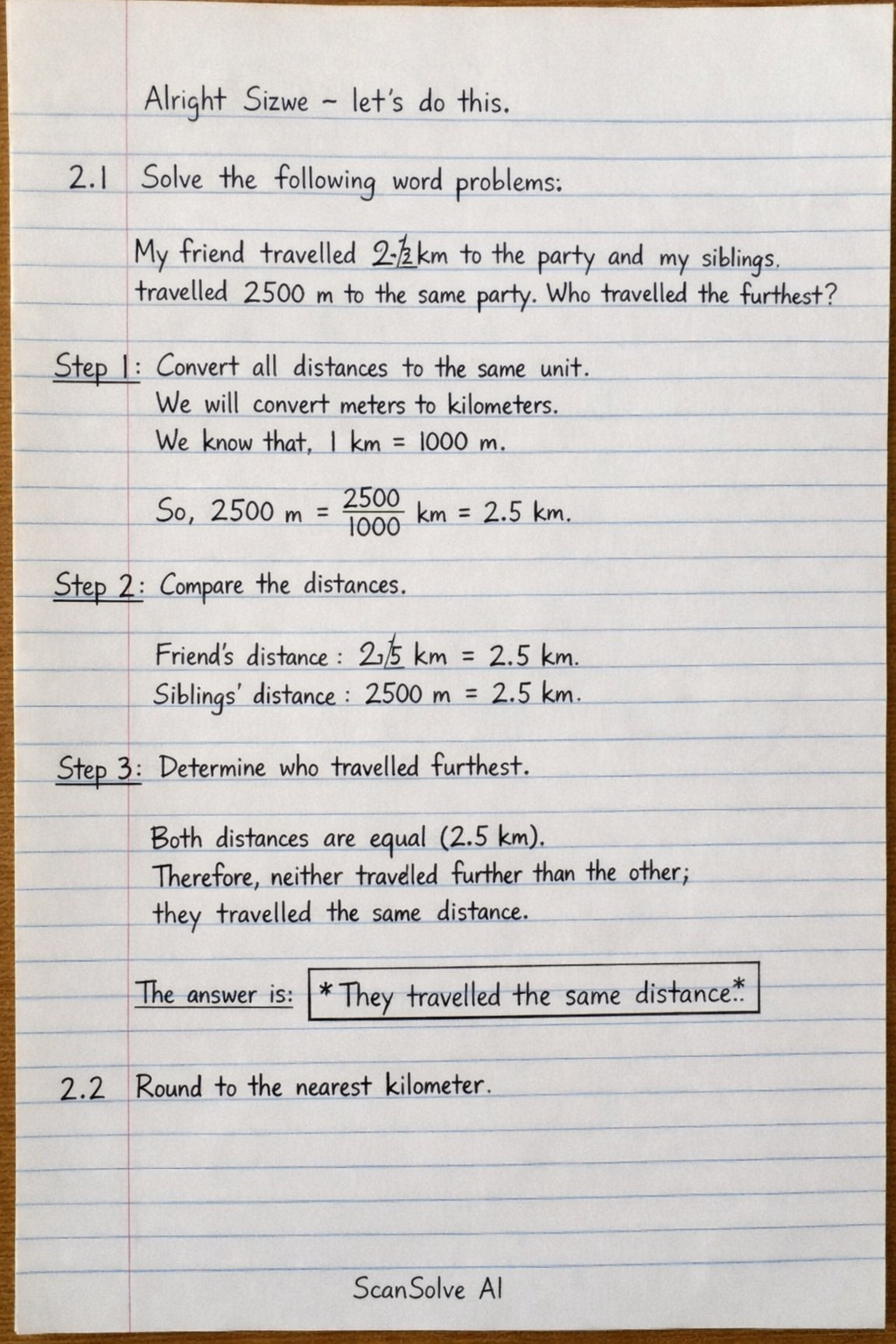
Solve the following word problems.
My friend travelled km to the party and my siblings travelled 2500 m to the same party. Who travelled the furthest?
Convert all distances to the same unit.
We will convert meters to kilometers.
We know that 1 km m.
So, 2500 m km km.Compare the distances.
Friend's distance: km km.
Siblings' distance: 2500 m km.Determine who travelled furthest.
Both distances are equal (2.5 km).
Therefore, neither travelled further than the other; they travelled the same distance.The answer is
Part 2.2· 6 steps
Round to the nearest kilometer.
- 2.2.1 1 km and 750 m = ____ km
Convert meters to kilometers.
750 m $= \frac{750}{1000}$ km $= 0.75$ km.Add the kilometers together.
1 km $+ 0.75$ km $= 1.75$ km.Round to the nearest kilometer.
Since the decimal part (0.75) is 0.5 or greater, round up.
1.75 km rounded to the nearest kilometer is 2 km.
The answer is- 2.2.2 8 km and 320 m = ____ km
Convert meters to kilometers.
320 m $= \frac{320}{1000}$ km $= 0.32$ km.Add the kilometers together.
8 km $+ 0.32$ km $= 8.32$ km.Round to the nearest kilometer.
Since the decimal part (0.32) is less than 0.5, round down.
8.32 km rounded to the nearest kilometer is 8 km.
The answer is
Part 2.3
Complete the table below.
Assuming "sidi number of" refers to the number of sides (for 2D shapes) or edges (for 3D shapes), and "ved flate cur" refers to the number of vertices.
| Shape | Number of sides/edges | Number of vertices |
|---|---|---|
| Hexagon | (2.3.1) | (2.3.4) |
| Cone | (2.3.5) | (2.3.6) |
- For the Hexagon (a 2D shape):
- It has 6 sides.
- It has 6 vertices (corners).
- For the Cone (a 3D shape):
- It has 1 edge (the circular base).
- It has 1 vertex (the apex or point).
Still stuck on this one?
Ask a follow-up, and the answer starts from this question.
More Mathematics Questions
Handwritten Step-by-Step Solution
Get this as a handwritten image on WhatsApp — like a tutor wrote it for you.
Try on WhatsApp