
We read your photo as:
Using the provided distance-time graph, determine the time taken to travel the following distances: a) 100 km b) 500 km c) 800 km d) 750 km e) 300 km f) 250 km
ScanSolve AI Answer
Step-by-step solution
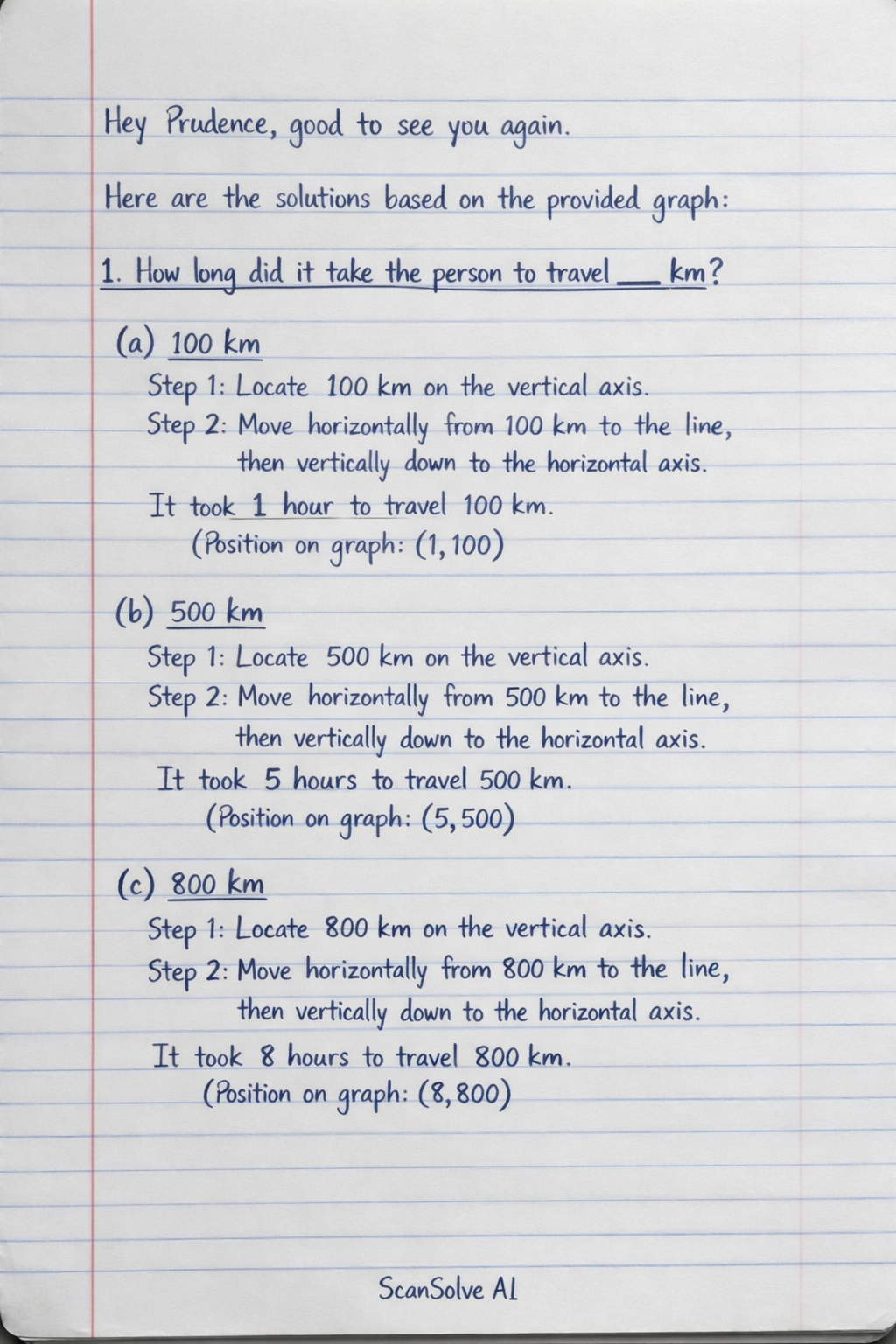
27 stepsHere are the solutions based on the provided graph:
1. How long did it take the person to travel ___ km?
a) 100 km
Locate 100 km on the vertical (distance) axis.
Move horizontally from 100 km to the line on the graph, then vertically down to the horizontal (time) axis.
It took 1 hour to travel 100 km. (Position on graph: (1, 100))
b) 500 km
Locate 500 km on the vertical axis.
Move horizontally from 500 km to the line, then vertically down to the horizontal axis.
It took 5 hours to travel 500 km. (Position on graph: (5, 500))
c) 800 km
Locate 800 km on the vertical axis.
Move horizontally from 800 km to the line, then vertically down to the horizontal axis.
It took 8 hours to travel 800 km. (Position on graph: (8, 800))
d) 750 km
Locate 750 km (halfway between 700 km and 800 km) on the vertical axis.
Move horizontally from 750 km to the line, then vertically down to the horizontal axis.
It took 7.5 hours (or 7 hours 30 minutes) to travel 750 km. (Position on graph: (7.5, 750))
e) 300 km
Locate 300 km on the vertical axis.
Move horizontally from 300 km to the line, then vertically down to the horizontal axis.
It took 3 hours to travel 300 km. (Position on graph: (3, 300))
f) 250 km
Locate 250 km (halfway between 200 km and 300 km) on the vertical axis.
Move horizontally from 250 km to the line, then vertically down to the horizontal axis.
It took 2.5 hours (or 2 hours 30 minutes) to travel 250 km. (Position on graph: (2.5, 250))
2. How far did the person travel in:
a) 1 hour
Locate 1 hour on the horizontal (time) axis.
Move vertically up from 1 hour to the line on the graph, then horizontally to the vertical (distance) axis.
The person traveled 100 km in 1 hour. (Position on graph: (1, 100))
b) 1 hour 30 minutes
Convert 1 hour 30 minutes to 1.5 hours.
Locate 1.5 hours on the horizontal axis.
Move vertically up from 1.5 hours to the line, then horizontally to the vertical axis.
The person traveled 150 km in 1 hour 30 minutes. (Position on graph: (1.5, 150))
c) 3 hours
Locate 3 hours on the horizontal axis.
Move vertically up from 3 hours to the line, then horizontally to the vertical axis.
The person traveled 300 km in 3 hours. (Position on graph: (3, 300))
d) 4 hours 30 minutes
Convert 4 hours 30 minutes to 4.5 hours.
Locate 4.5 hours on the horizontal axis.
Move vertically up from 4.5 hours to the line, then horizontally to the vertical axis.
The person traveled 450 km in 4 hours 30 minutes. (Position on graph: (4.5, 450))
e) 5 hours
Locate 5 hours on the horizontal axis.
Move vertically up from 5 hours to the line, then horizontally to the vertical axis.
The person traveled 500 km in 5 hours. (Position on graph: (5, 500))
f) 2 hours 30 minutes
Convert 2 hours 30 minutes to 2.5 hours.
Locate 2.5 hours on the horizontal axis.
Move vertically up from 2.5 hours to the line, then horizontally to the vertical axis.
The person traveled 250 km in 2 hours 30 minutes. (Position on graph: (2.5, 250))
How long will it take to travel 275 km?
Determine the speed from the graph.
The graph shows 1000 km traveled in 10 hours.
Use the speed to calculate the time needed to travel 275 km.
Convert the decimal part of the hours to minutes.
It will take 2 hours 45 minutes to travel 275 km.
Still stuck on this one?
Ask a follow-up, and the answer starts from this question.
More Mathematics Questions
Handwritten Step-by-Step Solution
Get this as a handwritten image on WhatsApp — like a tutor wrote it for you.
Try on WhatsApp