
We read your photo as:
Estimate the percentage of water consumption for domestic use if one person uses 100 liters/day and a family of 5 people uses 400 liters/day.
ScanSolve AI Answer
Answer
Step-by-step solution
4 stepsIdentify the given information.
Let the two forces be and .
Let the resultant force be .
Given:- The resultant force .
- One of the forces, let's call it .
- The resultant is at right angles () to the smaller force.
Apply the condition that the resultant is perpendicular to one of the forces.
Let's assume is the smaller force. This means the angle between the resultant and is .
When the resultant of two forces is perpendicular to one of the forces, a right-angled triangle is formed by the three forces. The larger of the two original forces () acts as the hypotenuse, and the resultant () and the smaller force () act as the two legs.
Therefore, we can use the Pythagorean theorem:Substitute the given values and solve for the unknown force.
We have and .
Simplify the result and verify the assumption.
To simplify :
Now, let's verify our assumption that is the smaller force.
.
. Since is approximately 3.606, .
Since , our assumption that is the smaller force is correct.The other force is .
Try one yourself
A new problem that tests the same skill.
Still stuck on this one?
Ask a follow-up, and the answer starts from this question.
More Mathematics Questions
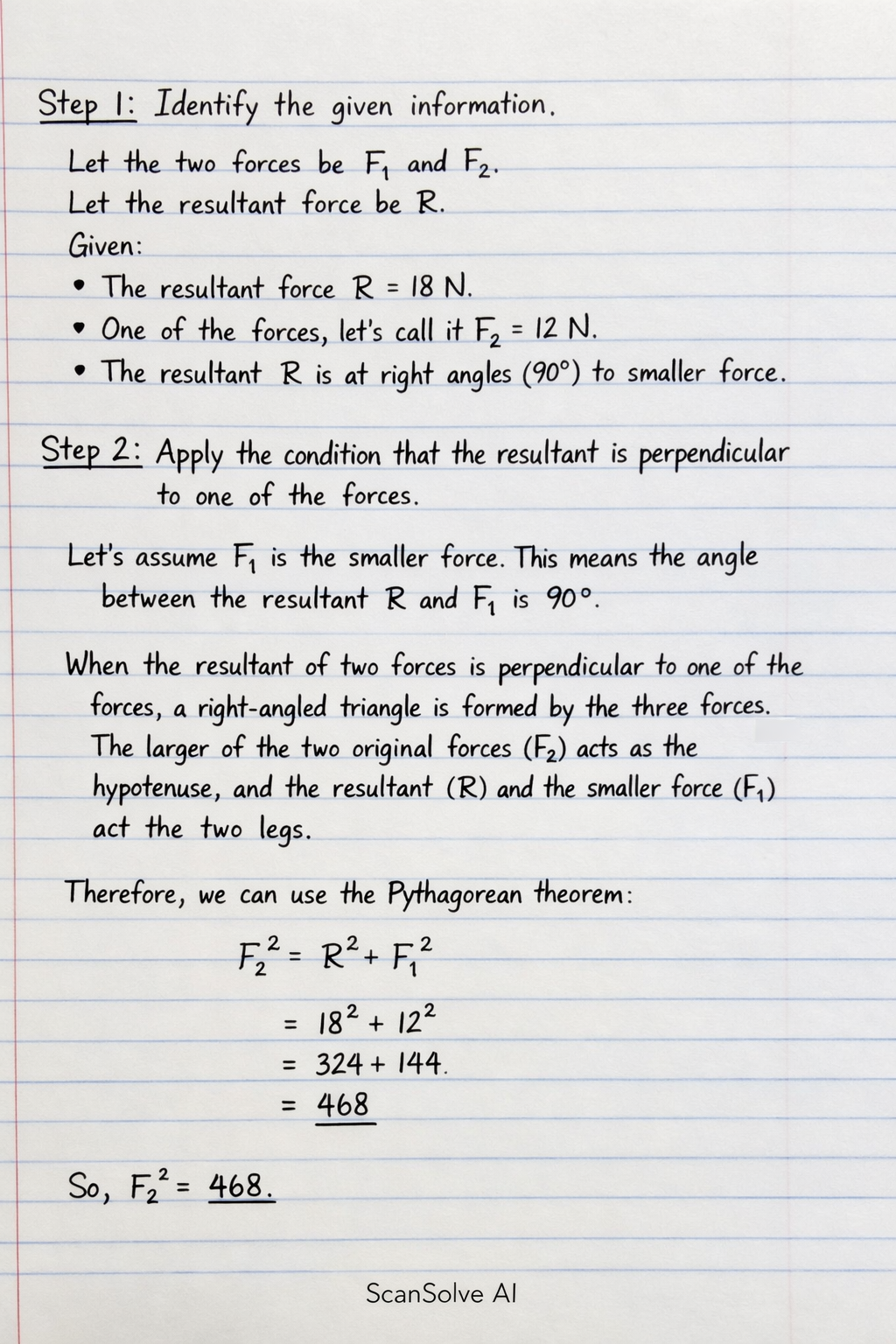
Handwritten Step-by-Step Solution
Get this as a handwritten image on WhatsApp — like a tutor wrote it for you.
Try on WhatsApp