We read your photo as:

Calculate the exact value of tan(15 degrees).

Mathematics

ScanSolve AI Answer

Answer

tan⁡(15∘)=2−3\tan(15^\circ) = 2 - \sqrt{3}

Step-by-step solution

4 steps
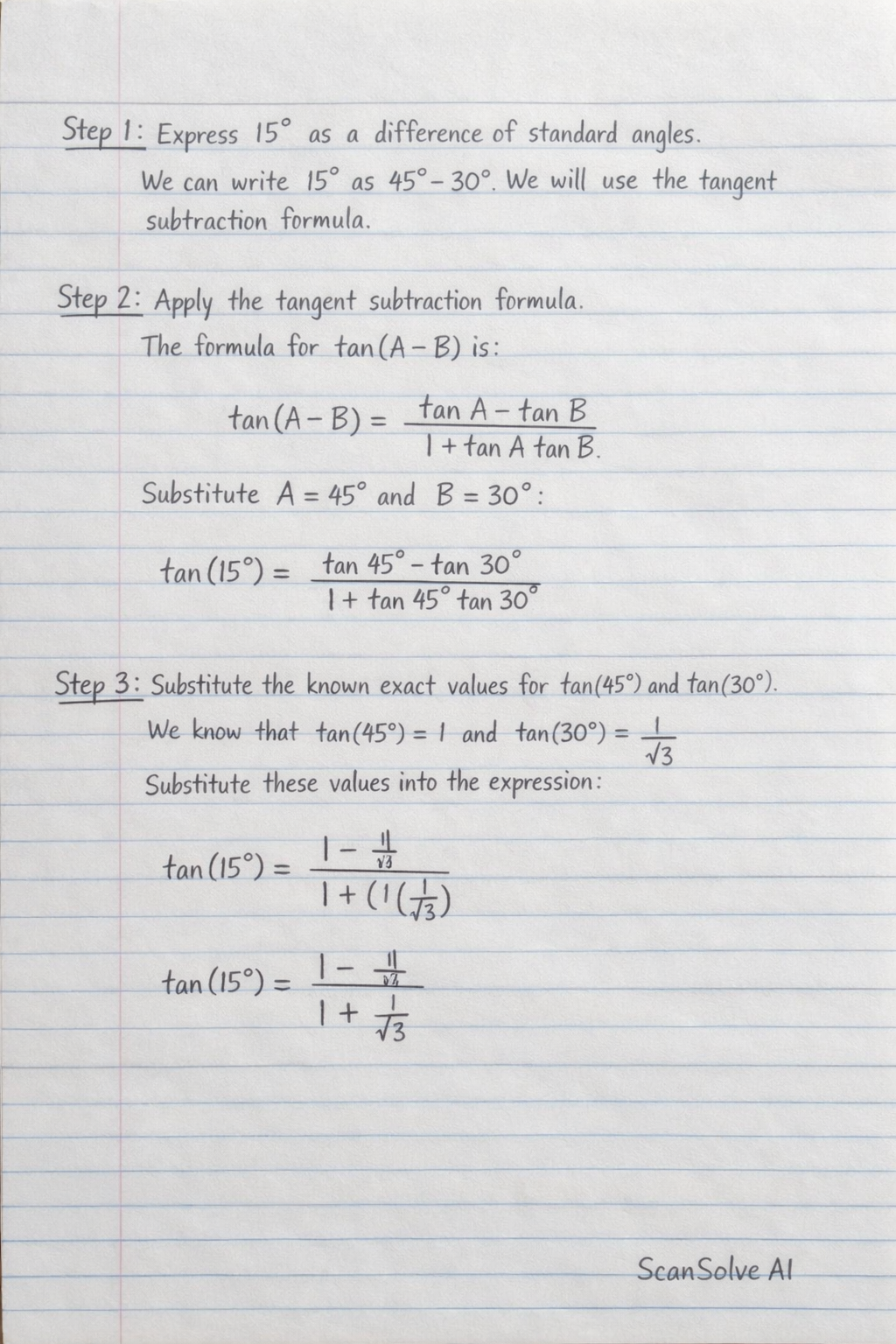
  1. Express 15∘15^\circ as a difference of standard angles.

    We can write 15∘15^\circ as 45∘−30∘45^\circ - 30^\circ. We will use the tangent subtraction formula.

  2. Apply the tangent subtraction formula.

    The formula for tan⁡(A−B)\tan(A - B) is:

    tan⁡(A−B)=tan⁡A−tan⁡B1+tan⁡Atan⁡B\tan(A - B) = \frac{\tan A - \tan B}{1 + \tan A \tan B}

    Substitute A=45∘A = 45^\circ and B=30∘B = 30^\circ:

    tan⁡(15∘)=tan⁡(45∘−30∘)=tan⁡(45∘)−tan⁡(30∘)1+tan⁡(45∘)tan⁡(30∘)\tan(15^\circ) = \tan(45^\circ - 30^\circ) = \frac{\tan(45^\circ) - \tan(30^\circ)}{1 + \tan(45^\circ) \tan(30^\circ)}
  3. Substitute the known exact values for tan⁡(45∘)\tan(45^\circ) and tan⁡(30∘)\tan(30^\circ).

    We know that tan⁡(45∘)=1\tan(45^\circ) = 1 and tan⁡(30∘)=13\tan(30^\circ) = \frac{1}{\sqrt{3}}.
    Substitute these values into the expression:

    tan⁡(15∘)=1−131+(1)(13)\tan(15^\circ) = \frac{1 - \frac{1}{\sqrt{3}}}{1 + (1) \left(\frac{1}{\sqrt{3}}\right)} tan⁡(15∘)=1−131+13\tan(15^\circ) = \frac{1 - \frac{1}{\sqrt{3}}}{1 + \frac{1}{\sqrt{3}}}
  4. Simplify the expression by rationalizing the denominator.

    To simplify, multiply the numerator and the denominator by 3\sqrt{3}:

    tan⁡(15∘)=3(1−13)3(1+13)\tan(15^\circ) = \frac{\sqrt{3}\left(1 - \frac{1}{\sqrt{3}}\right)}{\sqrt{3}\left(1 + \frac{1}{\sqrt{3}}\right)} tan⁡(15∘)=3−13+1\tan(15^\circ) = \frac{\sqrt{3} - 1}{\sqrt{3} + 1}

    Now, rationalize the denominator by multiplying the numerator and denominator by the conjugate of the denominator, which is (3−1)(\sqrt{3} - 1):

    tan⁡(15∘)=(3−1)(3−1)(3+1)(3−1)\tan(15^\circ) = \frac{(\sqrt{3} - 1)(\sqrt{3} - 1)}{(\sqrt{3} + 1)(\sqrt{3} - 1)}

    Expand the numerator and denominator:
    Numerator: (3−1)2=(3)2−2(3)(1)+(1)2=3−23+1=4−23(\sqrt{3} - 1)^2 = (\sqrt{3})^2 - 2(\sqrt{3})(1) + (1)^2 = 3 - 2\sqrt{3} + 1 = 4 - 2\sqrt{3}
    Denominator: (3+1)(3−1)=(3)2−(1)2=3−1=2(\sqrt{3} + 1)(\sqrt{3} - 1) = (\sqrt{3})^2 - (1)^2 = 3 - 1 = 2
    Substitute these back into the expression:

    tan⁡(15∘)=4−232\tan(15^\circ) = \frac{4 - 2\sqrt{3}}{2}

    Factor out 2 from the numerator:

    tan⁡(15∘)=2(2−3)2\tan(15^\circ) = \frac{2(2 - \sqrt{3})}{2}

    Cancel out the 2 in the numerator and denominator:

    tan⁡(15∘)=2−3\tan(15^\circ) = 2 - \sqrt{3}

    Thus, we have shown that tan⁡(15∘)=2−3\tan(15^\circ) = 2 - \sqrt{3}.

Was this helpful?

Try one yourself

A new problem that tests the same skill.

Still stuck on this one?

Ask a follow-up, and the answer starts from this question.

Got a different question?Ask your own question
Handwritten step-by-step solution preview

Handwritten Step-by-Step Solution

Get this as a handwritten image on WhatsApp — like a tutor wrote it for you.

Try on WhatsApp