
![Expand (2\[sqrt(2)] - 3\[sqrt(4)])5](/_next/image?url=https%3A%2F%2Fohijasnjvprzodcmxltt.supabase.co%2Fstorage%2Fv1%2Fobject%2Fpublic%2Fwhatsapp-images%2F1774635661767-10e4c9e915eeec31.png&w=3840&q=75)
This mathematics problem involves applying core mathematical principles and formulas. Below you will find a complete step-by-step solution with detailed explanations for each step, helping you understand not just the answer but the method behind it.
ScanSolve AI Answer
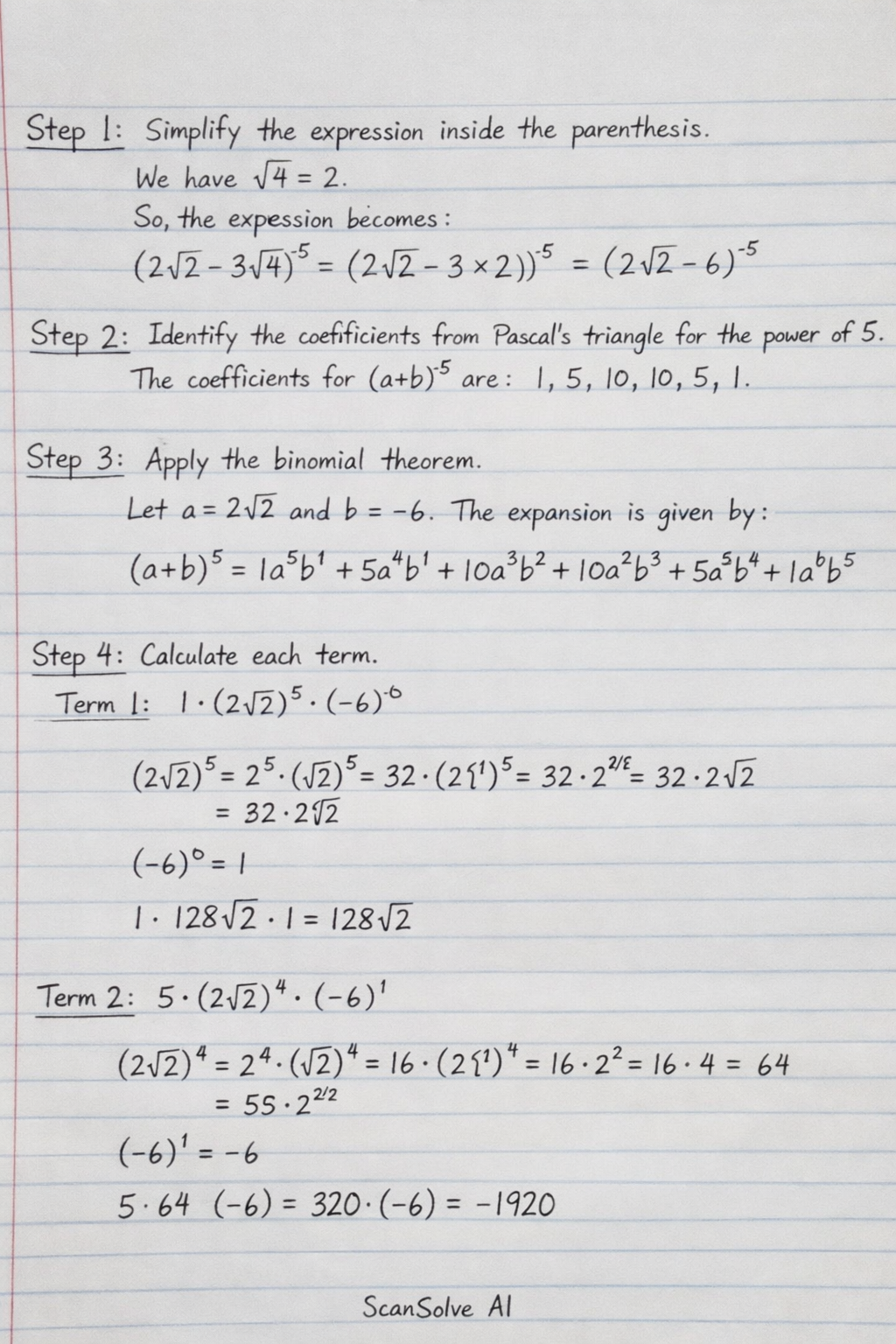
Step 1: Simplify the expression inside the parenthesis. We have sqrt(4) = 2. So, the expression becomes: (2sqrt(2) - 3sqrt(4))^5 = (2sqrt(2) - 3 × 2)^5 = (2sqrt(2) - 6)^5 Step 2: Identify the coefficients from Pascal's triangle for the power of 5. The coefficients for (a+b)^5 are 1, 5, 10, 10, 5, 1. Step 3: Apply the binomial theorem. Let a = 2sqrt(2) and b = -6. The expansion is given by: (a+b)^5 = 1a^5b^0 + 5a^4b^1 + 10a^3b^2 + 10a^2b^3 + 5a^1b^4 + 1a^0b^5 Step 4: Calculate each term. Term 1: 1 · (2sqrt(2))^5 · (-6)^0 (2sqrt(2))^5 = 2^5 · (sqrt(2))^5 = 32 · (2^1/2)^5 = 32 · 2^5/2 = 32 · 2^2 · sqrt(2) = 32 · 4 · sqrt(2) = 128sqrt(2) (-6)^0 = 1 1 · 128sqrt(2) · 1 = 128sqrt(2) Term 2: 5 · (2sqrt(2))^4 · (-6)^1 (2sqrt(2))^4 = 2^4 · (sqrt(2))^4 = 16 · (2^1/2)^4 = 16 · 2^2 = 16 · 4 = 64 (-6)^1 = -6 5 · 64 · (-6) = 320 · (-6) = -1920 Term 3: 10 · (2sqrt(2))^3 · (-6)^2 (2sqrt(2))^3 = 2^3 · (sqrt(2))^3 = 8 · (2^1/2)^3 = 8 · 2^3/2 = 8 · 2 · sqrt(2) = 16sqrt(2) (-6)^2 = 36 10 · 16sqrt(2) · 36 = 160sqrt(2) · 36 = 5760sqrt(2) Term 4: 10 · (2sqrt(2))^2 · (-6)^3 (2sqrt(2))^2 = 2^2 · (sqrt(2))^2 = 4 · 2 = 8 (-6)^3 = -216 10 · 8 · (-216) = 80 · (-216) = -17280 Term 5: 5 · (2sqrt(2))^1 · (-6)^4 (2sqrt(2))^1 = 2sqrt(2) (-6)^4 = 1296 5 · 2sqrt(2) · 1296 = 10sqrt(2) · 1296 = 12960sqrt(2) Term 6: 1 · (2sqrt(2))^0 · (-6)^5 (2sqrt(2))^0 = 1 (-6)^5 = -7776 1 · 1 · (-7776) = -7776 Step 5: Sum all the terms. Combine terms with sqrt(2): 128sqrt(2) + 5760sqrt(2) + 12960sqrt(2) = (128 + 5760 + 12960)sqrt(2) = 18848sqrt(2) Combine constant terms: -1920 - 17280 - 7776 = -26976 The expanded form is the sum of these combined terms. 18848sqrt(2) - 26976