

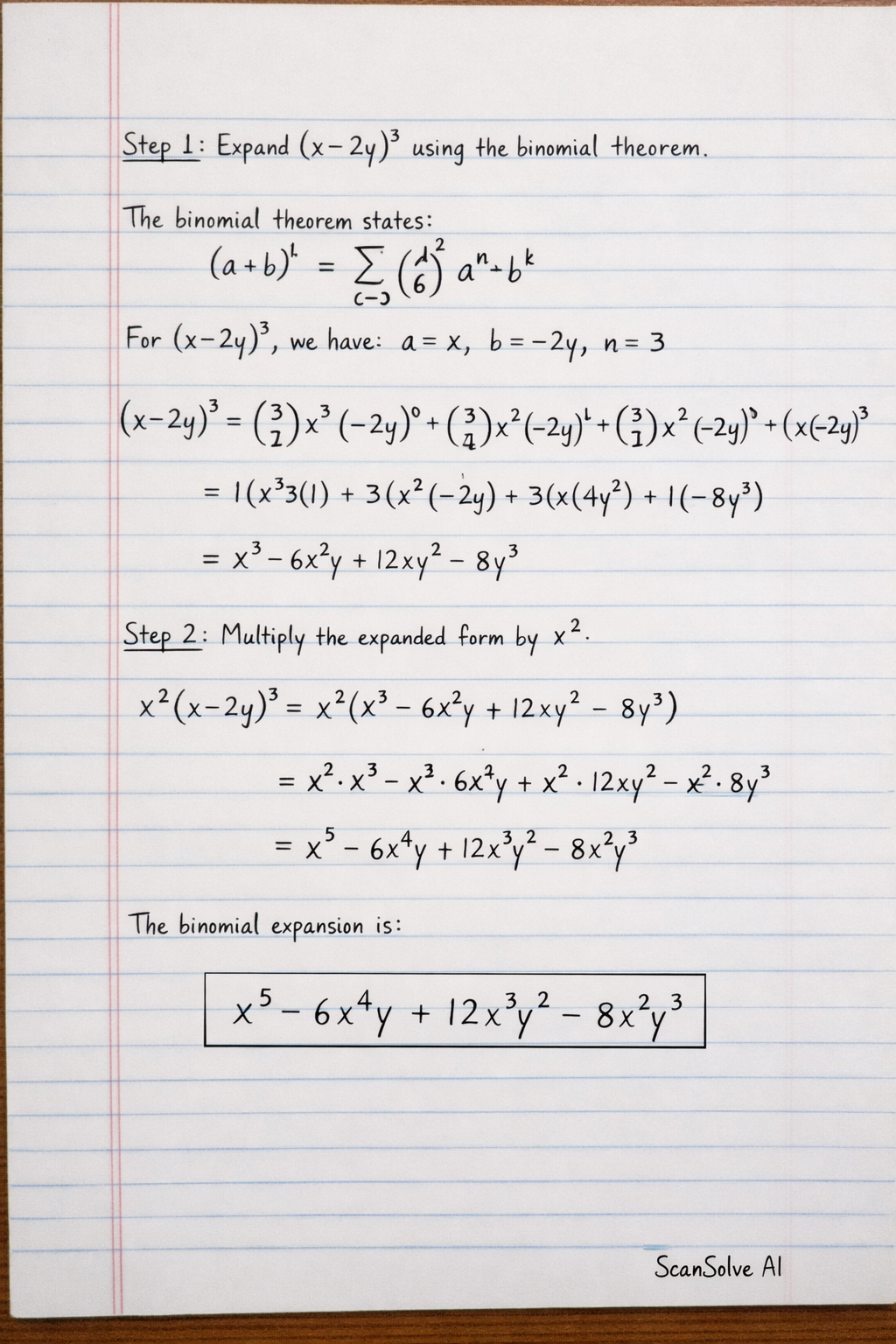
This mathematics problem involves applying core mathematical principles and formulas. Below you will find a complete step-by-step solution with detailed explanations for each step, helping you understand not just the answer but the method behind it.
ScanSolve AI Answer
Step 1: Expand (x-2y)^3 using the binomial theorem. The binomial theorem states that (a+b)^n = _k=0^n nk a^n-k b^k. For (x-2y)^3, we have a=x, b=-2y, and n=3. (x-2y)^3 = 30x^3(-2y)^0 + 31x^2(-2y)^1 + 32x^1(-2y)^2 + 33x^0(-2y)^3 = (1)x^3(1) + (3)x^2(-2y) + (3)x(4y^2) + (1)(1)(-8y^3) = x^3 - 6x^2y + 12xy^2 - 8y^3 Step 2: Multiply the expanded form by x^2. x^2(x-2y)^3 = x^2(x^3 - 6x^2y + 12xy^2 - 8y^3) = x^2 · x^3 - x^2 · 6x^2y + x^2 · 12xy^2 - x^2 · 8y^3 = x^5 - 6x^4y + 12x^3y^2 - 8x^2y^3 The binomial expansion is: x^5 - 6x^4y + 12x^3y^2 - 8x^2y^3 Step 1: Write the general term for the expansion of (x - (3)/(x))^4. The general term T_r+1 in the expansion of (a+b)^n is given by T_r+1 = nr a^n-r b^r. Here, a=x, b=-(3)/(x) = -3x^-1, and n=4. T_r+1 = 4r (x)^4-r (-3x^-1)^r T_r+1 = 4r x^4-r (-3)^r (x^-1)^r T_r+1 = 4r (-3)^r x^4-r-r T_r+1 = 4r (-3)^r x^4-2r Step 2: Find the value of r for the term independent of x. For the term independent of x, the power of x must be 0. 4-2r = 0 2r = 4 r = 2 Step 3: Substitute r=2 into the general term formula. T_2+1 = T_3 = 42 (-3)^2 x^4-2(2) T_3 = (4!)/(2!(4-2)!) (9) x^0 T_3 = (4 × 3 × 2 × 1)/((2 × 1)(2 × 1)) × 9 × 1 T_3 = (24)/(4) × 9 T_3 = 6 × 9 T_3 = 54 The term independent of x is: 54 Step 1: Use the binomial series expansion formula for (1+x)^n. The binomial series expansion is given by (1+x)^n = 1 + nx + (n(n-1))/(2!)x^2 + (n(n-1)(n-2))/(3!)x^3 + . For (1-y)^(1)/(3), we have x=-y and n=(1)/(3). Step 2: Calculate the first term. The first term is 1. Step 3: Calculate the second term. nx = ((1)/(3))(-