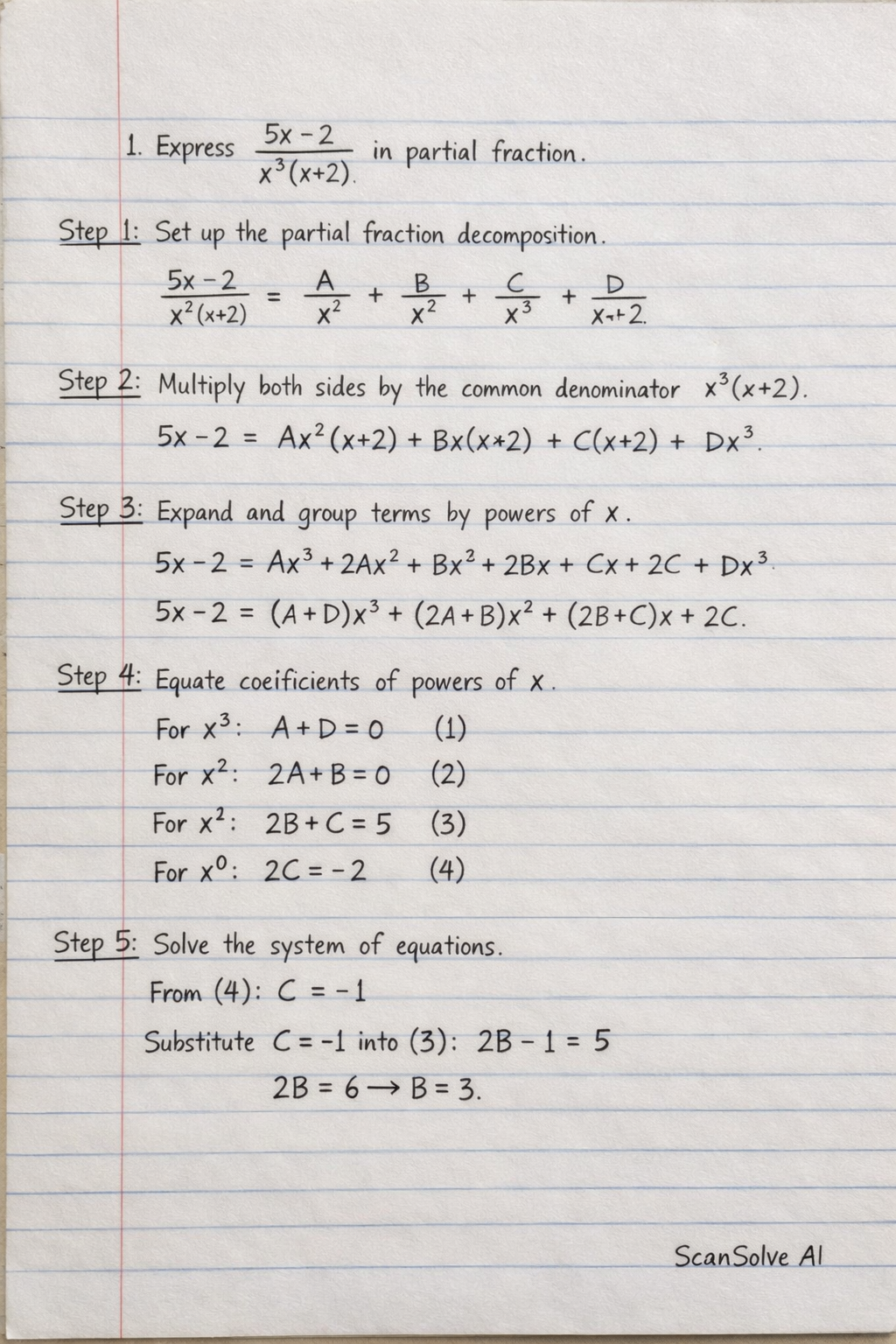
1. Express x3(x+2)5x−2 in partial fraction.
Step 1: Set up the partial fraction decomposition.
The denominator has a repeated linear factor x3 and a distinct linear factor (x+2).
x3(x+2)5x−2=xA+x2B+x3C+x+2D
Step 2: Multiply both sides by the common denominator x3(x+2).
5x−2=Ax2(x+2)+Bx(x+2)+C(x+2)+Dx3
Step 3: Expand the right side and group terms by powers of x.
5x−2=A(x3+2x2)+B(x2+2x)+C(x+2)+Dx35x−2=Ax3+2Ax2+Bx2+2Bx+Cx+2C+Dx35x−2=(A+D)x3+(2A+B)x2+(2B+C)x+2C
Step 4: Equate coefficients of corresponding powers of x.
For x3: A+D=0(1)
For x2: 2A+B=0(2)
For x1: 2B+C=5(3)
For x0 (constant): 2C=−2(4)
Step 5: Solve the system of equations.
From (4): C=−1.
Substitute C=−1 into (3): 2B+(−1)=5⟹2B=6⟹B=3.
Substitute B=3 into (2): 2A+3=0⟹2A=−3⟹A=−23.
Substitute A=−23 into (1): −23+D=0⟹D=23.
Step 6: Write the partial fraction decomposition.
x3(x+2)5x−2=x−23+x23+x3−1+x+223x3(x+2)5x−2=−2x3+x23−x31+2(x+2)3
The final answer is −2x3+x23−x31+2(x+2)3.
2. Integrate ∫x3(x+2)5x−2dx.
Step 1: Use the partial fraction decomposition from the previous problem.
∫x3(x+2)5x−2dx=∫(−2x3+x23−x31+2(x+2)3)dx
Step 2: Integrate each term.
Recall that ∫xndx=n+1xn+1+K for n=−1, and ∫x1dx=ln∣x∣+K.
∫−2x3dx=−23ln∣x∣∫x23dx=∫3x−2dx=3−1x−1=−x3∫−x31dx=∫−x−3dx=−−2x−2=2x21∫2(x+2)3dx=23ln∣x+2∣
Step 3: Combine the results and add the constant of integration K.
−23ln∣x∣−x3+2x21+23ln∣x+2∣+K
This can be rewritten using logarithm properties lna−lnb=lnba:
23(ln∣x+2∣−ln∣x∣)−x3+2x21+K23lnxx+2−x3+2x21+K
The final answer is 23lnxx+2−x3+2x21+K.
3. Solve x−1x+1≥2.
Step 1: Move all terms to one side to get a single fraction.
x−1x+1−2≥0
Step 2: Find a common denominator and combine the terms.
x−1x+1−x−12(x−1)≥0x−1x+1−(2x−2)≥0x−1x+1−2x+2≥0x−1−x+3≥0
Step 3: Identify the critical points where the numerator or denominator is zero.
Numerator: −x+3=0⟹x=3
Denominator: x−1=0⟹x=1
Note that x=1 because the denominator cannot be zero.
Step 4: Test intervals defined by the critical points (−∞,1), (1,3], and [3,∞).
• For x<1 (e.g., x=0): 0−1−0+3=−13=−3. This is not ≥0.
• For 1<x≤3 (e.g., x=2): 2−1−2+3=11=1. This is ≥0. So, this interval is part of the solution.
• For x>3 (e.g., x=4): 4−1−4+3=3−1. This is not ≥0.
Step 5: Write the solution.
The inequality holds for 1<x≤3.
The final answer is 1<x≤3.
What's next?
Was this helpful?
Need help with your own homework?
Get instant step-by-step solutions to any question. Free to start.
This mathematics problem involves applying core mathematical principles and formulas. Below you will find a complete step-by-step solution with detailed explanations for each step, helping you understand not just the answer but the method behind it.
ScanSolve AI Answer
Fresh day Modestine, let's solve. Here are the solutions to your questions: 1. Express (5x-2)/(x^3(x+2)) in partial fraction. Step 1: Set up the partial fraction decomposition. The denominator has a repeated linear factor x^3 and a distinct linear factor (x+2). (5x-2)/(x^3(x+2)) = (A)/(x) + (B)/(x^2) + (C)/(x^3) + (D)/(x+2) Step 2: Multiply both sides by the common denominator x^3(x+2). 5x-2 = A x^2(x+2) + B x(x+2) + C(x+2) + D x^3 Step 3: Expand the right side and group terms by powers of x. 5x-2 = A(x^3+2x^2) + B(x^2+2x) + C(x+2) + D x^3 5x-2 = Ax^3+2Ax^2 + Bx^2+2Bx + Cx+2C + Dx^3 5x-2 = (A+D)x^3 + (2A+B)x^2 + (2B+C)x + 2C Step 4: Equate coefficients of corresponding powers of x. For x^3: A+D = 0 (1) For x^2: 2A+B = 0 (2) For x^1: 2B+C = 5 (3) For x^0 (constant): 2C = -2 (4) Step 5: Solve the system of equations. From (4): C = -1. Substitute C=-1 into (3): 2B + (-1) = 5 2B = 6 B = 3. Substitute B=3 into (2): 2A + 3 = 0 2A = -3 A = -(3)/(2). Substitute A=-(3)/(2) into (1): -(3)/(2) + D = 0 D = (3)/(2). Step 6: Write the partial fraction decomposition. (5x-2)/(x^3(x+2)) = (-3)/(2)x + (3)/(x^2) + (-1)/(x^3) + (3)/(2)x+2 (5x-2)/(x^3(x+2)) = -(3)/(2x) + (3)/(x^2) - (1)/(x^3) + (3)/(2(x+2)) The final answer is -(3)/(2x) + (3)/(x^2) - (1)/(x^3) + (3)/(2(x+2)). 2. Integrate (5x-2)/(x^3(x+2))\,dx. Step 1: Use the partial fraction decomposition from the previous problem. (5x-2)/(x^3(x+2))\,dx = (-(3)/(2x) + (3)/(x^2) - (1)/(x^3) + (3)/(2(x+2)))\,dx Step 2: Integrate each term. Recall that x^n\,dx = x^n+1n+1 + K for n -1, and (1)/(x)\,dx = |x| + K. -(3)/(2x)\,dx = -(3)/(2)|x| (3)/(x^2)\,dx = 3x^-2\,dx = 3x^-1-1 = -(3)/(x) -(1)/(x^3)\,dx = -x^-3\,dx = -x^-2-2 = (1)/(2x^2) (3)/(2(x+2))\,dx = (3)/(2)|x+2| Step 3: Combine the results and add the constant of integration K. -(3)/(2)|x| - (3)/(x) + (1)/(2x^2) + (3)/(2)|x+2| + K This can be rewritten using logarithm properties a - b = (a)/(b): (3)/(2)(|x+2| - |x|) - (3)/(x) + (1)/(2x^2) + K (3)/(2)|(x+2)/(x)| - (3)/(x) + (1)/(2x^2) + K The final answer is (3)/(2)|(x+2)/(x)| - (3)/(x) + (1)/(2x^2) + K. 3. Solve (x+1)/(x-1) 2. Step 1: Move all terms to one side to get a single fraction. (x+1)/(x-1) - 2 0 Step 2: Find a common denominator and combine the terms. (x+1)/(x-1) - (2(x-1))/(x-1) 0 (x+1 - (2x-2))/(x-1) 0 (x+1 - 2x + 2)/(x-1) 0 (-x+3)/(x-1) 0 Step 3: Identify the critical points where the numerator or denominator is zero. Numerator: -x+3 = 0 x = 3 Denominator: x-1 = 0 x = 1 Note that x 1 because the denominator cannot be zero. Step 4: Test intervals defined by the critical points (-, 1), (1, 3], and [3, ). • For x < 1 (e.g., x=0): (-0+3)/(0-1) = (3)/(-1) = -3. This is not 0. • For 1 < x 3 (e.g., x=2): (-2+3)/(2-1) = (1)/(1) = 1. This is 0. So, this interval is part of the solution. • For x > 3 (e.g., x=4): (-4+3)/(4-1) = (-1)/(3). This is not 0. Step 5: Write the solution. The inequality holds for 1 < x 3. The final answer is 1 < x 3. What's next?