

This mathematics problem involves applying core mathematical principles and formulas. Below you will find a complete step-by-step solution with detailed explanations for each step, helping you understand not just the answer but the method behind it.
ScanSolve AI Answer
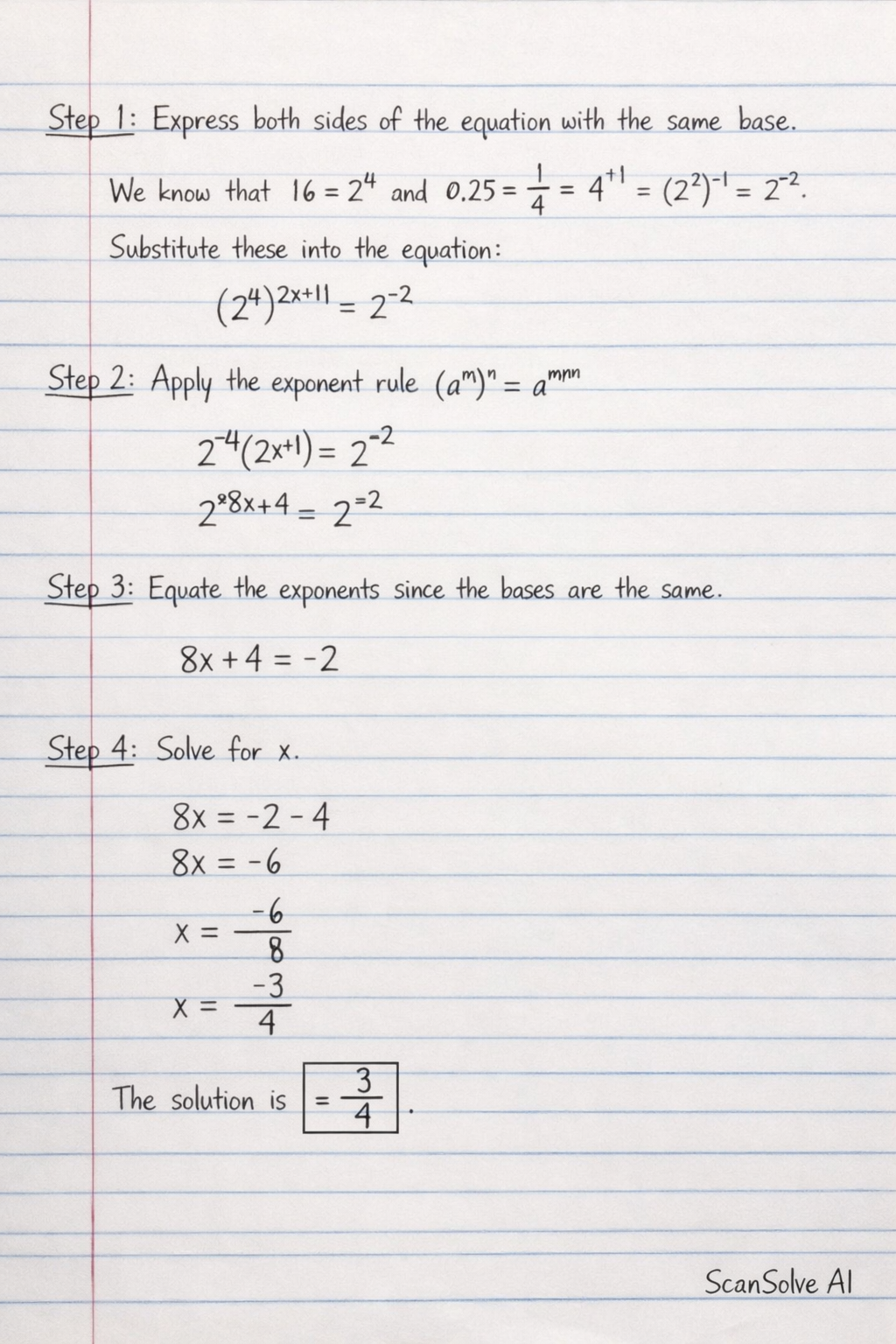
Step 1: Express both sides of the equation with the same base. We know that 16 = 2^4 and 0.25 = (1)/(4) = 4^-1 = (2^2)^-1 = 2^-2. Substitute these into the equation: (2^4)^2x+1 = 2^-2 Step 2: Apply the exponent rule (a^m)^n = a^mn. 2^4(2x+1) = 2^-2 2^8x+4 = 2^-2 Step 3: Equate the exponents since the bases are the same. 8x+4 = -2 Step 4: Solve for x. 8x = -2 - 4 8x = -6 x = (-6)/(8) x = -(3)/(4) The solution is -(3)/(4). Step 1: Evaluate the numerator. The numerator is (3)/(7) + 1(5)/(7) ÷ (4)/(7) of 2(1)/(3). Convert mixed numbers to improper fractions: 1(5)/(7) = (1 × 7 + 5)/(7) = (12)/(7) 2(1)/(3) = (2 × 3 + 1)/(3) = (7)/(3) Now, calculate "of" (multiplication): (4)/(7) of 2(1)/(3) = (4)/(7) × (7)/(3) = (4)/(3) Next, perform the division: (12)/(7) ÷ (4)/(3) = (12)/(7) × (3)/(4) = (36)/(28) = (9)/(7) Finally, perform the addition: (3)/(7) + (9)/(7) = (12)/(7) So, the Numerator is (12)/(7). Step 2: Evaluate the denominator. The denominator is (1(3)/(7) - (5)/(8)) × (2)/(3). Convert the mixed number to an improper fraction: 1(3)/(7) = (1 × 7 + 3)/(7) = (10)/(7) Perform the subtraction inside the parenthesis: (10)/(7) - (5)/(8) = (10 × 8)/(7 × 8) - (5 × 7)/(8 × 7) = (80)/(56) - (35)/(56) = (45)/(56) Next, perform the multiplication: (45)/(56) × (2)/(3) = (45 × 2)/(56 × 3) = (90)/(168) Simplify the fraction by dividing by common factors (e.g., 6): (90 ÷ 6)/(168 ÷ 6) = (15)/(28) So, the Denominator is (15)/(28). Step 3: Divide the Numerator by the Denominator. (12)/(7)(15)/(28) = (12)/(7) ÷ (15)/(28) = (12)/(7) × (28)/(15) = (12 × 28)/(7 × 15) Simplify by canceling common factors (7 with 28, and 3 with 12 and 15): = (4 × 4)/(1 × 5) = (16)/(5) The value is (16)/(5) or 3.2. Step 1: Simplify (1+sqrt(3))(1-sqrt(3)). This is in the form (a+b)(a-b) = a^2 - b^2. Here, a=1 and b=sqrt(3). (1+sqrt(3))(1-sqrt(3)) = 1^2 - (sqrt(3))^2 = 1 - 3 = -2 The simplified expression is -2. Step 2: Evaluate (1)/(1+sqrt(3)) to 3 significant figures. First, rationalize the denominator by multiplying the numerator and denominator by the conjugate of the denominator, which is (1-sqrt(3)). (1)/(1+sqrt(3)) = (1)/(1+sqrt(3)) × 1-sqrt(3)1-sqrt(3) = 1-sqrt(3)(1+sqrt(3))(1-sqrt(3)) Using the result from Step 1 for the denominator: = 1-sqrt(3)-2 Substitute the given value sqrt(3) = 1.7321: = (1 - 1.7321)/(-2) = (-0.7321)/(-2) = 0.36605 Round the result to 3 significant figures: The first three significant figures are 3, 6, 6. The next digit is 0, so we round down. 0.366 The evaluated expression is 0.366. The question asks to "Determine:" for a line passing through points A (1, 3) and B (3, 7). We will determine the gradient and the equation of the line. a) Determine the gradient of the line. Step 1: Identify the coordinates of the points. Let (x_1, y_1) = (1, 3) and (x_2, y_2) = (3, 7). Step 2: Use the gradient formula m = (y_2 - y_1)/(x_2 - x_1). m = (7 - 3)/(3 - 1) m = (4)/(2) m = 2 The gradient of the line is 2. b) Determine the equation of the line. Step 1: Use the point-slope form of a linear equation, y - y_1 = m(x - x_1). We have the gradient m=2 and can use point A (1, 3). y - 3 = 2(x - 1) Step 2: Simplify the equation to the slope-intercept form y = mx + c. y - 3 = 2x - 2 y = 2x - 2 + 3 y = 2x + 1 The equation of the line is y = 2x + 1.