
We read your photo as:
Express the following in the form a+bi: -1, 1+i, -5-12i, 3-4i, -2(sqrt(3)-i).
ScanSolve AI Answer
Step-by-step solution
27 stepsHere are the solutions to your complex numbers problems.
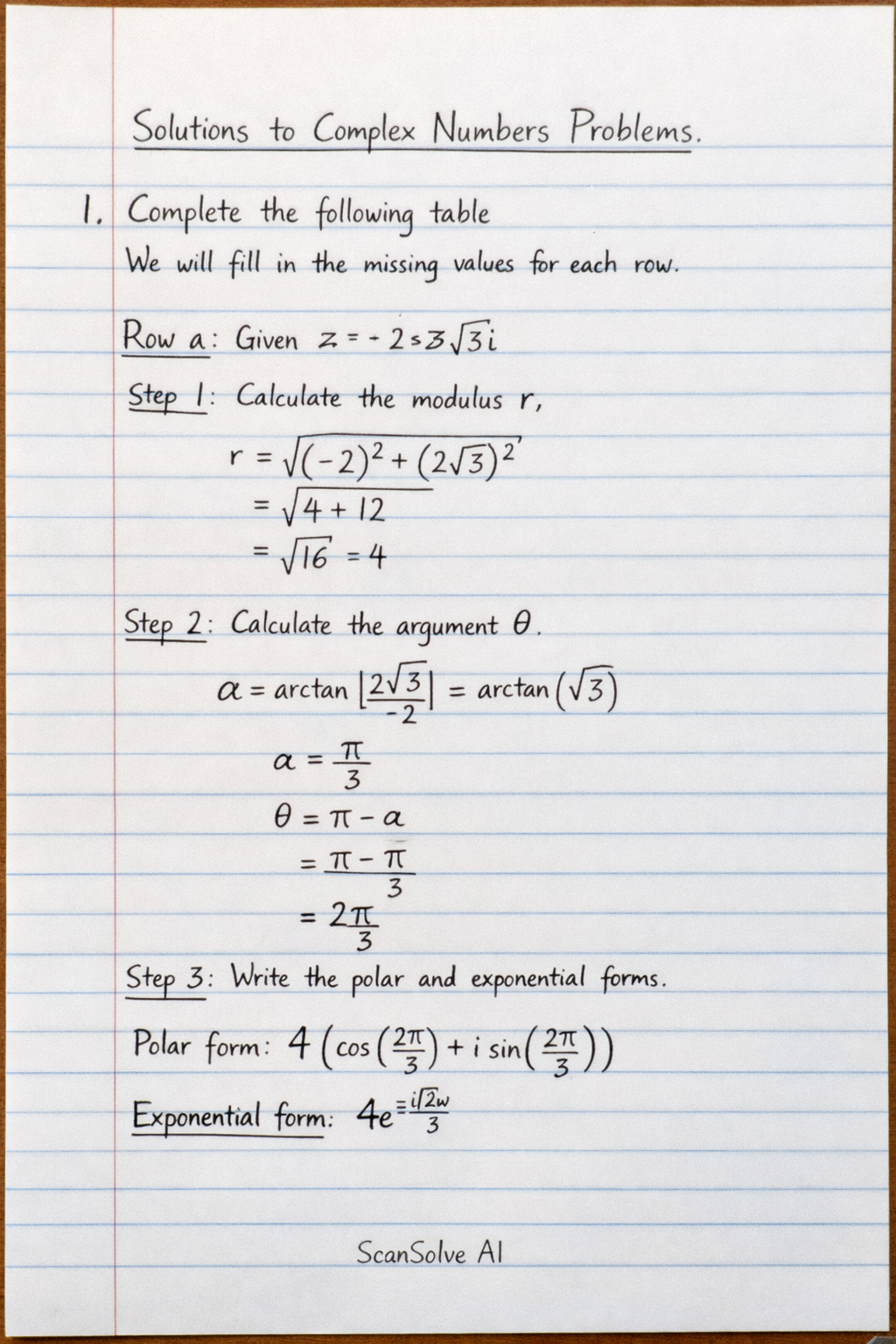
1. Complete the following table
We will fill in the missing values for each row.
- Row a: Given
Calculate the modulus .
$$ r = \sqrt{(-2)^2 + (2\sqrt{3})^2} = \sqrt{4 + 12} = \sqrt{16} = 4 $$Calculate the argument .
The number is in the second quadrant.
Write the polar and exponential forms.
$$ \text{Polar form: } 4\left(\cos\left(\frac{2\pi}{3}\right) + i\sin\left(\frac{2\pi}{3}\right)\right) $$ $$ \text{Exponential form: } 4e^{i\frac{2\pi}{3}} $$- Row b: Given modulus and argument
Calculate the rectangular form .
$$ x = r\cos\theta = 3\cos\left(-\frac{5\pi}{4}\right) = 3\left(-\frac{\sqrt{2}}{2}\right) = -\frac{3\sqrt{2}}{2} $$ $$ y = r\sin\theta = 3\sin\left(-\frac{5\pi}{4}\right) = 3\left(\frac{\sqrt{2}}{2}\right) = \frac{3\sqrt{2}}{2} $$ $$ \text{Rectangular form: } -\frac{3\sqrt{2}}{2} + \frac{3\sqrt{2}}{2}i $$Write the polar and exponential forms.
$$ \text{Polar form: } 3\left(\cos\left(-\frac{5\pi}{4}\right) + i\sin\left(-\frac{5\pi}{4}\right)\right) $$ $$ \text{Exponential form: } 3e^{-i\frac{5\pi}{4}} $$- Row c: Given polar form
Identify the modulus and argument.
$$ r = 6 $$ $$ \theta = \frac{\pi}{6} $$Calculate the rectangular form .
$$ x = r\cos\theta = 6\cos\left(\frac{\pi}{6}\right) = 6\left(\frac{\sqrt{3}}{2}\right) = 3\sqrt{3} $$ $$ y = r\sin\theta = 6\sin\left(\frac{\pi}{6}\right) = 6\left(\frac{1}{2}\right) = 3 $$ $$ \text{Rectangular form: } 3\sqrt{3} + 3i $$Write the exponential form.
$$ \text{Exponential form: } 6e^{i\frac{\pi}{6}} $$- Row d: Given exponential form
Identify the modulus and argument.
$$ r = \pi $$ $$ \theta = \frac{\pi}{2} $$Calculate the rectangular form .
$$ x = r\cos\theta = \pi\cos\left(\frac{\pi}{2}\right) = \pi(0) = 0 $$ $$ y = r\sin\theta = \pi\sin\left(\frac{\pi}{2}\right) = \pi(1) = \pi $$ $$ \text{Rectangular form: } \pi i $$Write the polar form.
$$ \text{Polar form: } \pi\left(\cos\left(\frac{\pi}{2}\right) + i\sin\left(\frac{\pi}{2}\right)\right) $$Here is the completed table:
2. Express the following in the form with
- a)
Identify .
Calculate the modulus.
Calculate the argument.
Since is on the negative imaginary axis, .
Write in exponential form.
$$ z = \boxed{e^{-i\frac{\pi}{2}}} $$- b)
Identify .
Calculate the modulus.
Calculate the argument.
The number is in the first quadrant.
Write in exponential form.
$$ z = \boxed{\sqrt{2}e^{i\frac{\pi}{4}}} $$- c)
Identify .
Calculate the modulus.
Calculate the argument.
The number is in the third quadrant.
Write in exponential form.
$$ z = \boxed{13e^{i\left(-\pi + \arctan\left(\frac{12}{5}\right)\right)}} $$- d)
Identify .
Calculate the modulus.
Calculate the argument.
The number is in the fourth quadrant.
Write in exponential form.
$$ z = \boxed{5e^{i\left(-\arctan\left(\frac{4}{3}\right)\right)}} $$- e)
Simplify the number.
. This is a real number.
Since , . This is a negative real number.Calculate the modulus.
$$ r = |-2(\sqrt{3} - 1)| = 2(\sqrt{3} - 1) $$Calculate the argument.
For any negative real number, .
Write in exponential form.
$$
z = \boxed{2(\sqrt{3} - 1)e^{i\pi}}
$$
Still stuck on this one?
Ask a follow-up, and the answer starts from this question.
More Mathematics Questions
Handwritten Step-by-Step Solution
Get this as a handwritten image on WhatsApp — like a tutor wrote it for you.
Try on WhatsApp