

This mathematics problem involves applying core mathematical principles and formulas. Below you will find a complete step-by-step solution with detailed explanations for each step, helping you understand not just the answer but the method behind it.
ScanSolve AI Answer
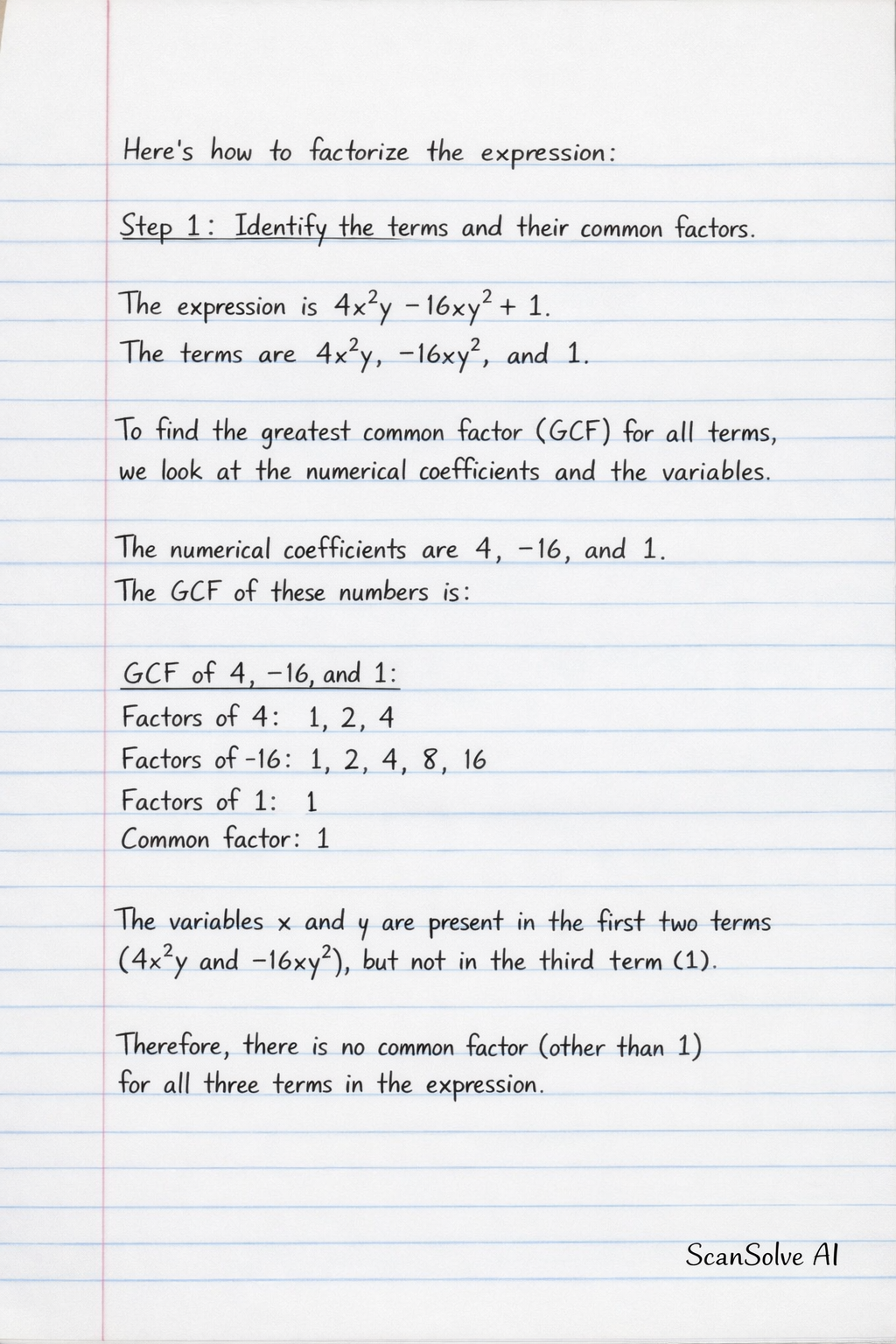
Here's how to factorize the expression: Step 1: Identify the terms and their common factors. The expression is 4x^2y-16xy^2+1. The terms are 4x^2y, -16xy^2, and 1. To find the greatest common factor (GCF) for all terms, we look at the numerical coefficients and the variables. The numerical coefficients are 4, -16, and 1. The GCF of these numbers is 1. The variables x and y are present in the first two terms (4x^2y and -16xy^2), but not in the third term (1). Therefore, there is no common factor (other than 1) for all three terms in the expression. Step 2: Check for other factorization methods. This is a trinomial. We check if it fits common factorization patterns: • It is not a perfect square trinomial because the last term is 1, but the middle term is not 2 · (first term's square root) · (last term's square root). • It is not a difference of squares or sum/difference of cubes, as these apply to binomials. • Factoring by grouping is typically used for four or more terms, or when a common binomial factor can be extracted after grouping. This is not applicable here. Step 3: Conclude on factorability. Since there is no common factor for all terms (other than 1) and the expression does not fit any standard factorization patterns, the expression 4x^2y-16xy^2+1 cannot be factored into simpler polynomials with integer coefficients. The expression cannot be factored over integers. The expression 4x^2y-16xy^2+1 cannot be factored over integers. Send me the next one 📸