Figure Q1 shows an equilateral triangle OPQ, of side 12 cm, and the point S such that OS = PS = QS. The arc PXQ has center O and radius 12 cm. Find the perimeter of the shaded region, giving your answer in terms of π and √3.

Mathematics
Figure Q1 shows an equilateral triangle OPQ, of side 12 cm, and the point S such that OS = PS = QS. The arc PXQ has center O and radius 12 cm. Find the perimeter of the shaded region, giving your answer in terms of π and √3.

ScanSolve AI Answer

Answer

(4π+83)cm*(4\pi + 8\sqrt{3}) cm*

Here's the solution for Question 1:

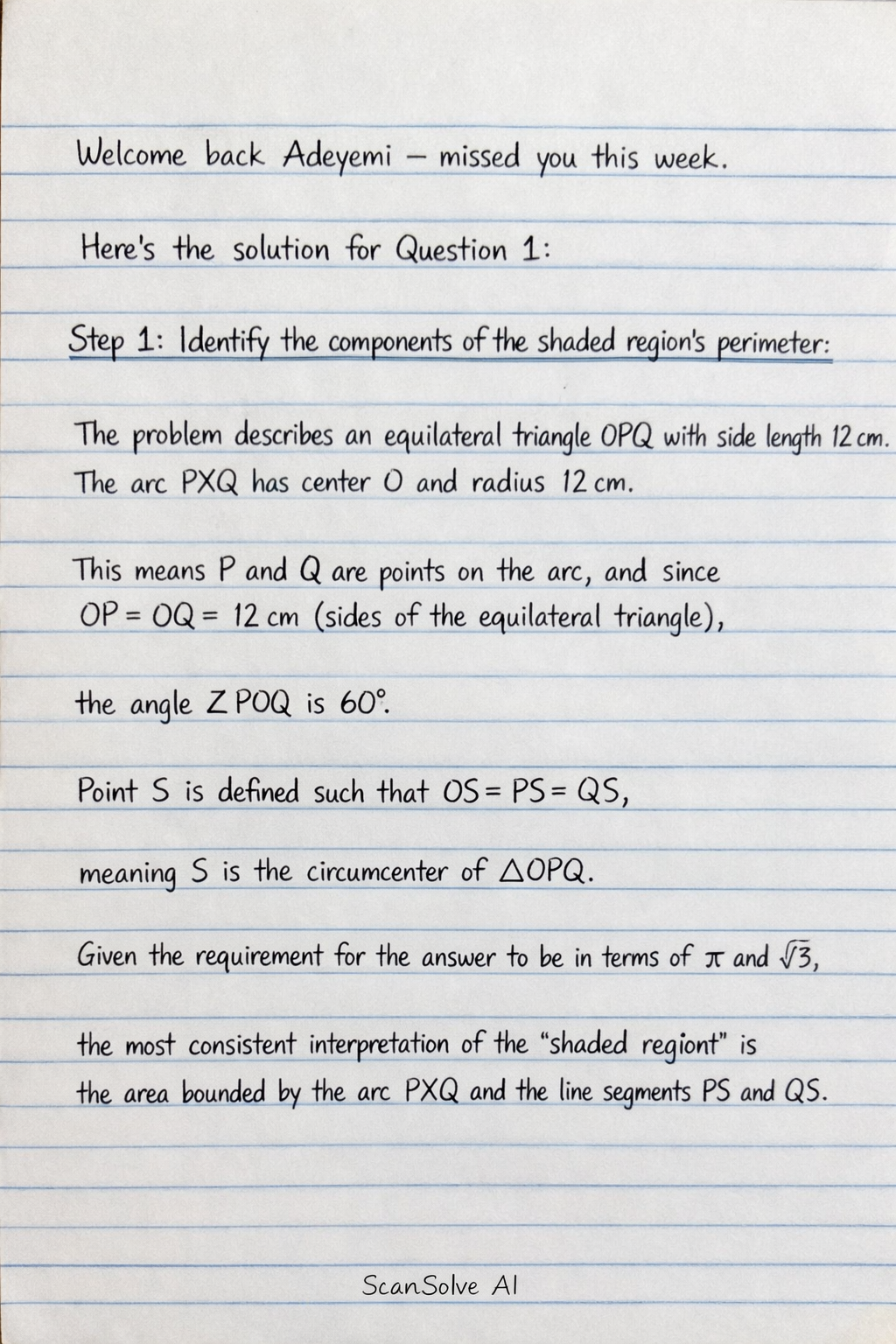
Step 1: Identify the components of the shaded region's perimeter. The problem describes an equilateral triangle OPQ with side length 1212 cm. The arc PXQ has center O and radius 1212 cm. This means P and Q are points on the arc, and since OP = OQ = 1212 cm (sides of the equilateral triangle), the angle POQ\angle POQ is 6060^\circ. Point S is defined such that OS = PS = QS, meaning S is the circumcenter of OPQ\triangle OPQ. Given the requirement for the answer to be in terms of π\pi and 3\sqrt{3}, the most consistent interpretation of the "shaded region" is the area bounded by the arc PXQ and the line segments PS and QS.

Step 2: Calculate the length of arc PXQ. The arc PXQ has center O and radius r=12r = 12 cm. Since OPQ\triangle OPQ is equilateral, the angle POQ\angle POQ subtended by the arc at the center O is 6060^\circ. Convert this angle to radians: θ=60×π180=π3 radians\theta = 60^\circ \times \frac{\pi}{180^\circ} = \frac{\pi}{3} \text{ radians} The length of an arc is given by the formula L=rθL = r\theta. LPXQ=12×π3=4π cmL_{PXQ} = 12 \times \frac{\pi}{3} = 4\pi \text{ cm}

Step 3: Calculate the lengths of segments PS and QS. S is the circumcenter of the equilateral triangle OPQ. The distance from any vertex of an equilateral triangle to its circumcenter is the circumradius, RR. For an equilateral triangle with side length aa, the circumradius is given by R=a3R = \frac{a}{\sqrt{3}}. Here, the side length a=12a = 12 cm. R=123R = \frac{12}{\sqrt{3}} To rationalize the denominator, multiply the numerator and denominator by 3\sqrt{3}: R=1233×3=1233=43 cmR = \frac{12\sqrt{3}}{\sqrt{3} \times \sqrt{3}} = \frac{12\sqrt{3}}{3} = 4\sqrt{3} \text{ cm} Therefore, the lengths of segments PS and QS are both 434\sqrt{3} cm.

Step 4: Calculate the total perimeter of the shaded region. The perimeter of the shaded region is the sum of the arc length and the lengths of the two segments PS and QS. P=LPXQ+PS+QSP = L_{PXQ} + PS + QS P=4π+43+43P = 4\pi + 4\sqrt{3} + 4\sqrt{3} P=(4π+83) cmP = (4\pi + 8\sqrt{3}) \text{ cm}

The perimeter of the shaded region is (4π+83)cm\boxed{*(4\pi + 8\sqrt{3}) cm*}.

Send me the next one 📸

Was this helpful?

Need help with your own homework?

Get instant step-by-step solutions to any question. Free to start.

Ask Your Question
Handwritten step-by-step solution preview

Handwritten Step-by-Step Solution

Get this as a handwritten image on WhatsApp — like a tutor wrote it for you.

Try on WhatsApp

Still have questions?

Quick Answer

Here's the solution for Question 1: Step 1: Identify the components of the shaded region's perimeter.

Figure Q1 shows an equilateral triangle OPQ, of side 12 cm, and the point S such that OS = PS = QS. The arc PXQ has center O and radius 12 cm. Find the perimeter of the shaded region, giving your answer in terms of π and √3.
Mathematics

This mathematics problem involves applying core mathematical principles and formulas. Below you will find a complete step-by-step solution with detailed explanations for each step, helping you understand not just the answer but the method behind it.

ScanSolve AI Answer
Here's the solution for Question 1: Step 1: Identify the components of the shaded region's perimeter. The problem describes an equilateral triangle OPQ with side length 12 cm. The arc PXQ has center O and radius 12 cm. This means P and Q are points on the arc, and since OP = OQ = 12 cm (sides of the equilateral triangle), the angle POQ is 60^. Point S is defined such that OS = PS = QS, meaning S is the circumcenter of OPQ. Given the requirement for the answer to be in terms of and sqrt(3), the most consistent interpretation of the "shaded region" is the area bounded by the arc PXQ and the line segments PS and QS. Step 2: Calculate the length of arc PXQ. The arc PXQ has center O and radius r = 12 cm. Since OPQ is equilateral, the angle POQ subtended by the arc at the center O is 60^. Convert this angle to radians: = 60^ × ()/(180^) = ()/(3) radians The length of an arc is given by the formula L = r. L_PXQ = 12 × ()/(3) = 4 cm Step 3: Calculate the lengths of segments PS and QS. S is the circumcenter of the equilateral triangle OPQ. The distance from any vertex of an equilateral triangle to its circumcenter is the circumradius, R. For an equilateral triangle with side length a, the circumradius is given by R = (a)/(sqrt(3)). Here, the side length a = 12 cm. R = (12)/(sqrt(3)) To rationalize the denominator, multiply the numerator and denominator by sqrt(3): R = 12sqrt(3)sqrt(3) × sqrt(3) = 12sqrt(3)3 = 4sqrt(3) cm Therefore, the lengths of segments PS and QS are both 4sqrt(3) cm. Step 4: Calculate the total perimeter of the shaded region. The perimeter of the shaded region is the sum of the arc length and the lengths of the two segments PS and QS. P = L_PXQ + PS + QS P = 4 + 4sqrt(3) + 4sqrt(3) P = (4 + 8sqrt(3)) cm The perimeter of the shaded region is (4 + 8sqrt(3)) cm. Send me the next one 📸