
We read your photo as:
Fill in the missing fractions and complete the following:
Mathematics
ScanSolve AI Answer
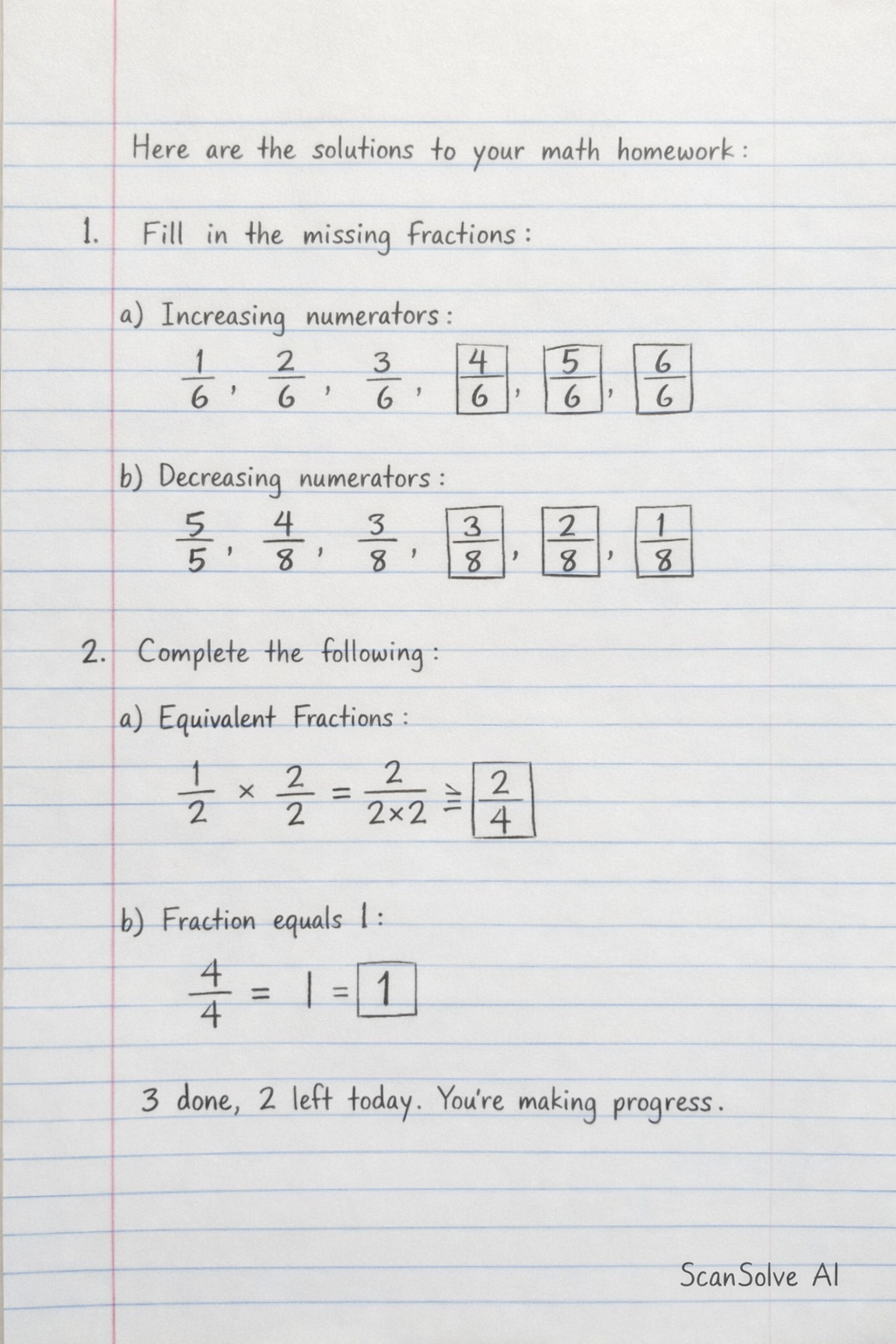
Here are the solutions to your math homework:
1. Fill in the missing fractions:
a) The fractions are increasing by one in the numerator while keeping the denominator constant.
b) The fractions are decreasing by one in the numerator while keeping the denominator constant.
2. Complete the following:
a) To find an equivalent fraction, multiply both the numerator and the denominator by the same non-zero number. For example, multiplying by 2:
b) When the numerator and the denominator of a fraction are the same, the fraction is equal to 1.
Was this helpful?
Still stuck on this one?
Ask a follow-up, and the answer starts from this question.
Got a different question?Ask your own question
More Mathematics Questions
QComplete the following equivalent fractions by finding the missing number in each case.QComplete the following problems on equivalent fractions and adding fractions:QFill in the missing fractions on the number line. Choose from the fractions in the box below. The…QFill in the given fractions and add the missing fractions onto your wall. Fill in >, <, or = to make…QSolve the following fraction addition and subtraction problems:
Browse by topic:Pre-Algebra
Handwritten Step-by-Step Solution
Get this as a handwritten image on WhatsApp — like a tutor wrote it for you.
Try on WhatsApp