
We read your photo as:
Complete the following equivalent fractions by finding the missing number in each case.
ScanSolve AI Answer
Step-by-step solution
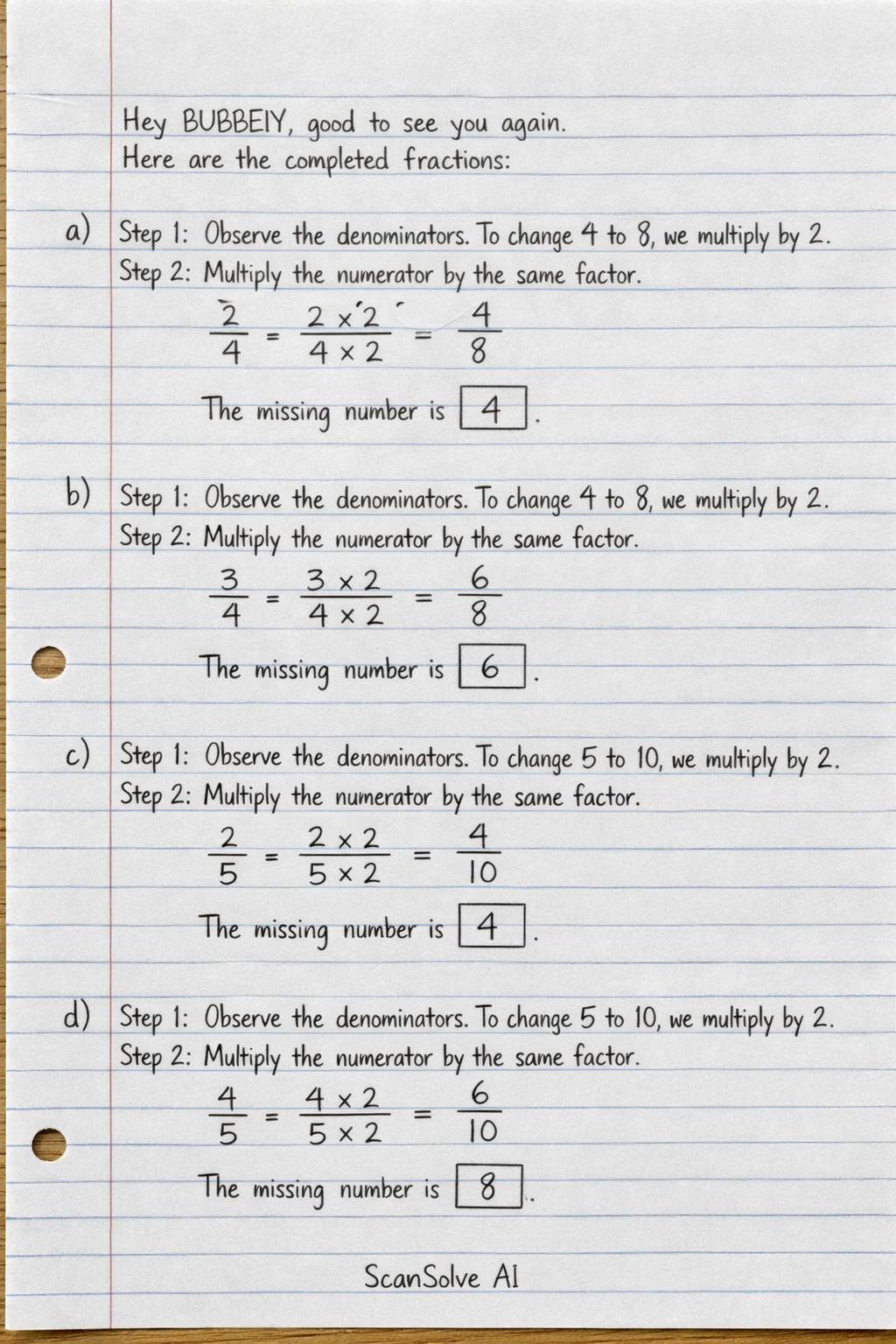
24 stepsHere are the completed fractions:
Part a· 2 steps
Observe the denominators.
To change 4 to 8, we multiply by 2.
Multiply the numerator by the same factor.
The missing number is .
Part b· 2 steps
Observe the denominators.
To change 4 to 8, we multiply by 2.
Multiply the numerator by the same factor.
The missing number is .
Part c· 2 steps
Observe the denominators.
To change 5 to 10, we multiply by 2.
Multiply the numerator by the same factor.
The missing number is .
Part d· 2 steps
Observe the denominators.
To change 5 to 10, we multiply by 2.
Multiply the numerator by the same factor.
The missing number is .
Part e· 2 steps
Observe the denominators.
To change 8 to 16, we multiply by 2.
Multiply the numerator by the same factor.
The missing number is .
Part f· 2 steps
Observe the denominators.
To change 8 to 16, we multiply by 2.
Multiply the numerator by the same factor.
The missing number is .
Part g· 2 steps
Observe the denominators.
To change 8 to 4, we divide by 2.
Divide the numerator by the same factor.
The missing number is .
Part h· 2 steps
Observe the denominators.
To change 8 to 4, we divide by 2.
Divide the numerator by the same factor.
The missing number is .
Part h(i)· 8 steps
Observe the denominators.
To change 10 to 5, we divide by 2.
Divide the numerator by the same factor.
The missing number is .
j)
Observe the denominators.
To change 10 to 5, we divide by 2.
Divide the numerator by the same factor.
The missing number is .
k)
Observe the denominators.
To change 4 to 2, we divide by 2.
Divide the numerator by the same factor.
The missing number is .
l)
Observe the denominators.
To change 4 to 2, we divide by 2.
Divide the numerator by the same factor.
The missing number is .
Still stuck on this one?
Ask a follow-up, and the answer starts from this question.
More Mathematics Questions
Handwritten Step-by-Step Solution
Get this as a handwritten image on WhatsApp — like a tutor wrote it for you.
Try on WhatsApp