This mathematics problem involves applying core mathematical principles and formulas. Below you will find a complete step-by-step solution with detailed explanations for each step, helping you understand not just the answer but the method behind it.

ScanSolve AI Answer
Answer
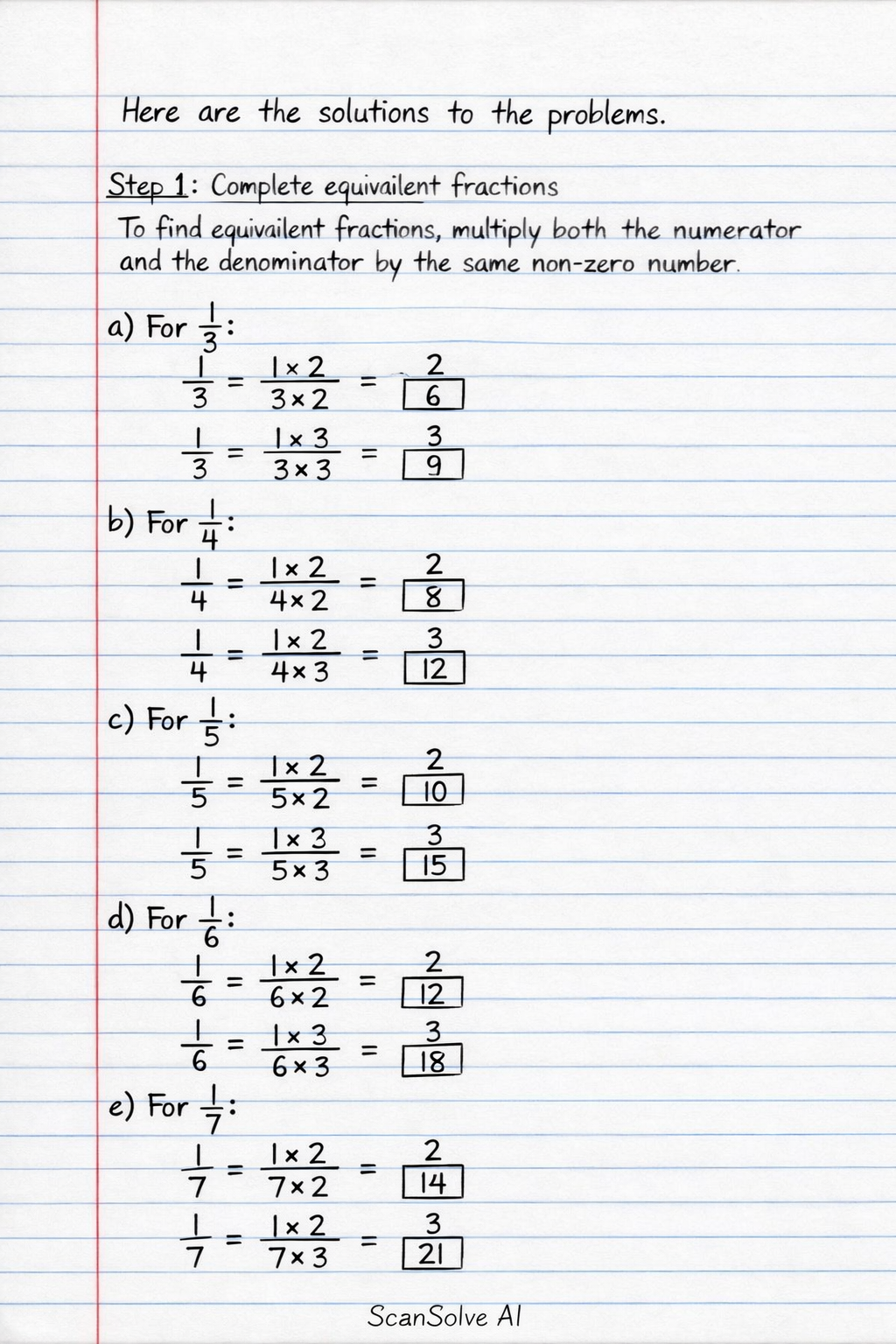
Here are the solutions to the problems.
Step 1: Complete equivalent fractions To find equivalent fractions, multiply both the numerator and the denominator by the same non-zero number.
*a) For : \frac{1}{3} = \frac{1 \times 2}{3 \times 2} = \frac{2{6}} \frac{1}{3} = \frac{1 \times 3}{3 \times 3} = \frac{3{9}}
*b) For : \frac{1}{4} = \frac{1 \times 2}{4 \times 2} = \frac{2{8}} \frac{1}{4} = \frac{1 \times 3}{4 \times 3} = \frac{3{12}}
*c) For : \frac{1}{5} = \frac{1 \times 2}{5 \times 2} = \frac{2{10}} \frac{1}{5} = \frac{1 \times 3}{5 \times 3} = \frac{3{15}}
*d) For : \frac{1}{6} = \frac{1 \times 2}{6 \times 2} = \frac{2{12}} \frac{1}{6} = \frac{1 \times 3}{6 \times 3} = \frac{3{18}}
*e) For : \frac{1}{7} = \frac{1 \times 2}{7 \times 2} = \frac{2{14}} \frac{1}{7} = \frac{1 \times 3}{7 \times 3} = \frac{3{21}}
*f) For : \frac{1}{8} = \frac{1 \times 2}{8 \times 2} = \frac{2{16}} \frac{1}{8} = \frac{1 \times 3}{8 \times 3} = \frac{3{24}}
Step 2: Add the fractions To add fractions with the same denominator, add the numerators and keep the denominator the same. Simplify the result if possible.
*a)
*b) \frac{1}{3} + \frac{1}{3} = \frac{1+1}{3} = \frac{2{3}}
*c) \frac{1}{4} + \frac{1}{4} = \frac{1+1}{4} = \frac{2}{4} = \frac{1{2}}
*d) \frac{1}{5} + \frac{1}{5} = \frac{1+1}{5} = \frac{2{5}}
*e) \frac{1}{6} + \frac{1}{6} = \frac{1+1}{6} = \frac{2}{6} = \frac{1{3}}
*f) \frac{1}{7} + \frac{1}{7} = \frac{1+1}{7} = \frac{2{7}}
*g) \frac{1}{8} + \frac{1}{8} = \frac{1+1}{8} = \frac{2}{8} = \frac{1{4}}
*h) \frac{1}{9} + \frac{1}{9} = \frac{1+1}{9} = \frac{2{9}}
*i) \frac{1}{10} + \frac{1}{10} = \frac{1+1}{10} = \frac{2}{10} = \frac{1{5}}
*j) \frac{2}{5} + \frac{1}{5} = \frac{2+1}{5} = \frac{3{5}}
*k) \frac{3}{6} + \frac{1}{6} = \frac{3+1}{6} = \frac{4}{6} = \frac{2{3}}
*l) \frac{4}{7} + \frac{2}{7} = \frac{4+2}{7} = \frac{6{7}}
*m) \frac{5}{8} + \frac{1}{8} = \frac{5+1}{8} = \frac{6}{8} = \frac{3{4}}
*n) \frac{6}{9} + \frac{2}{9} = \frac{6+2}{9} = \frac{8{9}}
*o) \frac{7}{10} + \frac{1}{10} = \frac{7+1}{10} = \frac{8}{10} = \frac{4{5}}
*p) \frac{8}{11} + \frac{2}{11} = \frac{8+2}{11} = \frac{10{11}}
*q) \frac{9}{12} + \frac{1}{12} = \frac{9+1}{12} = \frac{10}{12} = \frac{5{6}}
*r) $\frac{10}{13} + \frac{2}{13} = \frac{10+2}{13} = \frac{12{1
Get instant step-by-step solutions to any question. Free to start.
Ask Your Question
Handwritten Step-by-Step Solution
Get this as a handwritten image on WhatsApp — like a tutor wrote it for you.
Try on WhatsAppStill have questions?
Complete equivalent fractions To find equivalent fractions, multiply both the numerator and the denominator by the same non-zero number.
This mathematics problem involves applying core mathematical principles and formulas. Below you will find a complete step-by-step solution with detailed explanations for each step, helping you understand not just the answer but the method behind it.