
This mathematics problem involves applying core mathematical principles and formulas. Below you will find a complete step-by-step solution with detailed explanations for each step, helping you understand not just the answer but the method behind it.
ScanSolve AI Answer
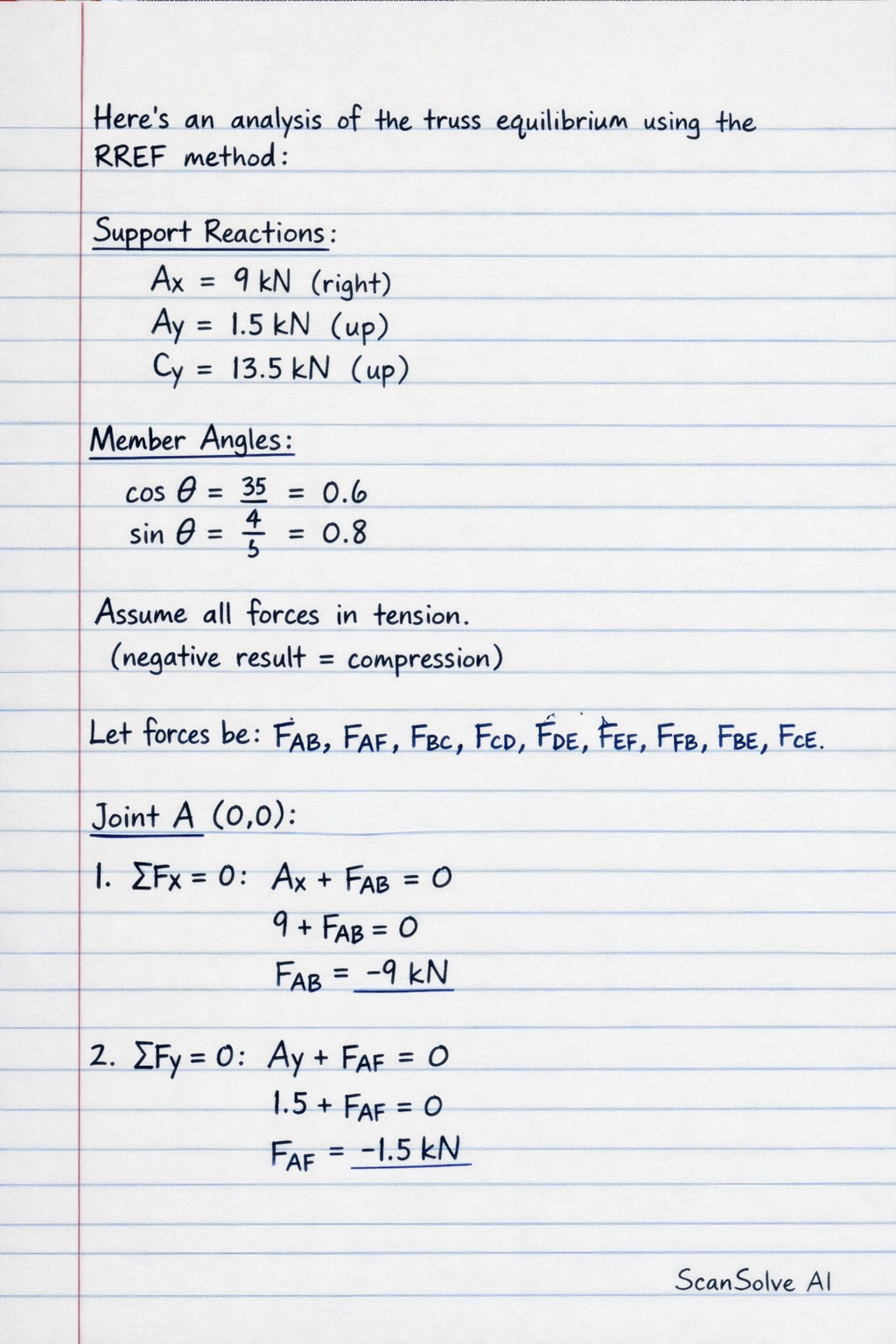
To solve this problem using the Reduced Row Echelon Form (RREF) method, we first need to set up the system of linear equations representing the equilibrium of each joint in the truss. We'll use the support reactions and loads calculated in the previous part (c) where P1 = 9 kN and P2 = 15 kN. Support Reactions: A_x = 9 kN (right) A_y = 1.5 kN (up) C_y = 13.5 kN (up) Member Angles: For members FB and CE, which are diagonal: = (3)/(5) = 0.6 = (4)/(5) = 0.8 We will assume all member forces are in tension (pulling away from the joint). A negative result will indicate compression. Let the unknown forces be F_AB, F_AF, F_BC, F_CD, F_DE, F_EF, F_FB, F_BE, F_CE. System of Equations (Equilibrium at each joint): Joint A (0,0): 1. F_x = 0: A_x + F_AB = 0 9 + F_AB = 0 2. F_y = 0: A_y + F_AF = 0 1.5 + F_AF = 0 Joint B (3,0): 3. F_x = 0: -F_AB + F_BC + F_FB = 0 -F_AB + F_BC + 0.6 F_FB = 0 4. F_y = 0: -P2 + F_BE + F_FB = 0 -15 + F_BE + 0.8 F_FB = 0 Joint C (6,0): 5. F_x = 0: -F_BC + F_CE = 0 -F_BC + 0.6 F_CE = 0 6. F_y = 0: C_y + F_CD + F_CE = 0 13.5 + F_CD + 0.8 F_CE = 0 Joint D (6,4): 7. F_x = 0: -F_DE = 0 (Member CD is vertical, so no x-component) 8. F_y = 0: -F_CD = 0 (Member DE is horizontal, so no y-component) Joint E (3,4): 9. F_x = 0: -F_EF + F_DE - F_CE = 0 -F_EF + F_DE - 0.6 F_CE = 0 10. F_y = 0: -F_BE - F_CE = 0 -F_BE - 0.8 F_CE = 0 Joint F (0,4): 11. F_x = 0: -P1 + F_EF - F_FB = 0 -9 + F_EF - 0.6 F_FB = 0 12. F_y = 0: -F_AF - F_FB = 0 -F_AF - 0.8 F_FB = 0 Let's write these equations in matrix form [A | b] where the variables are ordered as F_AB, F_AF, F_BC, F_CD, F_DE, F_EF, F_FB, F_BE, F_CE. 1 & 0 & 0 & 0 & 0 & 0 & 0 & 0 & 0 & | & -9 \\ 0 & 1 & 0 & 0 & 0 & 0 & 0 & 0 & 0 & | & -1.5 \\ -1 & 0 & 1 & 0 & 0 & 0 & 0.6 & 0 & 0 & | & 0 \\ 0 & 0 & 0 & 0 & 0 & 0 & 0.8 & 1 & 0 & | & 15 \\ 0 & 0 & -1 & 0 & 0 & 0 & 0 & 0 & 0.6 & | & 0 \\ 0 & 0 & 0 & 1 & 0 & 0 & 0 & 0 & 0.8 & | & -13.5 \\ 0 & 0 & 0 & 0 & -1 & 0 & 0 & 0 & 0 & | & 0 \\ 0 & 0 & 0 & -1 & 0 & 0 & 0 & 0 & 0 & | & 0 \\ 0 & 0 & 0 & 0 & 1 & -1 & 0 & 0 & -0.6 & | & 0 \\ 0 & 0 & 0 & 0 & 0 & 0 & 0 & -1 & -0.8 & | & 0 \\ 0 & 0 & 0 & 0 & 0 & 1 & -0.6 & 0 & 0 & | & 9 \\ 0 & -1 & 0 & 0 & 0 & 0 & -0.8 & 0 & 0 & | & 0 Step 1: Perform row operations to get the matrix into Reduced Row Echelon Form. The first two rows already give F_AB and F_AF. R_1 F_AB = -9 R_2 F_AF = -1.5 From R_7: F_DE = 0 From R_8: F_CD = 0 Substitute F_CD=0 into R_6: F_CD + 0.8 F_CE = -13.5 0 + 0.8 F_CE = -13.5 F_CE = (-13.5)/(0.8) = -16.875 Substitute F_CE=-16.875 into R_5: -F_BC + 0.6 F_CE = 0 -F_BC + 0.6(-16.875) = 0 -F_BC - 10.125 = 0 F_BC = -10.125 Substitute F_AF=-1.5 into R_12: -F_AF - 0.8 F_FB = 0 -(-1.5) - 0.8 F_FB = 0 1.5 - 0.8 F_FB = 0 F_FB = (1.5)/(0.8) = 1.875 Substitute F_FB=1.875 into R_4: 0.8 F_FB + F_BE = 15 0.8(1.875) + F_BE = 15 1.5 + F_BE = 15 F_BE = 13.5 Substitute F_CE=-16.875 into R_10: -F_BE - 0.8 F_CE = 0 -F_BE - 0.8(-16.875) = 0 -F_BE + 13.5 = 0 F_BE = 13.5 (Consistent) Substitute F_DE=0 and F_CE=-16.875 into R_9: -F_EF + F_DE - 0.6 F_CE = 0 -F_EF + 0 - 0.6(-16.875) = 0 -F_EF + 10.125 = 0 F_EF = 10.125 Substitute F_FB=1.875 and F_EF=10.125 into R_11: -9 + F_EF - 0.6 F_FB = 0 -9 + 10.125 - 0.6(1.875) = 0 1.125 - 1.125 = 0 (Consistent) Substitute F_AB=-9, F_BC=-10.125, F_FB=1.875 into R_3: -F_AB + F_BC + 0.6 F_FB = 0 -(-9) + (-10.125) + 0.6(1.875) = 0 9 - 10.125 + 1.125 = 0 (Consistent) The RREF of the augmented matrix would directly yield these values. Since many variables are directly solved or easily substituted, the RREF process would essentially perform these substitutions. The equivalent system in RREF form (or the solution obtained by RREF) is: 1 & 0 & 0 & 0 & 0 & 0 & 0 & 0 & 0 & | & -9 \\ 0 & 1 & 0 & 0 & 0 & 0 & 0 & 0 & 0 & | & -1.5 \\ 0 & 0 & 1 & 0 & 0 & 0 & 0 & 0 & 0 & | & -10.125 \\ 0 & 0 & 0 & 1 & 0 & 0 & 0 & 0 & 0 & | & 0 \\ 0 & 0 & 0 & 0 & 1 & 0 & 0 & 0 & 0 & | & 0 \\ 0 & 0 & 0 & 0 & 0 & 1 & 0 & 0 & 0 & | & 10.125 \\ 0 & 0 & 0 & 0 & 0 & 0 & 1 & 0 & 0 & | & 1.875 \\ 0 & 0 & 0 & 0 & 0 & 0 & 0 & 1 & 0 & | & 13.5 \\ 0 & 0 & 0 & 0 & 0 & 0 & 0 & 0 & 1 & | & -16.875 \\ 0 & 0 & 0 & 0 & 0 & 0 & 0 & 0 & 0 & | & 0 \\ 0 & 0 & 0 & 0 & 0 & 0 & 0 & 0 & 0 & | & 0 \\ 0 & 0 & 0 & 0 & 0 & 0 & 0 & 0 & 0 & | & 0 The solution for each member force is: • F_AB = -9 kN (Compression) • F_AF = -1.5 kN (Compression) • F_BC = -10.13 kN (Compression) • F_CD = 0 kN • F_DE = 0 kN • F_EF = 10.13 kN (Tension) • F_FB = 1.88 kN (Tension) • F_BE = 13.5 kN (Tension) • F_CE = -16.88 kN (Compression) What's next? 📸