
We read your photo as:
Solve the following arithmetic problems and sequence patterns.
ScanSolve AI Answer
Step-by-step solution
16 steps1.1.1
Perform the operation inside the parentheses.
Perform the division.
Perform the subtraction.
The answer is .
1.1.2
Perform the multiplication.
Subtracting a negative number is equivalent to adding the positive number.
Perform the addition.
The answer is .
1.1.3
Calculate the division to get the decimal.
Convert the decimal to a percentage by multiplying by 100.
The answer is approximately .
1.2
To arrange the numbers in descending order, we list them from largest to smallest.
The order is .1.3.1
Identify the pattern.
The sequence is . Each term is multiplied by 2 to get the next term (, ).
Apply the pattern to find the next two numbers.
The next number is .
The number after that is .
The missing numbers are .1.3.2
Identify the pattern.
The sequence is . Each term is divided by 3 to get the next term (, ).
Apply the pattern to find the next two numbers.
The next number is .
The number after that is .
The missing numbers are .1.3.3
Check for constant difference.
The difference is not constant.Check for constant ratio.
The ratio is constant.
The pattern in 1.3.2 is an example of a constant ratio. This is because each term is obtained by multiplying the previous term by a constant factor of (or dividing by 3).1.4
Recall the conversion factor between kilometers and meters.
Multiply the given value in kilometers by the conversion factor.
The answer is .
Still stuck on this one?
Ask a follow-up, and the answer starts from this question.
More Mathematics Questions
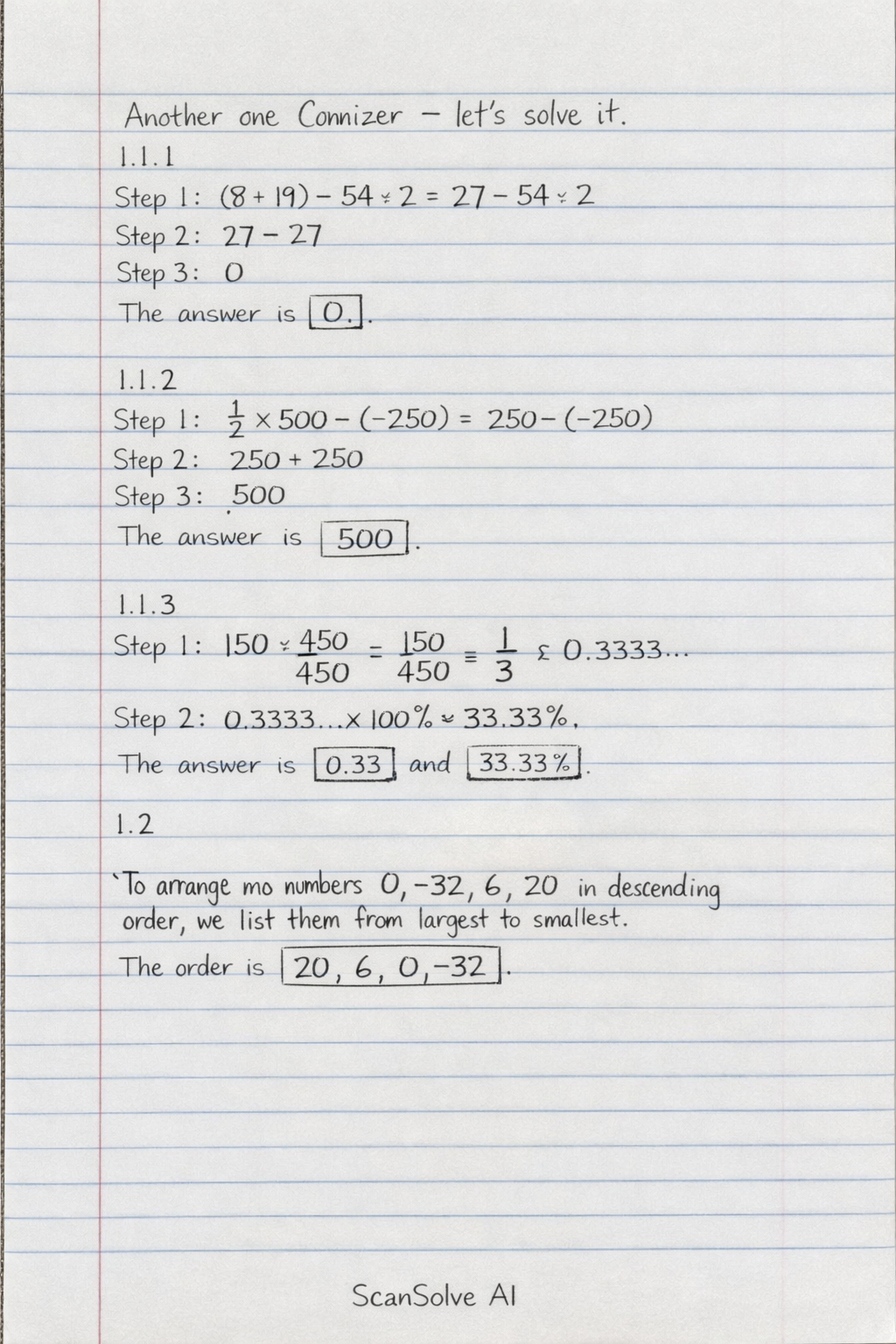
Handwritten Step-by-Step Solution
Get this as a handwritten image on WhatsApp — like a tutor wrote it for you.
Try on WhatsApp