
We read your photo as:
Solve the following definite integrals using the substitution method: I) integral from 0 to 6 of (6x)/(3x-2) dx II) integral from 5 to 6 of (1-2x)/(x-4) dx
Mathematics
ScanSolve AI Answer
Step-by-step solution
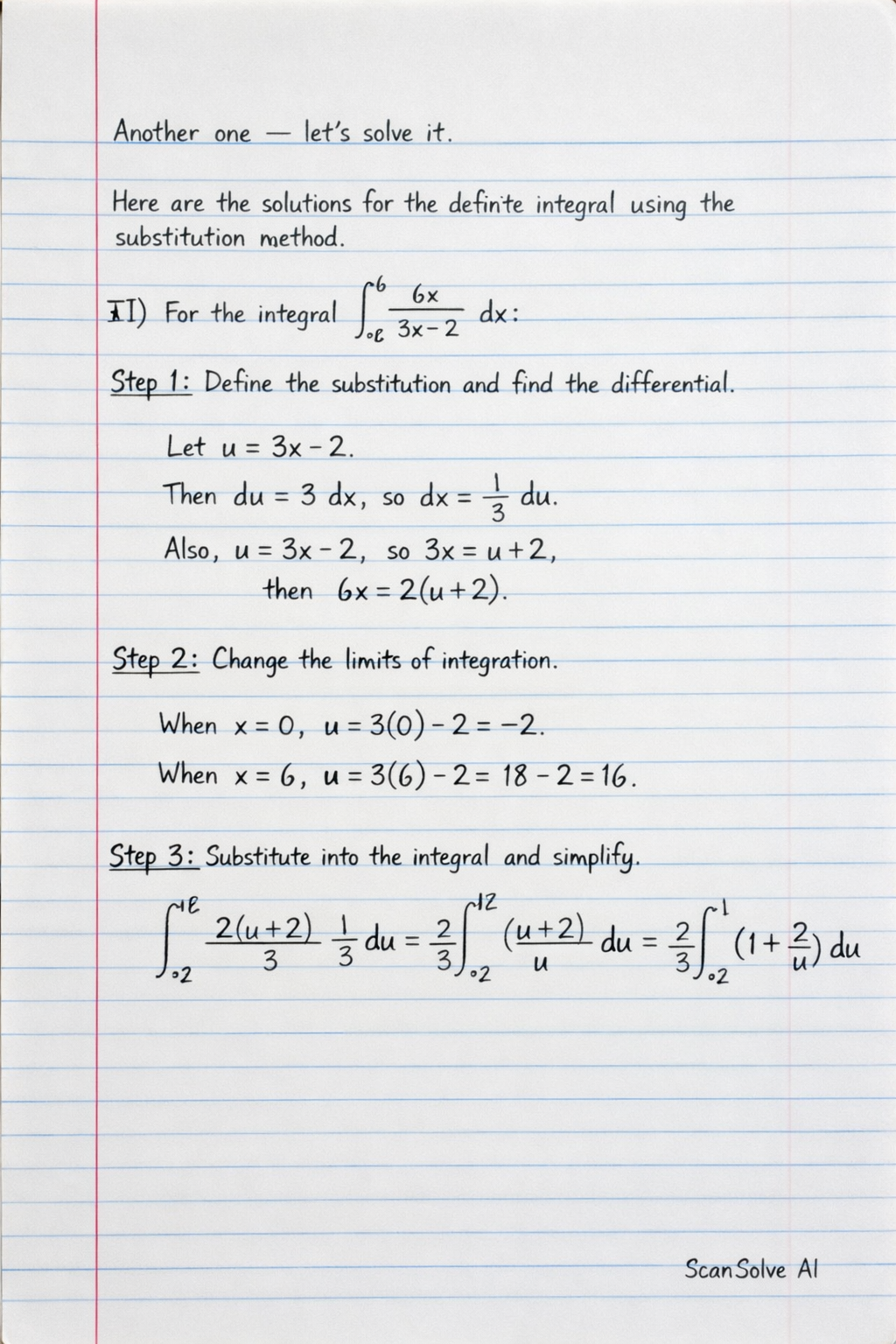
12 stepsHere are the solutions for the definite integrals using the substitution method.
I) For the integral :
Define the substitution and find the differential.
Let .
Then , which means .
Also, from , we have , so .Change the limits of integration.
When , .
When , .Substitute into the integral and simplify.
Integrate and evaluate using the new limits.
Since , the answer can also be written as:
The final answer is .
II) For the integral :
Define the substitution and find the differential.
Let .
Then .
Also, from , we have . So .Change the limits of integration.
When , .
When , .Substitute into the integral and simplify.
Integrate and evaluate using the new limits.
The final answer is .
III) For the integral :
Define the substitution and find the differential.
Let .
Then , which means .
Also, from , we have . So .Change the limits of integration.
When , .
When , .Substitute into the integral and simplify.
Integrate and evaluate using the new limits.
The final answer is .
Was this helpful?
Still stuck on this one?
Ask a follow-up, and the answer starts from this question.
Got a different question?Ask your own question
More Mathematics Questions
QEvaluate the following integrals: I. ∫(6t⁴+4t³−t²+1)dt II. ∫(3x²−6x−2)dx. Evaluate the following by…QEvaluate the following integrals: (i) integral(3x+2)dx (ii) integral x3 xdx (iii) integral…QIntegrate the following functions: (i) integral ( ( x))/(x) dx (ii) integral ( (3 x + 4 x)/(4 x − 3…QEvaluate the following integrals: 46. integral ( x)/(3 + x) dx 47. integral (2(2x))/(1 + (2x)) dxQIntegrate the following functions: 1. integral (16x)/(8x2 + 2)\,dx 2. integral (x2)/(x3 + 1)\,dx
Browse by topic:Calculus
Handwritten Step-by-Step Solution
Get this as a handwritten image on WhatsApp — like a tutor wrote it for you.
Try on WhatsApp