We read your photo as:

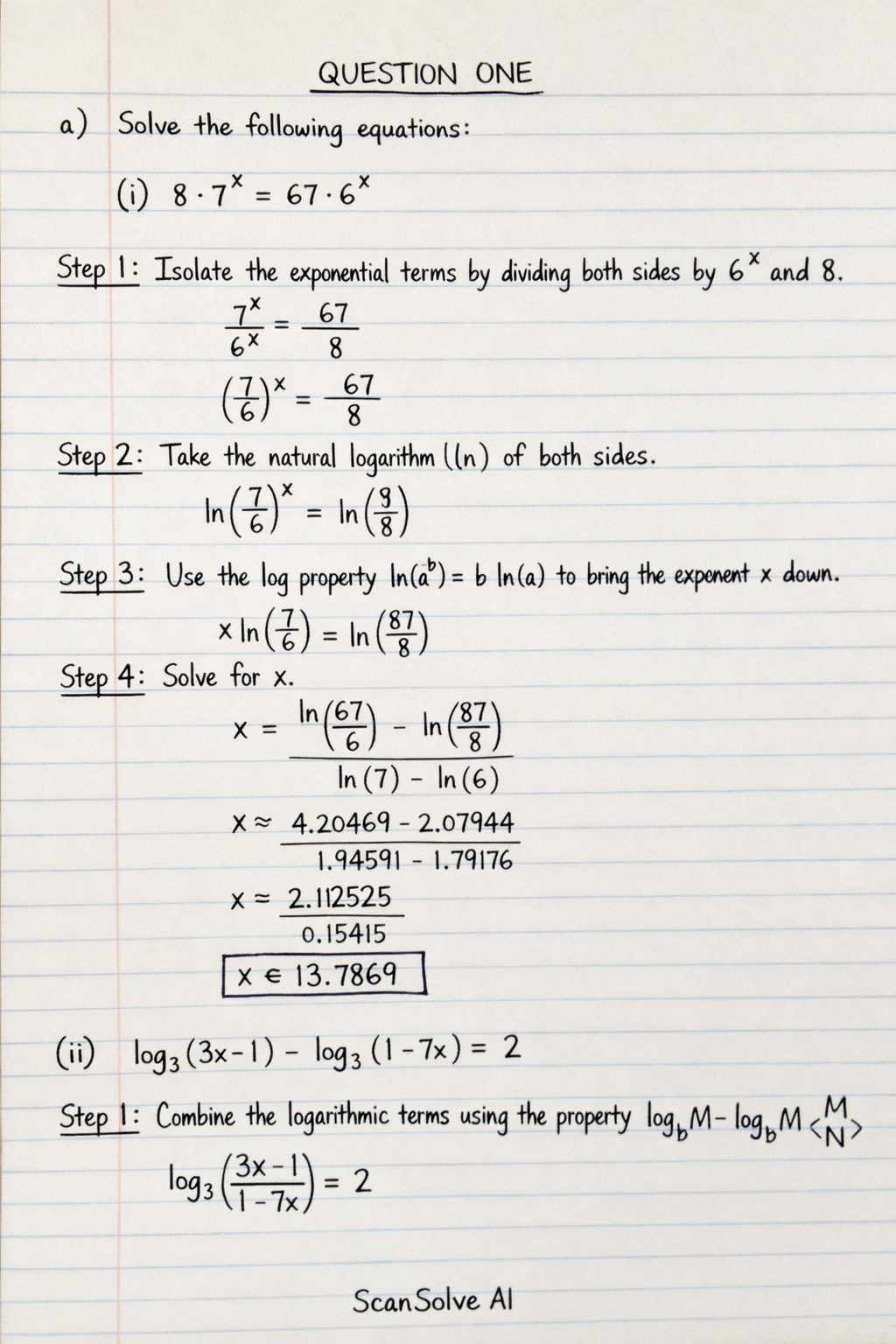
Solve the following equations: 8−79=67.65 (ii) log, (3x-1)-log, (1−7x)=2 (iii) 31−50(7)+7=0

Mathematics

ScanSolve AI Answer

Answers

3 parts
a(i)

x≈13.7869x \approx 13.7869

a(ii)

No solution\text{No solution}

a(iii)

t≈2.0090 or t≈−1.0088t \approx 2.0090 \text{ or } t \approx -1.0088

Step-by-step solution

11 steps

QUESTION ONE

Part a(i)· 4 steps

8⋅7x=67⋅6x8 \cdot 7^x = 67 \cdot 6^x

Solve the following equations

  1. Isolate the exponential terms by dividing both sides by 6x6^x and 8.

    7x6x=678\frac{7^x}{6^x} = \frac{67}{8} (76)x=678\left(\frac{7}{6}\right)^x = \frac{67}{8}
  2. Take the natural logarithm (ln⁡\ln) of both sides.

    ln⁡((76)x)=ln⁡(678)\ln\left(\left(\frac{7}{6}\right)^x\right) = \ln\left(\frac{67}{8}\right)
  3. Use the logarithm property ln⁡(ab)=bln⁡(a)\ln(a^b) = b \ln(a) to bring the exponent xx down.

    xln⁡(76)=ln⁡(678)x \ln\left(\frac{7}{6}\right) = \ln\left(\frac{67}{8}\right)
  4. Solve for xx.

    x=ln⁡(678)ln⁡(76)x = \frac{\ln\left(\frac{67}{8}\right)}{\ln\left(\frac{7}{6}\right)} x=ln⁡(67)−ln⁡(8)ln⁡(7)−ln⁡(6)x = \frac{\ln(67) - \ln(8)}{\ln(7) - \ln(6)} x≈4.20469−2.079441.94591−1.79176x \approx \frac{4.20469 - 2.07944}{1.94591 - 1.79176} x≈2.125250.15415x \approx \frac{2.12525}{0.15415} x≈13.7869\boxed{x \approx 13.7869}

Part a(ii)

No solution\text{No solution}

log⁡3(3x−1)−log⁡3(1−7x)=2\log_3(3x-1) - \log_3(1-7x) = 2

  1. Combine the logarithmic terms using the property log⁡bM−log⁡bN=log⁡b(MN)\log_b M - \log_b N = \log_b \left(\frac{M}{N}\right).

    log⁡3(3x−11−7x)=2\log_3\left(\frac{3x-1}{1-7x}\right) = 2
  2. Convert the logarithmic equation to an exponential equation using the definition log⁡bY=Z  ⟺  Y=bZ\log_b Y = Z \iff Y = b^Z.

    3x−11−7x=32\frac{3x-1}{1-7x} = 3^2 3x−11−7x=9\frac{3x-1}{1-7x} = 9
  3. Solve the resulting linear equation for xx.

    3x−1=9(1−7x)3x-1 = 9(1-7x) 3x−1=9−63x3x-1 = 9 - 63x 3x+63x=9+13x + 63x = 9 + 1 66x=1066x = 10 x=1066x = \frac{10}{66} x=533x = \frac{5}{33}
  4. Check the domain of the original logarithmic expressions.

    For log⁡3(A)\log_3(A) to be defined, A>0A > 0.
    For log⁡3(3x−1)\log_3(3x-1): 3x−1>0  ⟹  3x>1  ⟹  x>133x-1 > 0 \implies 3x > 1 \implies x > \frac{1}{3}.
    For log⁡3(1−7x)\log_3(1-7x): 1−7x>0  ⟹  1>7x  ⟹  x<171-7x > 0 \implies 1 > 7x \implies x < \frac{1}{7}.
    The value x=533≈0.1515x = \frac{5}{33} \approx 0.1515. This value does not satisfy x>13x > \frac{1}{3} (which is x>0.3333x > 0.3333) nor does it satisfy x<17x < \frac{1}{7} (which is x<0.1428x < 0.1428). In fact, there is no value of xx that can satisfy both x>13x > \frac{1}{3} and x<17x < \frac{1}{7} simultaneously.
    Therefore, the equation has no solution.

    No solution\boxed{\text{No solution}}

Part a(iii)

t≈2.0090 or t≈−1.0088t \approx 2.0090 \text{ or } t \approx -1.0088

72t−50(7t)+7=07^{2t} - 50(7^t) + 7 = 0

  1. Let y=7ty = 7^t.

    Substitute this into the equation to transform it into a quadratic equation.

    (7t)2−50(7t)+7=0(7^t)^2 - 50(7^t) + 7 = 0 y2−50y+7=0y^2 - 50y + 7 = 0
  2. Solve the quadratic equation for yy using the quadratic formula y=−b±b2−4ac2ay = \frac{-b \pm \sqrt{b^2 - 4ac}}{2a}.

    Here, a=1a=1, b=−50b=-50, c=7c=7.

    y=−(−50)±(−50)2−4(1)(7)2(1)y = \frac{-(-50) \pm \sqrt{(-50)^2 - 4(1)(7)}}{2(1)} y=50±2500−282y = \frac{50 \pm \sqrt{2500 - 28}}{2} y=50±24722y = \frac{50 \pm \sqrt{2472}}{2}

    Simplify the square root: 2472=4×618=2618\sqrt{2472} = \sqrt{4 \times 618} = 2\sqrt{618}.

    y=50±26182y = \frac{50 \pm 2\sqrt{618}}{2} y=25±618y = 25 \pm \sqrt{618}
  3. Substitute back y=7ty = 7^t and solve for tt using logarithms.

    Case 1: 7t=25+6187^t = 25 + \sqrt{618}

    t=ln⁡(25+618)ln⁡(7)t = \frac{\ln(25 + \sqrt{618})}{\ln(7)} t≈ln⁡(25+24.8596)ln⁡(7)t \approx \frac{\ln(25 + 24.8596)}{\ln(7)} t≈ln⁡(49.8596)1.9459t \approx \frac{\ln(49.8596)}{1.9459} t≈3.90921.9459t \approx \frac{3.9092}{1.9459} t1≈2.0090t_1 \approx 2.0090

    Case 2: 7t=25−6187^t = 25 - \sqrt{618}

    t=ln⁡(25−618)ln⁡(7)t = \frac{\ln(25 - \sqrt{618})}{\ln(7)} t≈ln⁡(25−24.8596)ln⁡(7)t \approx \frac{\ln(25 - 24.8596)}{\ln(7)} t≈ln⁡(0.1404)ln⁡(7)t \approx \frac{\ln(0.1404)}{\ln(7)} t≈−1.96311.9459t \approx \frac{-1.9631}{1.9459} t2≈−1.0088t_2 \approx -1.0088

    Both values of yy are positive, so both values of tt are valid.

    t≈2.0090 or t≈−1.0088\boxed{t \approx 2.0090 \text{ or } t \approx -1.0088}
Was this helpful?

Try one yourself

A new problem that tests the same skill.

Still stuck on this one?

Ask a follow-up, and the answer starts from this question.

Got a different question?Ask your own question
Handwritten step-by-step solution preview

Handwritten Step-by-Step Solution

Get this as a handwritten image on WhatsApp — like a tutor wrote it for you.

Try on WhatsApp